
How to Coordinate People Who Use Different Messaging Apps
Your football team lives on GroupMe, your family in iMessage, your oldest friends on Messenger — and the event needs all of them. Coordination across apps is a solved problem, provided you stop trying to solve it with another app.
Quick answer
You will never get everyone onto one messaging app, so stop trying — coordinate around a neutral hub instead. The hub is a single event address (a page or link) that belongs to no chat platform, opens in any browser, and holds the plan’s current state: final details, per-guest RSVPs, and changes as they happen. Announce in whatever app each cluster already uses; every announcement carries the same link. Debate stays native to each thread, but decisions land on the page, questions get answered with the link, and updates are made once at the source instead of relayed app by app. The pattern asks no guest to install anything and abandons no one’s favorite app — it simply gives the plan one home that everyone can reach, whatever they use to talk.
Your group was never going to standardize
Begin by retiring the dream. Every mixed group has, at some point, proposed the Great Consolidation: everyone moves to one app, one group, one thread, forever. And every mixed group has watched the proposal die the same quiet death — two people migrate, one migrates and drifts back, the rest never start. This is not a failure of leadership. Messaging apps are not neutral venues; they are where people’s existing relationships, habits and devices already live. iPhone households default to iMessage, which is woven into Apple devices — as Apple’s support materials reflect at every turn — while other circles organized themselves around Messenger or GroupMe years ago and have no reason to move. Asking a group to standardize is asking each member to pay a personal cost for an abstract benefit, and people — reasonably — decline.
The conclusion is not pessimism; it is a design brief. If the conversation layer will remain permanently fragmented, then coordination has to happen at a layer above the conversations. The question this article answers is practical: what does that layer look like, and how do you run it without exhausting yourself? The answer has three parts — a neutral hub, one shared link per event, and a handful of habits that keep the whole thing honest.
Three ways groups muddle through today
Most mixed groups coordinate by accident, using one of three improvised patterns. Naming them clarifies why each eventually hurts.
The first is the human relay: one member — usually the one who cares most, soon the one who regrets it most — holds the whole plan in their head and shuttles facts between apps. The dinner time is decided on GroupMe, relayed to the family thread, paraphrased to the Messenger crowd, and re-relayed when it changes. The relay works at small scale and then doesn’t; its failure mode is the organizer’s fatigue and a drift that only becomes visible on the night. The fuller anatomy of that drift is described in what happens when an event is planned across multiple messaging apps, and it is the failure this article exists to prevent.
The second is the forced install: the organizer picks an app, for reasons that are usually good, and pulls everyone in. Some guests comply; some comply resentfully; some comply nominally, meaning they are technically in the group and functionally absent. Every event now carries a small admission tax of goodwill, paid mostly by the people least invested. The group gets a shared thread and loses a fraction of its members’ actual attention — often the fraction that mattered.
The third is copy-paste duplication: every update is pasted into every app by whoever remembers. Unlike the relay, the labor is distributed; unlike the relay, the consistency is worse. Copies diverge within days, no one holds the authoritative version, and the group discovers that synchronizing databases by hand is not a hobby humans sustain. All three patterns share one root: they treat the conversation channel as the place the plan lives. The fix is to move the plan somewhere the conversations can all reach.
| Pattern | How it works | Where it breaks | Best for |
|---|---|---|---|
| Human relay | One member carries facts between apps | That member’s patience; drift on every change | Two apps, one change, a sainted organizer |
| Forced install | Everyone joins the organizer’s chosen app | Goodwill tax; silent non-participation of the conscripted | Groups with genuine unanimous buy-in |
| Copy-paste duplication | Updates pasted into every thread | Copies diverge; nobody knows which is current | Very small groups with almost no changes |
| Neutral event link | One address per event, linked from every app | Requires the organizer to create one page per event | Any group whose members use more than one app |
Choosing the pattern that fits your group
The comparison table is not a ranking; it is a menu, and the right order depends on two variables. The first is volatility — how often the plan will change between announcement and day. A plan with a settled venue and date changes rarely, and even a relay organizer can carry two apps through one change. A plan with open questions about time, place and attendance will change repeatedly, and anything manual will drift by the third change. The second variable is span — how many distinct clusters the event touches. One cluster means one conversation, and the whole question dissolves. Two clusters is the entry price for structure. Three or more, with partial overlaps between them, is where the relay organizer’s quiet suffering begins.
Map honestly rather than aspirationally. Groups routinely overestimate their stability (“we’ll decide everything tonight, then it’s fixed”) and underestimate their span (“we’ll just add her to the thread”). The pattern that fits the honest map is almost always one notch more structured than the one that fits the optimistic map — and one notch of structure, in the form of a single link, costs about ten minutes. Choose for the event you will actually have: busy, changeable, and full of people worth the trouble.
The neutral hub, and what neutrality requires
The fourth pattern deserves its own treatment because it is the one that scales. A neutral hub is a place the plan lives that belongs to none of the chat platforms. Neutrality is not a slogan; it has requirements, and a hub that fails any of them quietly re-creates the forced-install problem in a new costume.
A hub must be reachable by everyone without membership. A link that opens in any browser, on any phone, without an account, without joining a community — this is the property that makes it neutral in practice rather than in name. It must be app-agnostic at the edges: the link can be dropped into GroupMe, iMessage, Messenger, Signal, an email, a WhatsApp voicemail transcription, and it behaves identically everywhere. It must hold state, not just text — the final details as fields, RSVPs as named statuses, changes as edits — because a hub that is merely a shared document full of sentences reintroduces the reconstruction problem one layer up. And it should be hospitable to partial participants: the plus-one, the occasional guest and the grandparent should be able to consult the plan without being enrolled in anything.
Familiar tools occupy parts of this space. Doodle, the long-standing scheduling-poll service, solves one specific question — when — beautifully and neutrally. A shared document can hold facts but not statuses. A dedicated event page — of the kind Ontaym builds around one link per event, with going and maybe statuses, polls on options, updates and reminders — is designed to be the whole hub. The tool matters less than the properties; audit any candidate hub against the four requirements before trusting your event to it.
One link per event: the mechanics
The hub pattern reduces, in practice, to a discipline about links. Each event gets exactly one address, created before the plan has anything to fragment. The address is where the current truth lives; everything else — every thread, every group, every side conversation — is commentary orbiting it.
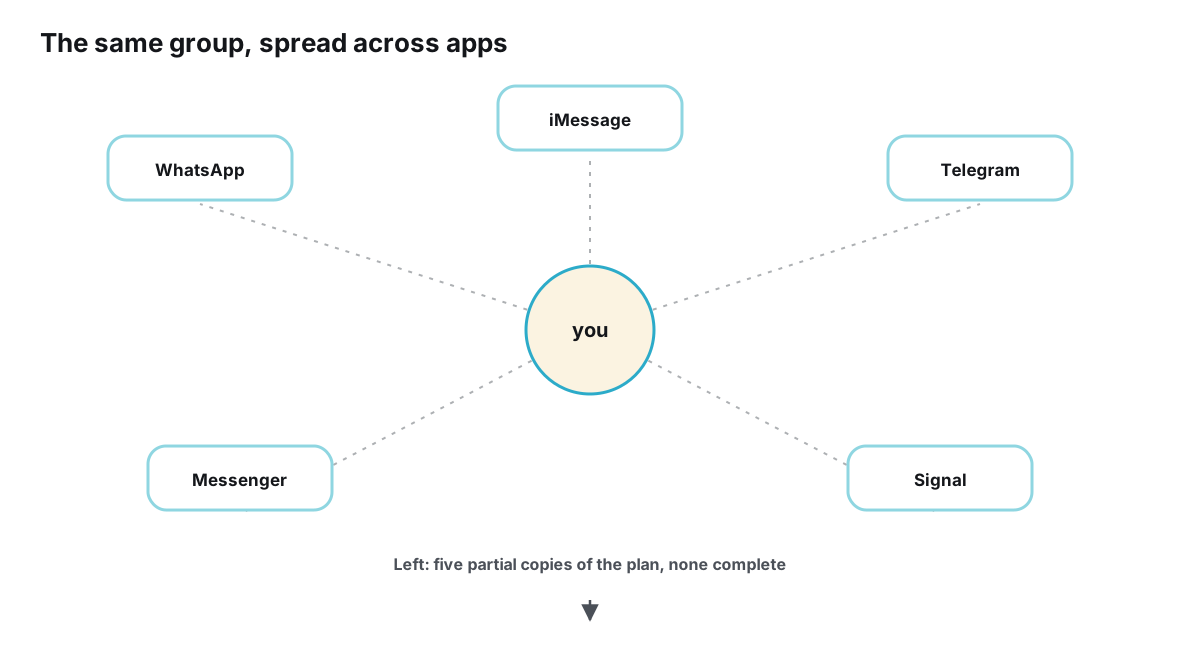
The mechanics are worth spelling out because their simplicity is what makes them durable. The announcement message is written natively in each app — the same link, different words, because the GroupMe crowd and the family thread deserve different greetings — and from that moment the link is the answer to every logistical question. When the plan changes, the page is edited once; a one-line pointer can follow in whichever threads the change matters to, but the edit, not the pointer, is the mechanism. Guests in different apps experience one identical, current plan. Nothing is relayed, because nothing needs to be.
There is a subtler benefit worth naming: the link is the only version of the plan that cannot be paraphrased. Every human relay compresses and loses; every copy-paste drifts; the link, opened fresh, always shows the same state. A plan distributed as a link is a plan with zero transcription errors — a property no number of diligent group members can replicate by hand.
A working routine for mixed-app groups
Patterns become effortless once they become routine. The routine below takes about ten minutes per event at the start and roughly zero thereafter; groups that adopt it usually report that the second event runs itself.
- Map the rooms. Before the plan forms, note which apps this event actually spans — the team thread, the family group, the friends’ chat. Two or three is typical. The map takes a minute and tells you where announcements must land.
- Create the event page first. Give the event its one address while it is still just an idea: a working title, a rough date, and honest “to be decided” fields. The page existing before the first decision is what prevents the fragments from ever becoming the plan.
- Announce everywhere, once each. Post the link in every room you mapped, in the voice of that room — one message per app, each carrying the same address. Say plainly what the link is: “the plan lives here; I’ll keep it current.”
- Debate locally, decide centrally. Let each thread argue in its native tongue; when a question settles, it settles on the page. The conversations keep their texture; the plan keeps its consistency.
- Answer questions with the link. Every “what time?” gets the address, not a typed answer. This is the habit that trains the group — within two events, people stop asking and start consulting.
- Update once at the source. Changes are edits to the page, with an optional one-line heads-up in the affected threads. Never re-publish full details app by app; you would be reinstalling the copy-paste machine you just dismantled.
The routine’s quiet genius is that it is almost invisible to guests. Nobody installs anything, nobody leaves a beloved app, nobody is added to a group they didn’t choose. From the inside, the experience is simply that this organizer’s plans are always easy to check — a reputation that, in most friend groups, is worth its weight in reserved tables.
Keeping conversation local: what stays in each app
A common misunderstanding treats the hub pattern as anti-conversation — as if the goal were to empty the group chats into a form. The opposite is true. The pattern works because it lets each app keep the part of the event it is best at. The banter stays on GroupMe, where the team’s whole relationship lives. The family logistics — who is driving, who cannot do Saturday — stay in the family thread, among the only people who can solve them. The side conspiracy about the gift stays private, as it should.
What moves to the page is only the small set of facts everyone must share: the final date and time, the place, the guest statuses, the changes. This division mirrors a distinction explored in the difference between a conversation and an event object — talk is a stream, the plan is state, and each is damaged by being stored as the other. Groups sometimes discover the boundary empirically: they put too much on the page (debate, jokes, opinions) and watch it clog; they put too little (no RSVPs, no updates) and watch the threads fill with questions again. The boundary is found, not decreed, and each organizer finds it in one event.
It also helps to know each app’s character as a coordination venue, because the pattern flexes to fit them. GroupMe — as covered in how GroupMe handles group coordination — is a straightforward group-messaging home whose basic polls make light work of binary questions, and it links out happily. iMessage threads are wonderful rooms that strain under complex plans, as examined in why iMessage groups are difficult for complex plans — and an Apple-only subcircle can keep planning there entirely, provided the results land on the shared page. The pattern is not a criticism of any app; it is a way of letting all of them be right.
Edge cases every mixed group meets
Real groups contain real people, and real people do not sit at the average. The edge cases below are where coordination patterns live or die; each has a humane answer that keeps the guest inside the plan rather than outside the system.
| Situation | What to do |
|---|---|
| The guest who never clicks links | Relay privately, once, without commentary — then keep including the link so the door stays open. Accommodate the exception; don’t design around it. |
| The grandparent on plain SMS | Send the key facts as a text when they firm up, and the link for everything else. Text still reaches every phone ever made. |
| A splinter thread starts making decisions | Redirect gently: “good call — noted it on the page.” Decisions made off the page are drift; catching them early costs one sentence. |
| The late invitee, mid-planning | One link, no catch-up required. This is the hub pattern at its best: joining late costs nothing because the current state is one tap away. |
| Someone replies in the “wrong” app | Answer where they asked, update on the page. Conversations are allowed to wander; only the plan must not. |
| A guest refuses event links on principle | Treat like the link-refuser above: personal messages, page updated anyway. One guest’s preference never becomes the group’s architecture. |
Notice the common thread in the table: the plan’s structure never bends to the exception, but the organizer always does. That combination — rigid about where the truth lives, flexible about how people reach it — is what makes the pattern both reliable and liked. Groups fail in the opposite configurations: structure flexible (drift) with organizers rigid (resentment), or everything rigid, which is how a birthday becomes a compliance exercise.
Update discipline across apps
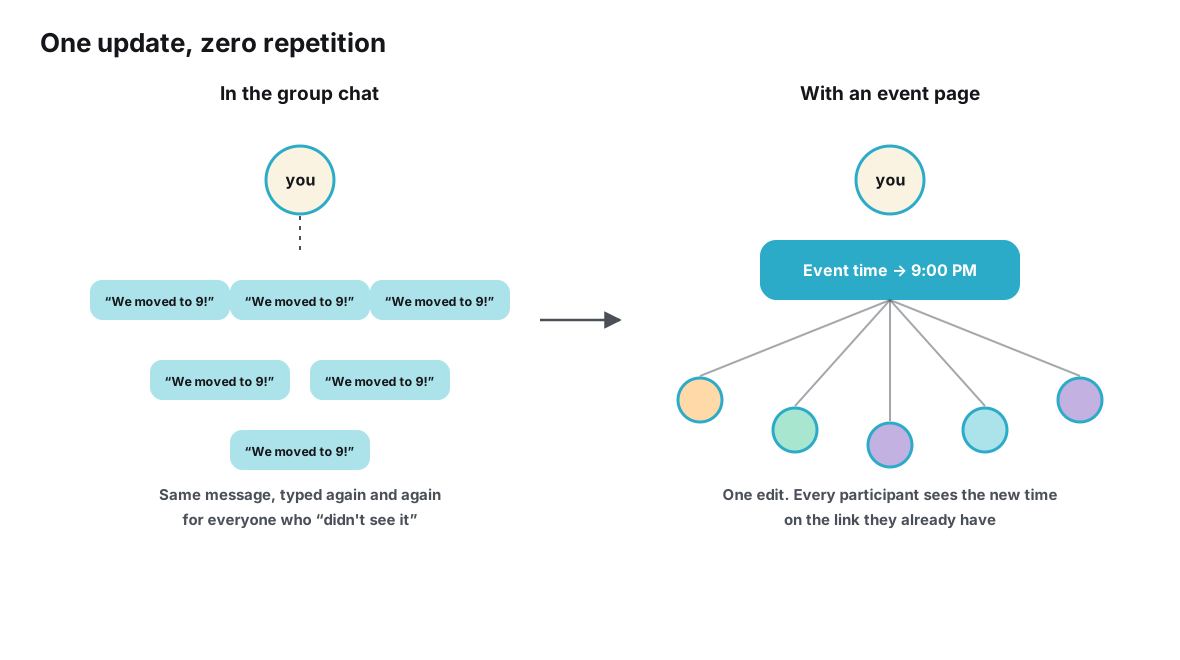
Updates are where mixed groups break, so they deserve their own rules. The discipline has three parts, none difficult. First, edit before you announce: the page changes first, so that anyone who follows a mention finds the new state already true. Second, announce in pointers, not payloads: the thread gets “time moved to 8:30 — updated on the page,” never a re-publication of the full details, because every payload is a new copy waiting to drift. Third, let significant changes be loud once, not quiet everywhere: a venue swap deserves a real message in the rooms it affects; a typo fix deserves silence. Calibrating loudness is a judgment call, and organizers get good at it fast when the page is carrying the actual truth.
The reward for this discipline is proportionality: updates stop feeling expensive, so they stop being delayed. In relay mode, announcing a change costs the organizer an app-by-app tour, so changes get postponed and softened — and the softening is where plans rot. With the page as the source, a change costs one edit and a sentence, so it happens immediately, while it is still small. Good update discipline is not about sending more messages; it is about making the messages you send count exactly once, everywhere.
The day before deserves special mention, because it is when the discipline pays its dividend. Final headcounts firm up, the weather makes its decision, and the messages that matter most compete with everyone else’s weekend logistics. A group whose plan lives at one address absorbs all of it with a handful of quiet edits and one pointer per room; a relay group spends the same evening re-explaining itself in four directions. The difference is not intelligence or effort — it is which system was in place when the pressure arrived.
The etiquette that keeps it working
Technique carries a group for one event; etiquette carries it for years. Three norms do most of the work, and none of them requires a memo — just an organizer who models them consistently.
Never conscript. Nobody is required to install anything, join anything, or move anywhere. The moment coordination starts feeling like an obligation imposed by the organizer’s convenience, cooperation quietly halves. The link asks for one tap; that is the entire tax, and it should stay that way.
Link the plan, not just the conclusions. When telling a subset of the group what was decided, include the address even for people who were there. Every message that carries the link reinforces where the truth lives; every message that doesn’t teaches people that answers arrive as favors from whoever typed them.
Be generous with repetition, stingy with detail. Re-sharing the link five times costs nothing and looks like care. Re-typing the details five times is how versions diverge. The etiquette inversion — repeat the pointer endlessly, publish the payload once — is the single habit that separates groups that stay coordinated from groups that relapse into relay.
Frequently asked questions
What’s the minimum viable setup for a mixed group?
One event page with the final details and RSVP options, plus one message per app carrying the link. That is the whole starter kit. Everything else — polls, reminders, per-guest statuses — is an enhancement, and most groups add them only after feeling their absence.
Isn’t a shared document enough?
A document can hold the facts, and for a short, simple plan it can suffice. But a document stores sentences, not state: there are no RSVP statuses, no automatic tally, no change history, and updates rely on everyone noticing the edit. It also tends to collect commentary until the current plan is buried in its own margins — a spreadsheet wearing a chat’s problems.
How do I get a stubborn group to adopt this?
Don’t announce a system; just behave like it exists. Create the page, share the link, answer questions with it. Most groups adopt the pattern by experience rather than by decree: within two or three events, people notice that this organizer’s plans are always one tap away, and the habit spreads because it is genuinely easier, not because anyone campaigned.
What if one subgroup refuses to leave their app for anything?
Then don’t ask them to. The pattern is not app-replacement; it is link-sharing. A subgroup that plans natively in GroupMe or iMessage and sees the final result land on the shared page is coordinating correctly — their conversation is local, their decisions are central, and nobody had to abandon anything.
Does this work for recurring events?
It works best there. Each instance gets its own link — the address is per event, not per group — and members learn once where every event lives. Recurring groups see the gains fastest: attendance tallies carry forward as habits, late joiners onboard themselves, and the organizer’s per-event work approaches the ten-minute routine.
How many apps before I need this?
Two. A single app has other problems, but fragmentation is not one of them; the moment a plan must exist in two places, every change has two chances to go wrong and no chance to be checked. The neutral-hub pattern is exactly the tool for the number two and everything above it.
Conclusion
Coordinating people across different messaging apps fails when it is attempted at the wrong layer. The conversations will never unify — each app is a home, and homes are not abandoned for logistics — so a plan that depends on unification is a plan that depends on something that will not happen. Coordination belongs one layer up: a neutral address per event, reachable by everyone, holding the plan’s current state, linked from every room the event touches.
The working routine is small enough to be believable: map the rooms, create the page before the plan fragments, announce once per app, decide centrally, answer with the link, update at the source. Around it sit habits that cost nothing — never conscript, link the plan, repeat pointers but never payloads — and edge-case manners that keep every kind of guest inside the plan, from the link-refuser to the late joiner. Groups that run this pattern do not coordinate more than other groups; they coordinate once, and then simply stop paying the relay tax. Whatever your people use to talk, that is the whole trick: meet them where they chat, and keep the truth where everyone can check it.
Whatever your people use to chat, meet them at one link.
Coordinate it with Ontaym