
Why iMessage Groups Are Difficult for Complex Plans
For groups of Apple users, iMessage isn’t a choice — it’s the default that’s already on every phone at the table. That default works beautifully for ordinary social plans. It starts to strain when a plan grows options, dependencies and a headcount, because a message thread can carry all of those as conversation but none of them as structure.
Quick answer
iMessage groups are excellent for groups where everyone uses Apple devices and the plan is a single decision — same place as always, see you at eight. They become difficult for complex plans for two structural reasons. First, the group is tied to Apple’s ecosystem, so any guest outside it turns one conversation into two, with the organizer copying details between them. Second, the thread offers no structure for the things complex plans are made of: options to compare, RSVPs that change, and a final version that must stay visible. Those need an event record, not a message history. The working fix keeps the thread for talk and gives the plan itself one link — an event page every guest can open, whatever device they hold.
The group chat that arrives pre-installed
Most messaging apps have to be adopted; iMessage is simply there. If a friend group, family or team is Apple-centered, the group conversation usually forms the moment someone texts several people at once — no downloads, no accounts, no convincing anyone. The people are already in everyone’s contacts, the thread already carries their names and photos, and the habit of using it is already years old. This is a genuine advantage, and it explains why so much social planning happens there: the friction of starting is zero.
The second strength is intimacy. An iMessage group is typically made of people who already have each other’s numbers — real, close relationships rather than assembled audiences. Messages get answered quickly, tone travels well, and the group sustains the low-level chatter that keeps a circle warm between actual plans. For a Saturday coffee run or a standing weekly dinner, this is all the infrastructure anyone needs: propose, confirm, show up.
Apple’s own support pages describe the feature set around group conversations — naming threads, leaving them, managing notifications. Read with an organizer’s eye, the list is telling in what it contains: tools for managing the conversation. There’s nothing in it about managing a plan, because that was never the thread’s job. The rest of this article is about what happens when a group asks it to do that job anyway.
Stress test one: the group has a border
The first structural fact about an iMessage group is that it lives inside Apple’s world. The experience everyone loves — the smooth group thread with its reactions and typing indicators — assumes that every participant is on Apple hardware. iMessage groups are tied to Apple devices, and that tie is invisible right up until the moment the guest list crosses it: the friend with an Android phone, the grandmother on a basic handset, the visiting cousin whose entire life runs on a different platform. The group doesn’t vanish, but it stops being the single seamless space it was designed to be, and someone — always the organizer — starts doing translation work between worlds.
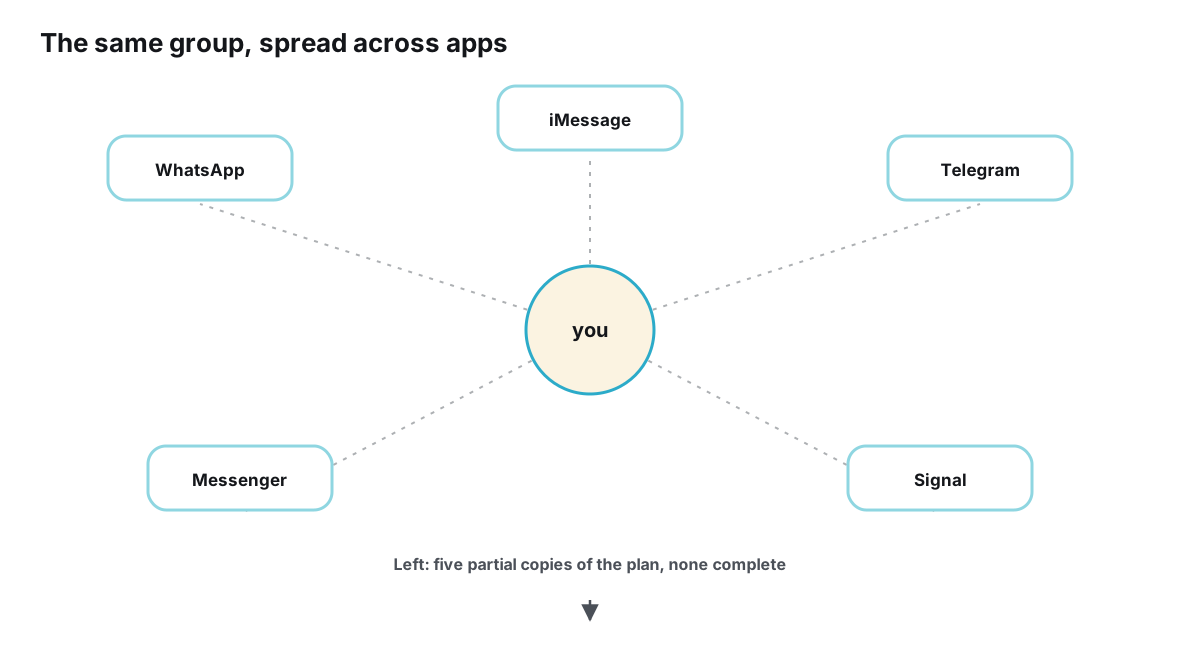
The translations multiply quietly. The mixed conversation gets mirrored into a second app for the people outside it. A screenshot of the thread gets texted to the one person who can’t see it properly. The poll the Apple users ran among themselves gets recounted verbally for everyone else. None of these steps is hard. Together they turn one plan into several loosely coupled copies, each updated by hand, each capable of drifting from the others at any moment — one thread confidently saying Saturday, the other still saying Sunday, and the difference surfacing when half the group is standing in the wrong place.
This is why complexity and lock-in interact so badly. A simple plan survives the border easily: “8 at ours?” travels between apps without losing anything. A complex plan doesn’t, because complexity lives exactly in the details — addresses, times, headcounts, changes — that manual copying is worst at keeping consistent. The more moving parts, the more the border costs. We cover the general shape of this problem in what happens when an event is planned across multiple messaging apps; for Apple-centered groups, the border is usually the first and most frequent trigger.
Stress test two: options have nowhere to live
Complex plans begin with choices — which weekend, which cabin, one big table or two small ones — and choices are where a message thread first shows its limits. In iMessage, an option can only exist as words in a bubble. “What about the 14th?” is a message like any other; so is “or the 21st, it’s cheaper”; so is “I could do either.” After a day of discussion, the options aren’t collected anywhere — they’re distributed across a screen of conversation, mixed with jokes and side topics, and weighted by nothing. Deciding means mentally aggregating the thread, which every participant does separately, which is how two people can leave the same discussion with different beliefs about what was chosen.
Other chat platforms have leaned into lightweight polls for exactly this moment. iMessage group chats don’t offer a native poll, so Apple groups improvise: numbered lists typed into a message with replies beneath, emoji voting schemes, or an external poll link pasted into the thread. These improvisations work — groups are resourceful — but they all share the same weakness: the result is still a message. It ages, it scrolls, it can be replied to, and it doesn’t update when circumstances change. A vote cast on Tuesday about a plan that changes on Thursday stays exactly where it was, still looking authoritative.
There’s a deeper issue than the missing widget, and it’s worth being precise about it. Options in a complex plan aren’t a one-time preference; they’re a live shortlist that narrows over days, sometimes reopening when someone’s schedule breaks. Tracking that requires a structure that holds the current state of each option — still open, winning, discarded — separate from the conversation about it. A thread can host the discussion but not the state. That distinction, between a conversation and the object it’s about, is developed fully in the difference between a conversation and an event object.
Stress test three: the headcount has to be right
The clearest line between casual and complex plans is whether anyone outside the group needs a number. A restaurant wants a final count. A cabin sleeps exactly eight. A paintball session is priced per head. At that moment the group needs RSVPs — named, current, changeable commitments — and an iMessage thread has no representation for one. What it has instead is a rich vocabulary of social signals: replies (“in!”, “I’ll try”, “what time?”), reactions on a message, and silence.
Every one of those signals is honest, and none of them is countable. A thumbs-up on “dinner on the 12th?” may mean yes, fun, or seen it, will think. “I’ll try” is a genuine answer about intention and a useless answer about capacity. Silence splits into “no”, “yes and assumed it was obvious”, and “hasn’t opened the app since Tuesday”. The organizer who needs eight firm bodies ends up re-asking individually, maintaining a private tally in their head or in a notes app, and posting gentle broadcast reminders that some members experience as pressure. The group isn’t misbehaving; the medium just doesn’t hold the thing the venue is waiting for.
It’s worth knowing that the concept of an RSVP is well-defined enough to be a standard structured-data type — schema.org describes RsvpAction as exactly this: a named response that says whether someone is attending. That formality is the point. A reaction is an annotation on a message; an RSVP is a field on a person that can be updated as plans shift, and that aggregates into a headcount without anyone counting. Complex plans need the second thing, and no amount of reaction discipline in a thread will synthesize it.
| The plan needs | Why complexity demands it | What an iMessage group offers |
|---|---|---|
| A compared option set | Dates, venues and formats must be weighed, then narrowed | Options as messages, mixed into conversation, no aggregation |
| Named RSVPs | Venues and bookings need a headcount that holds still | Replies, reactions and silence — expressive but not countable |
| One current version | Times and places change; late readers must see the final state | Corrections as newer messages, older ones left intact |
| Everyone in one place | Guest lists rarely match one platform exactly | A group tied to Apple devices, with everyone else outside it |
| Clear membership | The organizer needs to know who is even being asked | A thread of contacts, plus muted members who are effectively absent |
| A catch-up path | Late joiners and quiet members need the plan quickly | Scrolling back through the full social history |
Leaving, muting, and the quiet physics of membership
Group membership in iMessage follows Apple’s own conventions, and the way people leave or mute these groups differs from how it works in cross-platform apps — a detail that sounds technical until you see its social consequences. Because the thread sits in the same inbox as private conversations with the same people, exiting it is a deliberate, visible act. Many members who want out don’t take it; they mute instead, and remain on the roster while no longer reading. The group looks intact. Its effective audience is smaller than its member list, and nobody — including the organizer — knows by how much.
This matters for planning more than it first appears. RSVP-by-silence was already ambiguous; muted membership makes it worse, because “no response” now has an extra explanation that can’t be ruled out. A plan announced to a twelve-person thread may genuinely have reached seven. The organizer compensates by broadcasting more, the active members experience the thread as noisier, more of them mute in response, and the loop tightens. It’s nobody’s fault — each individual decision is rational — but it means the group’s reach decays precisely as the plan gets more important.
Complex plans also add people the thread was never sized for: the friend-of-a-friend joining the trip, the partner added late, the new teammate. Adding someone to an iMessage group hands them the entire backscroll — every joke, every rejected option, every message that was fine in context and reads differently cold. That’s a social cost other structures don’t impose. A plan with its own page welcomes the newcomer to the current state — final details, open questions, who’s coming — without packaging two weeks of private conversation along with it.
How changes behave when the plan is a thread
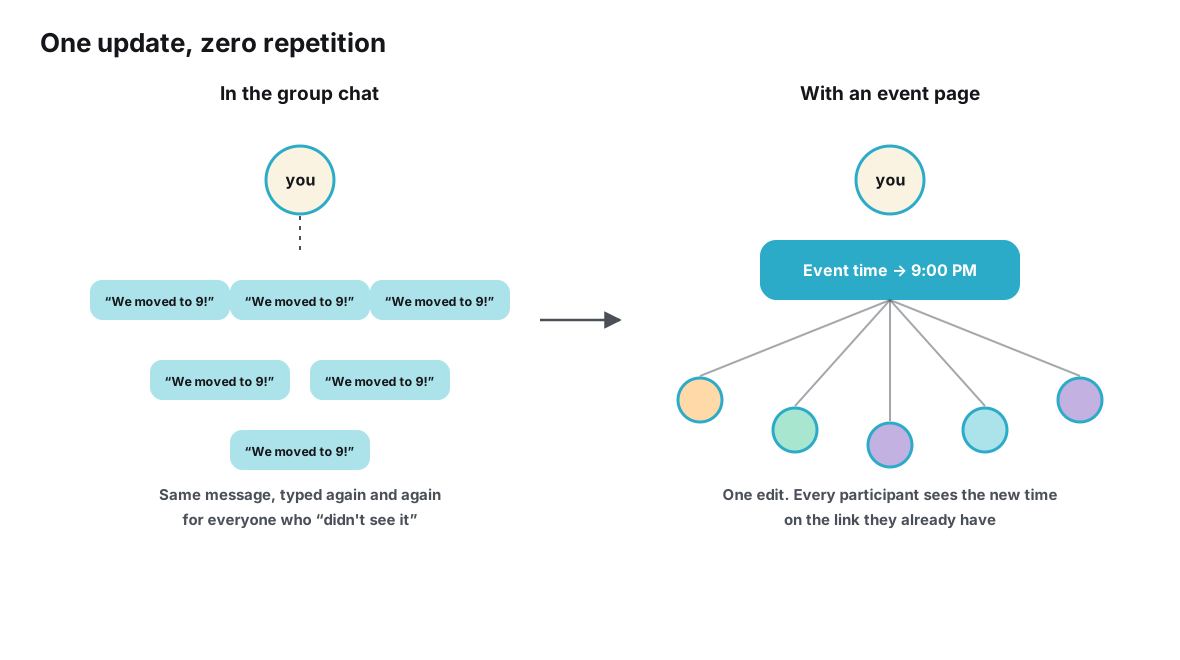
Complexity guarantees revisions, and revisions are where the message format finally gives way. A time change in a thread is a new message: “moved to 9!” From that instant the group contains two start times, both phrased with equal confidence, distinguishable only by position. Members who catch the correction are fine. Members who read the thread in summary, arrive from a notification, or check a screenshot taken before the change are fine too — wrongly. The organizer’s countermove is repetition: restating the plan, re-pinning the latest version, answering “what time?” individually for the fourth time this week.
Now scale that across a genuinely complex plan: the time changes once, the venue twice, the car shares three times, and each change spawns its own correction cycle. Every restatement buries the previous one a little deeper, which increases the odds of the next “wait, which restaurant?”, which triggers the next restatement. The thread isn’t failing to transmit information — it’s transmitting all of it, old and new, with equal weight, forever. What the plan needed was for the change to overwrite the previous fact in one place everyone trusts.
| Symptom | What it actually tells you | Practical response |
|---|---|---|
| “What time is it again?” asked repeatedly | The thread has no readable current state | Post one link to a page that always shows the final details |
| Two subgroups show up with different plans | Corrections aren’t reaching everyone equally | Move the source of truth out of the scroll entirely |
| The organizer is privately re-asking people for answers | Reactions can’t be aggregated into a headcount | Switch to named RSVP statuses each person controls |
| A second chat app appeared for the non-Apple guests | The guest list crosses the platform border | Give the event one device-neutral address shared in both threads |
| Newcomers keep asking for a recap | Catching up requires the whole back story | Point late joiners at the current plan, not the history |
| Enthusiastic early replies, empty seats on the night | Early signals were mistaken for commitments | Track commitment as status, not as enthusiasm in week one |
One weekend, told two ways
Make the stakes concrete with a familiar shape: eight friends, one cabin, two nights. In the thread-first version, the trip begins as enthusiasm in the group — someone finds the listing, someone else checks prices, and within a day the discussion has produced the first fork: the 14th or the 21st? Both dates have advocates. The debate interleaves with everything else the group talks about that week, so the date question resolves in fragments — one person concedes in a reply, another misses it entirely, a third keeps planning around the wrong weekend in a side conversation. A decision was effectively made, and effectively missed, in the same motion.
Then the logistics arrive: deposit due by a certain day, cars needed, groceries divided, plus-one confirmed at the last minute. Each of these generates its own message cluster, its own corrections, and its own private follow-ups when the thread fails to produce a clear answer. Priya, added on Wednesday to a discussion that started the previous Friday, asks what she needs to know — reasonably, and for the fourth time that week. By departure day the organizer has personally answered the same four questions in different corners of the thread and their own direct messages, one guest arrives a day late, and the grocery list turns out to have lived only in a message two people ever saw.
Tell it the second way and nothing about the conversation changes — the same jokes, the same debate, the same people — but the plan acquires one address early. The date question becomes an option poll on the page; the headcount becomes RSVP statuses each person updates themselves; the deposit, cars and groceries become fields on the same page; and Priya’s onboarding is a single link that shows her, in one screen, the final weekend, the car she’s in, and the salad she’s bringing. The thread got to stay a thread. The difference is that somewhere in it, there was always one place to look.
What good looks like for an Apple-centered group
None of this means an Apple group should abandon its thread — the thread is the right home for everything social that surrounds a plan. The change worth making is smaller and more durable: stop asking the conversation to also be the record. In practice that means each real event gets one address of its own — a page holding the options while they’re open, the RSVP list while it fills, and the final details once they’re set. The iMessage group stays exactly where it is; it just gains a link it can trust. “What’s the plan?” gets answered once, with the link, forever.
This pattern is precisely how tools like Ontaym are meant to sit alongside a group chat: the event page carries voting on options, going/maybe statuses, updates and reminders, while iMessage keeps doing what no event tool can replace — the actual talk of actual friends. The same division of labor holds for circles built on other messengers: the dynamics of Meta’s world are covered in how Messenger groups can be used for event coordination, and the privacy-first variant in Signal groups and real-world event planning. The app in the middle matters less than the boundary: conversation in the chat, state on the page.
Introduce it lightly. The groups that adopt this well don’t announce a new system; they just answer the next “what’s the plan?” with a link instead of a paragraph. The link earns its authority by being right every time it’s opened — final time, final place, current headcount — and within a plan or two, “check the page” becomes the group’s reflex, precisely because it costs less than scrolling. The thread gets quieter, the organizer gets their evenings back, and the friends outside Apple’s world stop being a special case. Complexity didn’t break the friendship; it just outgrew the container, and the container is easy to supplement.
Frequently asked questions
Can’t we just use reactions to count who’s coming?
Reactions tell you how people felt about a specific message, not what they’ll do on a specific date. A thumbs-up may mean yes, support, or merely “seen”. And because reactions attach to one message at one moment, they can’t update when someone’s plans change. For a headcount that matters — a reservation, a capacity limit — you need per-person statuses people can change, not annotations on a bubble.
Why does adding one non-Apple friend cause so much trouble?
Because the group’s smoothness assumes everyone is inside Apple’s ecosystem. Once a guest is outside it, the conversation either downgrades for everyone or forks into a second app — and a forked plan means details are copied by hand between copies that can drift apart. The trouble isn’t the friend; it’s that a plan held in one platform’s private format now has to reach someone the platform doesn’t cover.
Is there a way to run a poll inside iMessage?
Group chats in iMessage don’t include a native poll, so groups improvise: typed lists with numbered replies, emoji voting, or a link to an external poll pasted into the thread. Improvised polls capture a snapshot of preferences, which helps — but the result still lives as a message, so it ages badly when options change or the discussion reopens. Structure that holds the current state of the decision beats a snapshot every time.
What’s the best way to handle friends who mute the group?
First, stop treating silence as an answer — muted members can’t be distinguished from uninterested ones, so anything important needs an explicit response mechanism. Second, shrink what they need to catch up on: a single link to the current plan means a muted friend can re-engage in five seconds without reading two weeks of messages. And for genuinely important changes, a direct message to key people remains a healthy habit.
When is iMessage actually the right tool for planning?
When the group is all-Apple, the plan is one or two decisions, the details are stable, and everyone is actively reading — the standing dinner, the weekend hike at the usual spot. That describes a large share of social life, which is why the default works so often. The trigger to add structure is any of the opposites: mixed platforms, several linked decisions, details that will change, or a headcount someone outside the group is waiting on.
How do we move a plan that’s already deep in the thread?
Extract, don’t rewrite. Pull out the facts that currently matter — the final date, the place, the likely attendees, the open questions — put them on a fresh event page, and post it once with one sentence: “From here on, this is the plan.” The thread remains the social history, which is a fine thing for it to be; it just stops being the reference. Expect the first day or two to need a few gentle redirects when someone asks the thread instead of the page — each redirect is the habit forming.
Conclusion
iMessage groups fail at complex plans for reasons that have nothing to do with effort or goodwill. The thread is tied to one ecosystem, so the guest list it can truly hold is smaller than the guest list your life produces. It has no structure for options or RSVPs, so decisions and commitments exist only as social signals scattered across the scroll. And it records corrections as additions, so every change makes the plan slightly harder to read rather than easier.
None of these are reasons to leave — they’re reasons to specialize. Let the thread do the thing nothing else does for an Apple circle: carry the actual conversation among people who already have each other’s numbers. And when a plan grows past a decision or two, give it a small piece of structure of its own — one page, one link, holding the options, the RSVPs and the final version. The friends who noticed nothing keep chatting exactly as before; the friends on other phones finally see the same plan as everyone else; and the organizer stops being the group’s memory.
Your group chat stays. Give the plan one link everyone can open.
Plan it with Ontaym