
Why Event-Specific Notifications Are Better Than Group Notifications
A group chat notifies; that is its job. But its notifications are scoped to the room, not to the plan — so the ten messages that matter and the four hundred that don’t all arrive wearing the same buzz, and the people who tire of the noise mute exactly the channel their plans depend on.
Quick answer
Group notifications are scoped to a room: every message in the group is a potential ping for every member, so relevance is left entirely to chance and self-discipline. Event-specific notifications are scoped to a plan: they fire when that one event changes, hits a deadline, or needs a decision, and they reach exactly the people connected to it. As groups grow, room-scoped noise pushes members to mute — and muting then swallows the signal, which is the death spiral of planning in chat. Scoping by event keeps the ratio sane: followers of a plan hear about that plan, everyone else hears nothing, and opting out means leaving one event rather than abandoning a whole conversation. The buzzes you get are few, on-topic, and attached to things you can actually act on.
The room is the unit
Every messaging app you use makes one quiet decision on your behalf: the thing you subscribe to is the conversation. Join a group and you have, by default, opted into an alert for every message every member will ever send. There is no intermediate step where the system asks what you’re there for — the birthday planning, the match logistics, the one announcement a month — because the system has no idea what you’re there for. The room is the unit. The room is what you join, the room is what notifies you, and the room is what you mute when you can’t take it anymore.
This design is a perfect fit for what chat is: an ongoing social space, where being present for the flow is the point. If a group is primarily a place to talk — the family thread, the banter group — then room-scoped notifications are correct, and the volume is the price of the companionship. The design only becomes a problem when the room acquires a second job: being the nervous system of a plan. From that moment, the room must somehow deliver both a stream of conversation and a set of critical, rare, time-sensitive facts — through a single notification channel that cannot tell the two apart.
Some apps subdivide the room — channels, topics, threads — and those subdivisions genuinely help, because they let a big server split into quieter rooms. But the subdivisions are still conversational units, not plan units. There is no channel that means “only Saturday’s hike,” that falls silent when the hike is over, that survives the hike moving to Sunday, or that stops notifying you when you change your answer to not-going. To get notification behavior like that, the subscription has to be attached to something that knows what an event is.
Where the noise comes from
It is worth doing the arithmetic honestly, because the scale of the problem is usually underestimated. In a room-scoped system, every message from every member is a candidate notification for every other member. The math is unforgiving: a handful of chatty members can generate dozens of messages a day about nothing in particular, while the plan itself might produce four load-bearing messages a week — a confirmed time, a venue change, a cancellation, a meeting point. The four that matter arrive dressed identically to the hundreds that don’t, and the ratio worsens precisely when the group is most active. Busy weeks are noisy weeks, and noisy weeks bury plans.
Scale makes it stark. WhatsApp groups support up to 1,024 participants, and Telegram’s supergroups go as high as 200,000 members, as their own documentation describes — see the WhatsApp Help Center and the Telegram FAQ for the platforms’ own accounts. Those numbers exist because huge rooms are genuinely useful for communities. But a room of even a hundred friends planning a picnic is, as a notification system, a hundred transmitters wired to a hundred receivers with no filtering between them except politeness. Discord’s large servers solve this with roles, channels and carefully tuned notification settings — Discord’s support guides read as a map of this exact problem — yet even there, the tuning is about rooms and roles, not about the one plan you actually follow.
The deepest part of the problem is that noise is not random; it is correlated with the signal. The days when a plan produces the most messages — the final week, the day itself — are exactly the days when the plan’s real updates most need to be seen. Chat’s noise floor rises precisely when the stakes rise. A signal that arrives during peak noise isn’t a signal; it’s a lottery ticket.
| Dimension | Group (room) notifications | Event-specific notifications |
|---|---|---|
| Unit of subscription | The conversation — all messages, all topics | The plan — one event and its changes |
| What triggers a ping | Any member sending any message | A change, deadline, or decision point on the event |
| Relevance filter | None — relevance is the reader’s problem | Structural — you hear only what you follow |
| What muting means | Silence everything, including the plan | Leaving one event, keeping everything else |
| After the event | The room keeps talking forever | The notifications stop by themselves |
| Who tunes it | Each member, against the whole room | Each member, per event, by following or unfollowing |
The mute spiral
Nobody plans to miss the important update; they just get tired first. The sequence is so common it deserves a name. A group gets chatty. A member — reasonable, busy — mutes it for eight hours, then for a week, then forever. The group’s planning continues in the thread. One day the time changes, and the changed time lands in the thread of a muted conversation. The member arrives at eight; everyone else arrives at nine. Somebody says “it was in the group.” Technically true, functionally useless. The member, now burned, faces a worse version of the original bargain: unmute and drown, or stay muted and risk it. Most stay muted, and simply stop relying on the group for anything that matters.
The organizer experiences the spiral from the other end. Attendance at the group’s announcements seems to fall, so announcements get louder — mentions of everyone, re-posts, ALL-CAPS urgency. Each escalation raises the noise floor further, pushing another cohort into muting. The channel is now spending its remaining credibility to compensate for the credibility it spent earlier. Every step of this spiral is locally rational, and the destination is a group where the plan’s real facts are effectively posted into a void.
The platform’s mute controls cannot break the spiral because they answer the wrong question. Muting, as implemented across chat apps, is a statement about a conversation: silence this thread, for this duration, at this volume. What the tired member actually wants to say is a statement about content: keep me informed about the plan, stop informing me about everything else. No room-scoped control can express that, because the room cannot distinguish its plan-facts from its chatter — both are just messages. The wish is common and precise; the vocabulary to express it simply doesn’t exist at the level of the group.
The trust ledger
Underneath the mute spiral runs something quieter: a trust ledger. Every notification system works only as long as its pings predict relevance. When a buzz reliably means “this concerns you,” people read the buzz — that is the entire mechanism by which any alert has ever functioned. When a buzz means “someone, somewhere, said something,” people stop reading the buzz, and reasonably so: the rational response to unpredictable signals is to ignore them and check on your own schedule. Room-scoped groups almost always end up on the wrong side of that ledger, because their signals are generated by chatter, which is unpredictable by nature.
The ledger explains a puzzling pattern every organizer has seen: the same group that ignores the room’s announcements will still respond instantly to a private message. It isn’t laziness — it’s accurate calibration. Privately sent messages have a near-perfect relevance rate, so they retain full attention value; the group’s broadcast has a low one, so it is discounted to near zero. The organizer, reading this as apathy, escalates in the room; the group, reading the escalation as more noise, discounts further. What looks like a social problem is an accounting one: the room has spent its trust and cannot buy it back with volume. Only changing what generates the pings — relevance, not activity — restores the balance.
Different people need different slices
The room-scoped model has one more blind spot, less obvious but equally structural: it gives everyone the same feed. The organizer of Saturday’s hike genuinely needs to hear every message — they’re hosting. A committed guest needs the final details and the morning-of meeting point, but not the forty messages debating which trail. A maybe-guest needs one thing above all: the decision deadline, and then the outcome. A plus-one who was dragged in needs almost nothing until the day. These are four different information diets attached to four different roles, and the group chat delivers all four of them the same all-you-can-eat stream, at the same volume, forever.

The funnel explains why role-aware notifications matter. At the top, invitees need prompts tied to deciding. In the middle, the committed need prompts tied to preparing. Near the bottom, everyone needs the final facts, once, with authority. These are not just different messages — they are different audiences, shrinking as the event approaches, with different urgency profiles. A room-scoped system broadcasts every message to the entire funnel at once: the undecided get preparation chatter, the committed get re-decision debates, and the plus-one gets all of it. An event-scoped system can, in principle, match the message to the stage — because the event record knows who has decided, who is committed, and who is only adjacent. The notification becomes a function of the plan’s state, not of the room’s mood.
Make it concrete. Maya is hosting, and wants — genuinely — to read everything about her own dinner. Tom is a firm yes who cares about one fact: the start time, if it moves. Priya is a maybe whose whole relationship with the event should be three prompts: the deadline approaching, the final headcount mood, and the day-of decision. In a room-scoped world, all three receive the identical feed — every debate, every joke, every side quest — and each must personally filter it, all day, at the cost of their attention or their manners. Maya can’t unsubscribe from her own dinner; Tom can’t subscribe to only the time; Priya can’t subscribe to only the deadline. The feed fits no one, and fits everyone equally badly.
| Control | What it does | Its blind spot |
|---|---|---|
| Mute the group | Silences every message from the room | Also silences the plan; all-or-nothing by design |
| Mention someone | Forces a ping to a named person | Spends social capital; still just a message about the plan, not the plan |
| Mention everyone | Forces a ping to the whole room | The loudest tool available; each use trains people to flinch |
| Pin a message | Keeps one message visible at the top | Nothing notifies anyone; stale after the first change |
| Custom per-chat settings | Tunes sound, preview, vibration per room | Changes the wrapping, not the relevance — same messages, quieter |
Look at what the column on the right has in common: every control adjusts volume or position, and none of them can express relevance. That is not an oversight by any platform — it is the direct consequence of the room being the unit. A system that cannot represent “the plan” cannot offer a setting that means “notify me about the plan.”
Notifications that carry meaning, not just sound
There is a second dimension to the problem, easy to miss because it hides inside the buzz itself: what the notification says. A room-scoped ping is semantically empty — “New message in Friday Group.” It asserts only that speech occurred somewhere in a place you once joined. To learn whether the message concerns you, you must open the app, tap through, read, and — most of the time — discover it didn’t. Multiply that journey by a hundred pings a week and you have explained a great deal of modern phone fatigue: not too many important things, but too many empty ones, each demanding the same trip to decode it.
An event-scoped notification can afford to be informative because it is generated from state, not from speech. “Saturday’s hike moved to 10:00 — you’re marked Going” is a complete thought. It names the plan, states the change, and locates you in it, all before the tap. The reader can act on it from the lock screen: accept, adjust, or ignore with knowledge. Empty notifications train people to dismiss; meaningful notifications train people to read. Over the life of a group, that difference compounds into something social, not just technical — a group whose pings mean something is a group people stay subscribed to.
The lock screen is where the difference is actually spent. An empty notification obligates a journey — tap, open, scroll, read, conclude “not for me” — and that journey is the hidden tax on every room-scoped ping. A stateful notification ends the journey at the banner: the fact is either relevant to you, in which case you act, or not, in case you dismiss with full knowledge and zero curiosity. One design charges a trip per buzz; the other closes the account on the spot. Across the dozens of buzzes a busy group produces, that is the difference between a phone that feels like a chore and one that feels like a tool.
This is also why the notification is only ever as good as the record behind it. A ping that says “the plan changed” but can’t say to what is just an expensive way of saying “go look,” and “go look” is the problem chat already had. The whole point of scoping notifications to events is that somewhere there is one current record of each event — the case for which is made in how to create one source of truth for a group event. Without the record, event-scoped notifications would be a slightly quieter version of the same emptiness.
What scoping buys the organizer
Guests are half the story; organizers are the other half, and their incentive structure is inverted. Where guests want fewer pings, the organizer’s nightmare is the ping that doesn’t arrive: the guest who didn’t see the venue change, the answer that comes in silently on page six of the thread, the cancellation nobody notices until the table sits empty. In the room-scoped world, the organizer’s only tools for reach are escalation — mention everyone, re-post, chase privately — each of which spends the group’s patience. Reach is achieved by being loud, and loudness is the disease being treated.
Event-scoped systems give organizers something chat structurally cannot: addressable reach. Because the system knows who is connected to the event and what each person’s status is, a change can be delivered to exactly the affected set — the going, the maybe, the pending — without shouting at the declined or the unrelated. The chase becomes a nudge to a named, shrinking list rather than a broadcast to a weary room. And the organizer’s own phone gets quieter too, in a targeted way: instead of being pinged for every message of the debate, they hear the events — a decision closed, a number crossed, a deadline hit — which is the short list they were actually trying to track by reading everything.
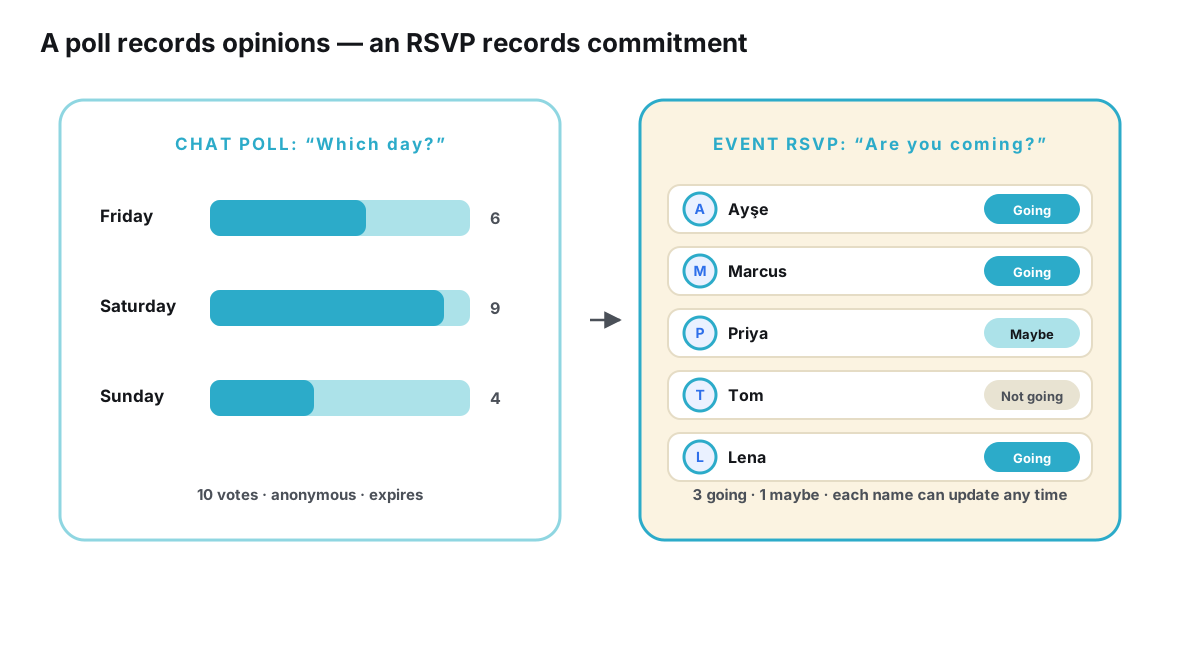
None of this requires the group to stop talking, and it shouldn’t. The conversation keeps its room, its rhythm, its noise — all of it voluntary now, because the plan no longer lives inside the noise. What changes is that the plan’s critical facts stop competing for bandwidth with the room’s social life, and start traveling on their own, narrower, more trusted channel.
The social weight of opting in and out
There is a final difference between the two models, and it is social rather than technical: what it means to subscribe and unsubscribe. Joining a group chat is a social act. Leaving one is louder — the group is notified, feelings are consulted, and for small friend groups the exit of one member can read as a statement about the friendship. Muting, the discreet alternative, is thus not just a settings change but a small deception: still listed as present, no longer actually there. The room-scoped model forces every member’s notification preferences through this socially loaded doorway, which is why so many people endure years of pings from a group they long since stopped reading. The cheapest honest option is unavailable.
Following an event carries almost none of that weight. Joining an event’s updates is a statement about a plan — “I might come to this” — and unfollowing is the same statement reversed, about a thing rather than about people. When the event ends, the subscription ends with it; nothing persists that anyone would have to formally quit. This lightness is a feature, not a triviality: systems with cheap exits get honest signals. People follow what they actually care about, unfollow what they don’t, and the organizer’s audience count means something. Rooms, by contrast, run on polite fictions — hundreds of members, a dozen readers — and polite fictions are exactly what planning data should never be built on.
A calmer default
Putting it together, the pattern that works is simple to state. Keep the group chat as the group’s living room — open, chatty, optionally muteable with a clear conscience. Give each plan its own address — an event page that holds the current facts and knows its followers. Let the plan’s notifications be born from the plan: scoped to it, timed by it, carrying its state, reaching its people. And let opting out mean unfollowing a plan, a decision about a thing, rather than exiting a room, a decision about people.
Ontaym implements exactly this split: events live on their own pages with updates and RSVPs, so the people following an event hear about that event when it changes, while the group chat remains free to be what it was always good at — a conversation, not a klaxon. The polls-and-pings version of the same contrast — why a chat poll generates chatter while an event poll generates commitments — is unpacked in WhatsApp polls vs. event polls, and the underlying structural reason a room can’t behave like a record is the subject of the difference between a conversation and an event object.
Frequently asked questions
Isn’t muting the group enough?
Muting solves the noise and keeps the problem. It is all-or-nothing at the level of the room: silence the chatter and you silence the venue change with it. What most people want — quiet conversation, loud plan — is not expressible in a room-scoped control, because the room can’t tell its plan-facts from its banter.
Don’t @mentions cut through the noise?
They force attention, which is different from earning it. A mention of everyone is the loudest tool a chat has, and it works — once or twice. Used routinely it trains people to flinch at the group’s name and to mute harder. It also still points at speech rather than state: it says “look at the thread,” not “here is what changed.”
Couldn’t event notifications also become annoying?
Yes, if they fire on trivia — every edit, every comment, every arrival. The discipline that keeps them valuable is firing on what changes decisions: time, place, status, deadline. Because the notification is generated from the event record, the system can be selective in a way a room cannot, which is exactly why scoping must be paired with restraint.
How does this work when the group is spread across apps?
Not by making the rooms quieter — by making the rooms irrelevant to the plan. Each event has one address; each person follows the event itself; the plan’s notifications come from the event, not from whichever room the recipient happens to be in. The rooms keep their own notification politics, and the plan simply stops depending on them.
What about the organizer — don’t they need to hear everything?
Organizers need reach, and more of it than anyone — but reach at the moments that matter, not a firehose of debate. Event-scoped systems give them targeted delivery (the change reaches the affected) and role-aware alerts (a decision closed, a deadline hit), which replaces the two organizer habits chat forces: reading everything, and shouting to compensate.
Does this mean the group chat becomes useless?
The opposite — it becomes usable again. Once the plan has its own channel, the chat is free to be judged on its actual merits: is it fun, is it social, do I want to be in it? Plenty of groups get noisier and happier at the same time once the plan leaves, because the people who muted for peace come back for the company.
Conclusion
Notifications are a budget. Every buzz spends a unit of the group’s collective attention, and room-scoped systems spend that budget indiscriminately — on jokes and logistics alike, at whatever rate the chattiest members set. The results are predictable: noise, muting, missed plans, and organizers compensating with the very volume that caused the problem.
Scoping notifications to events changes the budget itself. Fewer pings, each attached to a plan you chose to follow, each carrying the fact that triggered it, each stopping when the event does. The chat keeps its humanity; the plan gets a nervous system. And the quietest members of your group — the ones who muted months ago and never said why — quietly start showing up on time again, holding the correct address, at the correct hour.
Let people follow the plan without living in the group chat.
Plan it with Ontaym