
How Event Reminders Differ From Chat Notifications
Every buzz on your phone looks identical, but a notification that fires because someone typed is a fundamentally different signal from a reminder that fires because a moment you agreed on has arrived. Confusing the two is how plans slip.
Quick answer
A chat notification reports speech: it fires the moment another person sends a message, it points into an ongoing conversation, and its usefulness fades as the thread moves on. An event reminder is scheduled by the event itself: it fires when a moment tied to the plan is approaching, it carries the event’s current facts — what, when, where — inside the notification, and it invites a specific action, such as confirming attendance or opening the final details. A chat notification asks for your attention; a reminder asks for a decision. Groups that rely on chat notifications to double as reminders end up hand-posting “don’t forget!” messages that many members have already muted, which is why reminders attached to the event, rather than to the conversation, are what keep plans from quietly slipping away.
What a chat notification actually announces
Unlock your phone after an hour away and read the notifications literally. Almost every one tells the same story: somebody said something. That is the entire content of the event. The trigger was a person pressing send. The payload is a name and the first few words. The destination is a conversation that has already moved on by the time you arrive. Everything that would make the notification useful — whether the message matters, whether it concerns the plan you care about, whether anything is required of you — is left for you to work out after you open it.
None of this is a design flaw. Messaging apps are conversation machines, and inside a conversation, every utterance is legitimately worth a nudge. The notification’s job is to pull you back into the room so the talk can continue. It treats you as a participant in an exchange, because that is what you are, and the group’s rhythm — jokes, replies, tangents, half-thoughts — is the whole point of the room existing.
The trouble begins when the group’s rhythm and the group’s plan need different things from the same channel. A conversation wants your attention now, while the talking is happening. A plan wants your attention at the right moment, with the right facts in hand, leading to the right action. One buzz is being asked to do both jobs, and the two announcements genuinely have nothing in common: “Tom sent a meme” and “your train leaves in ninety minutes” differ in timing, in content, in consequence. A system that treats them identically will shortchange one of them — and it is almost always the one with consequences attached.
What an event reminder actually announces
A reminder is anchored to a thing, not to a speaker. It fires because a moment tied to an event has arrived: the plan is tomorrow, the decision deadline is tonight, the meeting point changes in an hour. Nobody had to press send at that moment. The reminder exists because the event exists, which means its timing is a property of the plan itself, not a byproduct of somebody’s typing habits or memory.
The second difference is what the reminder carries. Because it is attached to an event record rather than to a message, it can transport that record’s current facts: what the event is, when it starts, where it happens, and — just as important — your own status in it. A well-formed reminder can be understood completely from the lock screen. A chat notification is a door into a building; a reminder is the building’s summary handed to you at the threshold.
The third difference is addressing. A reminder concerns the people connected to one event, not the population of a chat room. A friend who left the group months ago but promised to come, or a plus-one who was never in the thread at all, can still be reached by the event’s clock. Meanwhile the group’s most vocal member, who happens not to be invited to this particular plan, is correctly left alone. The chat notification cannot make either of those distinctions, because its only concept of an audience is “everyone in the room.”
Set side by side, the differences are hard to unsee:
| Dimension | Chat notification | Event reminder |
|---|---|---|
| What fires it | A person pressing send | The event’s schedule reaching a meaningful moment |
| When it arrives | The instant someone speaks, useful or not | Ahead of a moment that was agreed in advance |
| What it carries | A sender’s name and the first words of a message | The event’s current facts: what, when, where, and your status |
| Where it leads | The thread, which keeps moving after you arrive | The event itself: final details, your RSVP, the location |
| What it asks of you | “Read this conversation” | “Decide, confirm, or prepare” |
| Who receives it | Everyone in the group who hasn’t muted it | The people connected to that one event |
| How it ages | Relevance decays as new messages pile on top | Relevance peaks at the exact moment it fires |
The two rows people most often confuse are payload and action. We intuitively accept that a reminder should arrive at the right time — that part feels obvious. What is less obvious is that a real reminder must also be self-contained and actionable: it should not need the thread to explain it, and tapping it should do something more useful than dropping you into a conversation you then have to interpret.
Attention on demand vs. attention on schedule
The deepest difference is whose clock the notification obeys. A chat notification obeys the sender’s clock. It arrives when someone chose to speak, whether or not that moment is useful to anyone else. Late-night bursts, mid-meeting pings, three replies landing in the seconds it takes you to glance down — the sender’s convenience sets the entire schedule, and everyone else’s context is irrelevant to it.
A reminder obeys the event’s clock. Saturday’s hike needs attention on Saturday morning, no matter that the discussion about it happened on Tuesday at half past midnight. The reminder is the mechanism that closes that gap: it takes a fact agreed at one time and delivers it at the moment it becomes operative. In that sense a reminder is not really a message at all. It is scheduled attention — a way of converting “we discussed this once” into “this is now.”
This is precisely why a chat thread is structurally unable to remind anyone of anything. A thread has no clock of its own; it only has members who happen to be awake and members who happen to remember. The only way a thread can produce timed attention is if a human volunteers to be the timer — setting a private alarm, recalling the obligation at the right hour, typing the fateful sentence. That system works right up until the one evening it doesn’t, which is also, by a cruel statistical property of evenings, the one that mattered.
The mismatch shows up most clearly with decisions that expire. “Let me know by Thursday if you’re coming, the restaurant needs numbers” is a sentence containing a deadline, spoken into a medium that has no concept of one. Thursday arrives silently. The thread does not change appearance. Nobody’s phone buzzes at the boundary. The deadline that existed only as words expires without a sound, and the organizer discovers the emptiness only when they start counting heads. A reminder attached to the event can fire at that boundary on its own — not because someone remembered, but because the plan itself knows when it stops being decidable.
A pointer to a message vs. a summary of the plan
Read a chat notification closely and you will notice it contains almost no information of its own. “Tom: so is it 9 now or…” is a pointer plus a fragment. The meaning — which plan, which field, changed from what, settled or still open — lives in the thread behind it, and the thread has to be opened, scrolled, and mentally reconstructed before the fragment means anything. The notification’s job ends at the door, and everything of substance happens inside.
An event reminder can afford to be self-describing precisely because it hangs off structured state rather than off a sentence someone typed. “Boardgame night, Saturday 19:30, at Priya’s — you’re marked Going” needs nothing behind it. There is nothing to reconstruct, nothing to infer, and no possibility of decoding the wrong fragment. The facts arrive pre-assembled because somewhere they exist as facts, in fields, rather than as prose in motion.
There is a subtler consequence worth naming. Notifications that are mere pointers train people to stop reading them, because experience teaches that their content is unreliable — the fragment could be anything, so the only usable signal is the sender’s name. Notifications that are summaries train the opposite habit: reading the banner itself becomes the efficient move. Over months, the first pattern teaches a group to ignore its own alarms, and the second builds a quiet reliance on them. If you want the structural root of this difference — a stream of utterances versus a record with fields — it is laid out in the difference between a conversation and an event object.
What the notification asks you to do
The final difference is the action attached. A chat notification offers exactly one action: enter the conversation. Once inside, whatever needed doing — confirming, checking the address, switching your answer, finding the map — is left as an exercise in typing. The notification is an entrance, not an instrument. It summons you to a place where the work still has to be done by hand, in sentences, in public, in order.
A reminder attached to an event record can carry the decision itself: confirm your seat, change your answer to maybe, open the location, see exactly what changed since you last looked. The tap lands on the plan rather than on the chatter. And because the action lands in a record rather than in the stream, its result persists: your tap updates the state that everyone else — and every future reminder — reads from. A tap on a chat notification produces a reply; a tap on a reminder produces a fact.
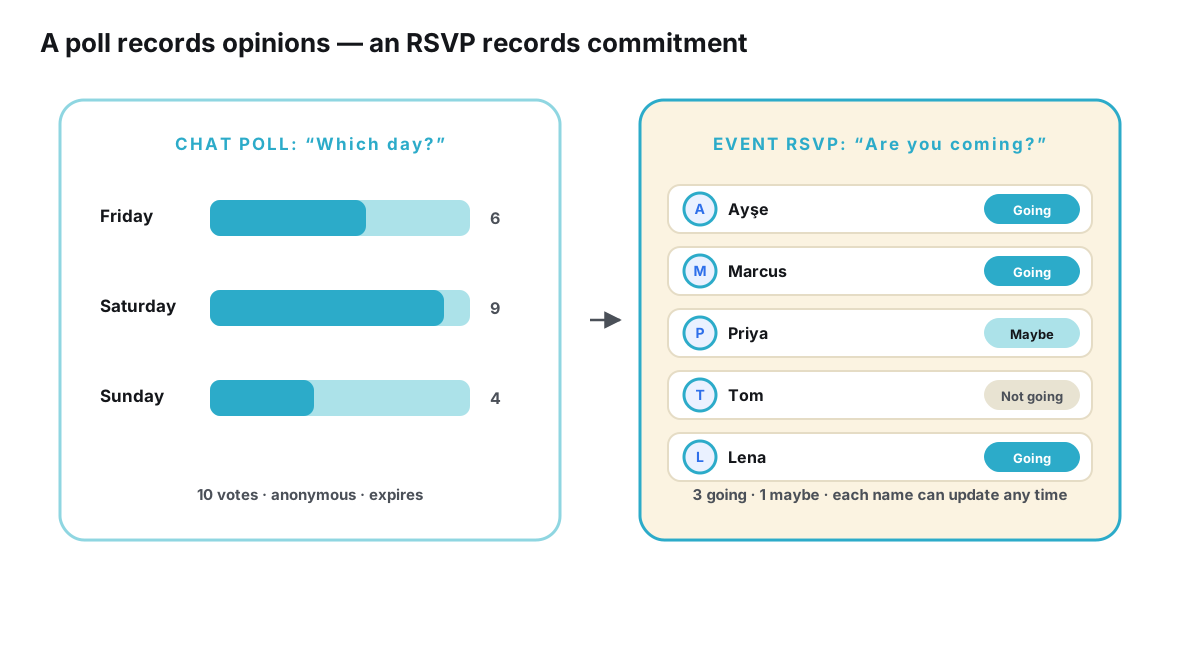
This is where reminders and RSVPs interlock. A reminder without a record behind it can only nag; a reminder with a record converts attention into state at the moment the attention arrives. The distinction between a genuine response and the ambient gestures a chat produces — thumbs-ups, “ok!!”, heart reactions — is covered in detail in event RSVP vs. group chat reaction, and it matters here for one reason: a reminder that asks for a reaction collects noise, while a reminder that asks for an RSVP collects a headcount.

The funnel above is a useful way to see the timing problem whole. On the day an invitation goes out, most guests need a prompt to decide. A week out, the committed need a prompt to prepare. The night before, everyone needs the final details. On the morning itself, people need the meeting point. These are four different messages with four different audiences at four different times — and a group chat delivers them as one undifferentiated stream, at whatever moments happen to coincide with someone typing. A reminder system scoped to the event can, in principle, deliver each prompt at its own moment, because the event record knows what stage it is in.
The reminder economy inside group chats
Watch any group chat in the week before an event and you will see reminders being manufactured by hand. “Bumping this!” “Don’t forget it’s tomorrow!” “Can everyone confirm by tonight please.” Each of these is a person performing, manually and unreliably, the job a scheduler would do for free — and each one is simultaneously a new message with full noise privileges in the thread, interrupting everyone for a benefit that accrues mostly to people who were already going to come.
Hand-made reminders fail in a characteristic way. They cost the whole group’s attention every time, so the organizer hesitates to send them often, so they arrive too late to change anyone’s behavior. They decay with scroll, so the people who most needed them — the ones who don’t check the app often — are the least likely to ever see them. And they must be repeated for everyone who missed the previous one, and each repetition makes the next reminder slightly less effective, because people adapt to a channel that keeps crying wolf. The organizer ends up running a manual notification service out of a conversation, with worse tools and worse temper.
| Tactic | What it tries to do | What it actually delivers |
|---|---|---|
| “Bumping this” | Push the plan back to attention | A new message; the old facts still sit above it, now twice |
| Reposting the full details | Guarantee the facts are seen | A second copy of the plan that can drift out of sync with the first |
| Marking everyone in a mention | Force attention on the fence-sitters | A jolt that works once, and trains quiet resentment of the group |
| Pinning the plan and saying “see pin” | Give the plan a fixed home | A snapshot that goes stale the moment any detail changes |
| “Confirm again please” | Re-collect answers close to the date | A wall of replies that buries the very answer being collected |
| Private one-to-one chases | Reach the silent without spamming all | Accuracy at the price of the organizer’s evening, one guest at a time |
Notice that every tactic in the table has the same underlying shape: it converts one person’s memory into messages, and pays for the conversion with the group’s collective attention. None of them create a message that fires itself at the right hour, carries the current facts, or lands on only the people who still owe an action. An organizer with an event page instead has a simpler move — update the record once, and let the reminder system do the speaking. For the related pattern of answering “what’s the plan?” with a single address instead of another message, see how event links solve problems that group messages can’t.
When muting backfires
Because a group chat carries both the party and the plan in one channel, everyone eventually faces the same bargain: endure the noise to keep the plan, or mute the noise and risk the plan. Most people, given a loud group, choose the mute. It is the rational choice at the level of an afternoon — and it quietly saws off the branch the group was sitting on, because the muted group is now precisely the audience that no hand-posted reminder, however urgent, can reach. The chat has become a room full of people who are not listening, and the organizer has no way to know which ones.
The platform controls are not to blame; they are simply built for a different problem. Muting in chat apps is scoped to the conversation, not to the content. WhatsApp’s notification and mute settings, described in the WhatsApp Help Center, silence a thread for a span of time; Telegram’s equivalent, documented in the Telegram FAQ, mutes a chat wholesale. The setting expresses “stop telling me about this room,” which is a perfectly good wish for a chatty room, and a disastrous one when the room is also your only channel for “the time changed tonight.” There is no dial for “silence the banter, keep the changes.” The room is the smallest unit the system knows.
Cross-platform wrinkles make it messier rather than better. Apple’s iMessage groups are tied to Apple devices, and leaving or muting behaves differently from cross-platform apps, as Apple’s own support materials make clear — which means the same “group” can contain people whose notification settings follow different rules entirely. The lesson in every variant is the same: when reminders are messages, their fate is decided by each recipient’s relationship with the room, not by the importance of the moment they announce.
A reminder scoped to the event escapes this trap by construction, because it was never a message in the room at all. It does not inherit the room’s mute status, doesn’t compete with the room’s noise for attention, and doesn’t require the recipient to make an all-or-nothing bet on a chat they may love but not want to live inside.
What good reminder design looks like
Pulling the threads together, a reminder that actually works has three properties, and each one comes directly from the differences above. It is anchored to the event record, so its payload is the current facts rather than a fragment of speech. It is timed by the plan’s own moments — decision deadlines, final confirmation, the day itself — rather than by anyone’s typing schedule. And it carries the action, so a tap completes the loop instead of opening a conversation the recipient then has to perform in.
Ontaym is built around exactly this separation: each event has its own page holding the structured plan — options, RSVPs, final details — and reminders attach to that page, so when a moment arrives or a detail changes, the people connected to the event hear about it with the facts and a decision in hand, while the group chat stays what it should be: a place for talk.
None of this requires abandoning chat, and it shouldn’t. The group chat remains the right medium for everything social — the persuasion, the jokes, the “should we invite Maya’s cousins” debates that no system can host better than humans can. The change is narrower and easier: stop asking speech to keep time. When the plan needs timed attention, give it a channel whose job is timed attention, and let every notification in the chat go back to meaning exactly one thing — somebody said something.
Frequently asked questions
Can’t a scheduled message do the same job as a reminder?
Only superficially. A scheduled message still arrives as a message: it was composed at one moment, so its facts are frozen at that moment; it is addressed to a room, so it inherits the room’s mute settings and noise level; and it decays with scroll like any other message. If the plan changes after the message was composed, the scheduled message faithfully delivers the outdated version on time.
If someone posts “reminder: tomorrow 8pm” in the chat, isn’t that a reminder?
It is a reminder-shaped message, and for a small, attentive group it often works. But structurally it is still speech: it costs everyone’s attention, it reaches only people who open the app, it cannot show each recipient their own status, and it must be repeated manually for every moment the plan passes through. It relies on a person remembering, which is the exact faculty reminders exist to replace.
Why do calendar invites feel different from chat pings?
Because a calendar invite is an event object, not a message. It carries structured fields — a start time, a location, an accept/decline action — and the notification it generates summarizes that structure rather than quoting a sentence. That is also why it feels bureaucratic: it carries state but no conversation. The ideal setup gives the event both — structure for the plan, chat for the people.
How many reminders does an event actually need?
There is no fixed number, because the right reminders track the event’s decision points rather than a schedule: one when the plan firms up, one at any decision deadline, one when final details land, one near the start. A handful of well-timed reminders beats a drumbeat of arbitrary ones — every unnecessary reminder spends the same attention budget the necessary ones depend on.
Do event reminders make chat notifications obsolete?
No, and they shouldn’t try. The two serve different masters: chat notifications exist to sustain a conversation, event reminders exist to sustain a commitment. Groups work best when each is free to do its own job — conversation in the chat, timing and state on the event — instead of one channel awkwardly imitating the other.
Conclusion
The buzz on your phone is a user interface over two very different facts: someone spoke and something is due. Treating them as one thing is convenient right up until the plan grows a deadline, a headcount, or a change of time — at which point the conversation’s habits of attention (instant, noisy, unmuted or muted as a whole) start dropping exactly the signals the plan depends on.
The practical moves follow directly from the three differences. Give timed announcements their timing by attaching them to the event rather than to someone’s memory. Give them their context by letting them carry the plan’s current facts instead of pointing into a thread. And give them their action by deep-linking to a decision — a confirmation, a status change, a map — rather than to a conversation. A chat notification is somebody else’s present. A reminder is your plan’s future, arriving on time.
Let the plan keep its own time, and let the chat get back to talking.
Plan it with Ontaym