
Why Event Invitations Need More Information Than a Message
A message can announce a plan. An invitation has to carry one — what, when, where, who, and the moment by which people must decide. Chat bubbles hold words; real invitations hold fields, and the difference shows up in every headcount that ever came up short.
Quick answer
An event invitation is a structured object: it states what is happening, when, where, who is invited, what each guest must decide, and by when that decision is due. A chat message is a stream of sentences with none of those guarantees — the details live in prose, the deadline is implied, and there is no reliable way to see who has answered and who hasn’t. When groups invite through chat, the missing fields don’t disappear; they reappear later as follow-up questions, repeated confirmations, and headcount guesswork. The remedy is to send an invitation that carries its own fields — usually a link to an event page — so the message becomes the envelope and the event itself arrives intact.
The fifty-two-word invitation
You have received it. You have probably sent it. One gray bubble, typed in a hurry, trying to do a form’s job: “Hey so we’re doing dinner for Sam’s birthday on the 14th, probably 8ish, at that Italian place near the station unless someone objects, let me know if you’re in — also don’t bring anything, just yourselves, and if you’re bringing a plus-one tell me early so I can book!” It is warm, it is human, and it is structurally a form that has been crushed into prose. Every fact the group needs is present. Nothing the group needs is addressable.
The message fails not as communication but as an artifact. It is read carefully once, at the moment of arrival, and then it becomes one bubble among hundreds. Six separate facts inside it have to survive a week of scrolling, a venue change, two side conversations and a hundred messages about something else entirely. The thread moves on within minutes. The invitation, as a container, has no way to stay current, no way to collect answers, and no way to close itself. It can only be read again — or, more often, re-asked.
What follows is the anatomy of that failure, and of the fix. The short version: a message is a moment of speech, while an invitation is an instrument — a small machine with parts, each of which does a job the others can’t.
A moment of speech vs. an instrument
A chat message is built to carry a moment. It is composed now, read soon, and superseded by the next bubble. Its permanence is positional — it stays in the thread — but its relevance is perishable: nobody scrolls back to savor last Tuesday’s logistics. This is exactly right for conversation, where the value of any utterance is mostly in its immediacy. A message doesn’t need fields because it doesn’t need to survive being read.
An invitation has the opposite requirements. It must remain intact and findable for the entire life of the plan. It must stay correct while details change underneath it. It must present identical, current facts to the person who opened it in the first minute and the person who opens it an hour before the event. It must address a specific set of people, record their answers, distinguish the answered from the silent, and eventually close the question it asked. Those are not literary properties; they are the properties of a record. An invitation you cannot fill in like a form is an announcement, not an invitation.
This is why “just send it in the group” works beautifully for the announcement and terribly for everything after. The message delivers the news. The instrument has to deliver the plan — and the plan has parts.
It helps to picture the two artifacts aging side by side. An hour after sending, both look healthy: the message has been read, the invitation has been opened. Three days later they have diverged. The message is a hundred bubbles deep, its facts half-superseded by replies it can’t see; the invitation has absorbed two changes and currently holds one time, one place, and a growing list of answers. On the evening itself, the difference becomes material: the message can only be found by scrolling, while the invitation is whatever it now says. One artifact recorded a moment of enthusiasm. The other carried a plan to the table.
The five things an invitation must carry
Strip away etiquette, and every functional invitation carries five loads. Each one maps to a field, and each field is something a sentence can only assert, never hold.
What. The plan’s identity: dinner for Sam’s birthday, the quarterly team offsite, Thursday five-a-side. This sounds trivial until two similar plans exist in one group — the birthday dinner and the birthday drinks, say — and replies start arriving without any indication of which one they answer. An invitation needs a name precisely so that every later message, answer, and change can be attached to the right thing.
When. Not just a start time, but a start time marked as settled or provisional, plus whatever boundary conditions matter: how long it runs, when doors close, when the group leaves. Chat handles “when” as a topic of discussion, which means the thread typically contains several times, of which only the last is true. An invitation holds one time with a status — proposed, confirmed — and updates in place when the status changes.
Where. An address, not a name-drop. “That Italian place near the station” works only if every reader shares the same memory of the same neighborhood; a plus-one from across town has no chance. Where also wants structure because it is the field guests interact with — the one they navigate from, arrive at, and complain about. A place you can’t tap is a place someone will have to ask about.
Who. Two different facts travel under “who”: the list of people being asked, and the running tally of answers. Guests need the first — people decide differently depending on who else is coming — and organizers desperately need the second. A chat message has no concept of either. Its audience is “whoever is in the room,” and its answers, if any, are scattered across replies and reactions that answer nothing in particular.
Decide-by. The field chats forgot. Real plans have decision deadlines because the physical world imposes them: restaurants want numbers, venues hold tables for a limited time, tickets sell out, lifts need booking. An invitation without a decide-by date defers every answer to the indefinite future, where it quietly becomes a no. A real invitation carries the deadline as a first-class fact — visible, remembered by the system, and able to arrive on time as a reminder rather than as a hope.
| Field | What it must do | How a chat message holds it |
|---|---|---|
| What | Name the plan so everything else can attach to it | A phrase inside a sentence, sharing a bubble with four other facts |
| When | One start time with a settled-or-provisional status | A proposal among several, of which only the last is meant |
| Where | An address guests can act on — open, navigate, share | A nickname for a place, intelligible only to those already in the know |
| Who | The invited list and the live tally of their answers | Room membership on one side, scattered replies and reactions on the other |
| Decide-by | A deadline that is visible, enforced, and remembered | A clause (“let me know by Thursday”) that expires in silence |
| Changes | Update in place so every reader sees the current facts | A new message that supersedes the old one only for whoever reads it |
Read down the right-hand column and a pattern emerges: the message doesn’t lose these fields through carelessness. It loses them because sentences assert and records hold, and a bubble is made of sentences.
Decide-by: the field that changes everything
Of the five fields, the decision deadline deserves a closer look, because its absence is what turns friendly invitations into slow-motion chaos. When “let me know if you’re in” carries no deadline, each recipient performs the same private calculation: I’ll decide later. Later is frictionless. Later costs nothing today. And since nothing in the thread ever marks the moment when “later” has run out, later stretches until the organizer, embarrassed, starts chasing people one by one.
A decide-by date reframes the whole exchange. It converts an open-ended invitation into a question with a closing date, which is precisely what the physical event already is: the restaurant wants a number on Thursday, so the question closes on Thursday whether or not anyone has answered. A structured invitation simply makes that boundary visible to everyone. Guests can see how long the door is open. The polite can decide promptly. The hesitant can see the deadline approaching instead of being ambushed by it. And the organizer stops being a debt collector and becomes the holder of a tally that closes itself.
The deadline also changes the quality of the answers. Answers gathered before a visible deadline are decisions; answers gathered after a chase are apologies. Groups that move their invitations onto an event page with a real cutoff notice something odd at first, then wonderful: people answer early, because the instrument makes answering the easiest move available. For the companion piece on what a real answer is — as opposed to the gestures chat produces — see event RSVP vs. group chat reaction.

The addressee problem
Beneath the five fields sits a structural question a message cannot even express: who, specifically, owes an answer? A group message is addressed to a room. An invitation is addressed to a list of people, each of whom carries an individual obligation that exists whether or not they ever speak. These are different things, and confusing them produces the signature silence problem of chat-based planning: when Maya doesn’t reply for three days, the thread cannot distinguish didn’t see it, saw it and is deciding, saw it and can’t come but feels awkward saying so in the group, and saw it and forgot. All four look identical from the outside. The organizer, lacking the distinction, either chases all four kinds of silence or ignores all four kinds and underbooks.
An invitation object makes the outstanding list a first-class fact. It knows who has been asked, who has answered, and who is still pending — not by reading tea leaves in a thread, but because each answer is recorded against the person who gave it. The chase, when one is needed, becomes precise: a nudge to the pending few, rather than a broadcast that re-interrupts the committed and annoys the declined. This is also the honest resolution of the social awkwardness: saying “can’t make it” to a form is easier than saying it to a room full of enthusiasts.
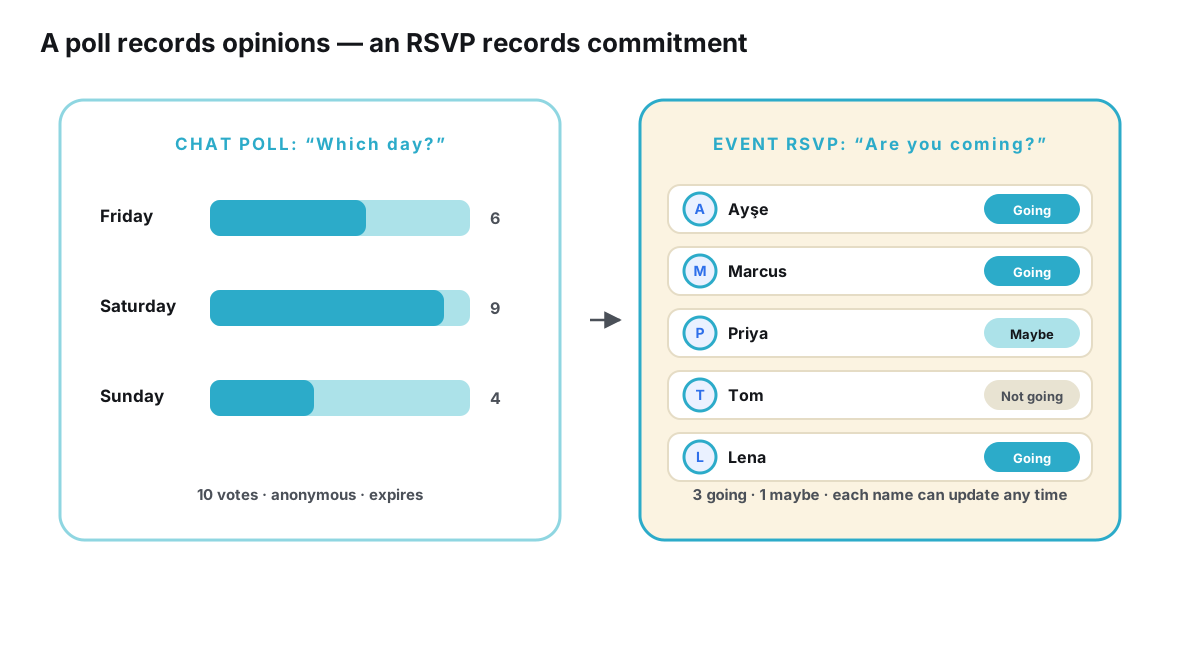
The figure above is the two philosophies side by side. A poll in a group chat is a genuine improvement over prose — it asks a crisp question and aggregates replies — but it is still an instrument with one field. It records a preference at a moment, usually anonymously, with no deadline, no per-person obligation, and no way to follow the answer as it changes. An RSVP list on an event page records a commitment per person, with a status that can move from maybe to going and back, and a deadline that closes the question. For groups deciding between two dates this difference is the whole ballgame, and the sharper version of that comparison is covered in WhatsApp polls vs. event polls.
One more consequence of addressing deserves a sentence: the “who’s coming” field is social information, not just arithmetic. People commit to gatherings partly on the strength of who else committed. An invitation that can show its own current guest list lets each “yes” make the next “yes” easier — the network effect that enthusiastic threads simulate with a wall of replies, and that a live list provides quietly, on demand, without a single message.
Plus-ones and the fuzzy edge of “who”
The “who” field has a permanently fuzzy border that prose handles worst of all. Does “you’re in?” include Maya’s partner? The message says nothing, so Maya interprets generously, Tom interprets strictly, and the organizer discovers the disagreement at the door. Does the invitation to the team lunch extend to the contractor who started last week? In a chat, the answer is ambient — whoever feels included is included, and whoever is unsure stays home rather than ask. A structured invitation can simply carry the policy: “plus-ones welcome” as a visible fact, or a headcount that lets guests flag a plus-one as part of their answer. Ambiguity at the edge of the guest list is natural; leaving it to be resolved by each reader’s guess is a choice, and it is the wrong one for anything with a reservation attached.
What happens when the fields go missing
Fields never simply vanish. Each missing field converts into work, and the work is distributed in the worst possible way: to everyone, individually, forever. A missing “where” becomes the question five people ask privately on the day. A missing decide-by becomes the organizer’s chase. An untracked guest list becomes the headcount that is wrong twice — once in each direction. The thread fills with the same five questions on a loop, each answered separately, each answer itself a message that future readers will have to find and interpret.
The formats groups actually use deserve an honest audit, because each one carries some fields and drops others:
| Format | What it carries well | What it loses |
|---|---|---|
| The wall-of-text message | Warmth, context, tone — everything persuasion needs | Addressability; any field that changes; who owes an answer; the deadline |
| The forwarded screenshot | The original facts, preserved verbatim | Currency — it is a copy frozen at send time, correct until the first change |
| The pinned details block | A fixed, visible home for the facts as of pinning | Staleness management; every change requires a human to remember to re-pin |
| The group poll | One crisp question, aggregated replies | Commitment, deadlines, named obligations, any field beyond the one question |
| The calendar invite | Structured when and where, accept/decline per person | The conversation, options under debate, and graceful mid-plan changes |
Notice that the calendar invite — the most structured item in the table — is treated fairly and still falls short, because it arrives after the decisions are made. A calendar invite is a conclusion; an invitation, in the phase that hurts, is a question. What groups actually need in the forming phase is the calendar’s structure married to the chat’s liveliness: fields that can start provisional, survive debate, and harden in place without being re-sent. That object is neither a message nor a meeting; it is an event page.
The world already models invitations as objects
You don’t have to take this on theory. Wherever machines need to understand events, the people who build the web have converged on the same shape. schema.org’s Event type describes an event not as prose but as properties: a name, a start and end, a location, attendees. Its companion, the RsvpAction type, models the response itself — who answered, and whether the answer was yes, no, or maybe. When a search engine or calendar reads an event, it does not read a transcript; it reads fields. The shared vocabulary of the open web quietly asserts the thesis of this article: an invitation is a data shape, not a prose exercise.
The messaging world, for its part, remains honest about being a messaging world. WhatsApp’s group features, documented in the WhatsApp Help Center, are built around messages, members and announcements — superb for reaching a room, with no representation of an outstanding answer or a closing date. That is not a criticism; it is a boundary. Rooms and their conveniences are for talking in. The invitation’s five fields need somewhere to live, and the room is not shaped like them.
An invitation that fits in one line
The practical resolution is almost embarrassingly simple: let the message be the envelope, and let the link be the invitation. A single line of genuine warmth — “Sam’s birthday dinner, you’re invited, here’s everything” — followed by a link that opens the event itself: all five fields present, live, and individually addressable. The link carries the what, when, where, who and decide-by because the thing behind the link is an event page, not a sentence. When the time changes, the page changes, and yesterday’s envelope still opens today’s facts. When a guest answers, the answer lands on the list, against their name, with the deadline visible. The message ages; the invitation doesn’t.
This envelope-and-instrument split is exactly how Ontaym approaches the problem: create the event once, fill in the fields — even provisionally — and share the invite link wherever the people already are. The chat keeps its role as the place where the invitation is delivered; the page takes over the job of being the invitation. For the broader argument about why that page deserves to exist apart from any conversation at all, see why an event needs its own digital space, and for how a single shared address behaves once it’s circulating, how event links solve problems that group messages can’t.
What the five fields add up to
There is a quiet payoff to carrying fields that is easy to miss while arguing about them one at a time: the fields compose. A named plan plus per-person answers yields a guest list. Answers plus a deadline yield an outstanding list that shrinks on schedule. A place plus a status yields directions that are correct without being re-sent. Each field is modest on its own; together they produce the views that organizers actually work from — the headcount, the maybes, the silence that still owes an answer. No one designs a dinner around a database, but every dinner with twelve guests and one reservation is, for a week, managed exactly like one.
A chat produces none of these views, no matter how carefully it is written, because views are built from fields and the chat holds only sentences. The organizer’s compensation is heroic reading: reconstructing the tally from a week of replies, reactions, non-replies and one private message from Priya that says her cousin might come after all. That reconstruction is a real cost, paid in the organizer’s time and paid again in its errors. The invitation that carries its own fields simply hands over the tally — going, maybe, not going, pending — as a fact rather than an estimate. When the restaurant calls on Thursday, the organizer answers in five seconds with a number they trust, and the entire debate about what the thread meant never has to happen.
Frequently asked questions
What’s the bare minimum an invitation must include?
Functionally: what the event is, when it starts, where it happens, who is being asked, and by when they should answer. Anything less is an announcement. Anything delivered as prose rather than fields will hold those facts only until the first change or the first question, whichever comes first.
Isn’t a group poll basically an invitation?
It’s one field of one. A poll captures a preference — usually a date — at a moment in time, and it does that well. An invitation must also carry place, people, obligations and a closing date, and must keep all of them current. Groups that poll when they need commitments discover the gap on the night, when the tally and the turnout disagree.
Why do people still send invitations as chat messages, then?
Because it’s instant, familiar, and genuinely good enough for small plans: a fixed group, a settled plan, no changes. The costs are proportional to time, ambiguity and headcount — they barely register for coffee with three friends and dominate anything involving a booking, a deadline, or a plus-one.
How do I set a decide-by date without sounding rude?
Tie the deadline to a real constraint and say so: “the restaurant needs our number Thursday, so answers by Wednesday night.” Deadlines feel rude when they seem arbitrary and respectful when they visibly protect something. A visible deadline on an event page does this work automatically, because the reason is sitting right next to the date.
Doesn’t attaching a calendar invite solve this?
Partly. A calendar invite is a real object with real fields for when and where, and per-person accept/decline. But it presumes the plan is already settled; it can’t host options, debate, or a soft maybe. It works as a conclusion to planning, not as the invitation that does the planning.
Conclusion
A message tells people that something is being planned. An invitation is the plan, in a form that can survive contact with a week: named, timestamped, addressed, deadline-carrying, and updatable without a re-send. The five fields — what, when, where, who, decide-by — are not bureaucratic decoration. Each one is a future question you are answering in advance, and each missing one is a future question someone will have to answer by hand, probably at the worst moment.
The next time an invitation wants to leave your hands as a paragraph, pause and count the fields hiding inside it. Then deliver the warmth as the message and the facts as the instrument: a short, human note and a link to a living event page. The note gets read; the page gets used; the headcount comes in on time. Nobody has to scroll for either.
Send the warmth in a message. Send the plan as an invitation with fields.
Create it with Ontaym