
How to Plan a Group Activity Without 200 WhatsApp Messages
Two hundred messages sounds like an exaggeration until you count: the option ping-pong, the RSVP roundup, the fourth repost of the address. Almost none of it is conversation. Here is the workflow that gets a group activity fully planned in a fraction of the traffic.
Quick answer
A group activity generates hundreds of messages only when the chat is doing three jobs it is bad at: comparing options, collecting attendance, and re-delivering information that sank. Replace those jobs and the traffic collapses. Frame the activity privately with one or two people, create a record for it — a page with its own link holding the what, when, where, cost, and open options — and send one invitation message with that link. Let people vote on the open options and set their own going or maybe status in silence, on their own schedule. Set a decision deadline, finalize the fields, and publish the complete plan exactly once. From then on, changes are edits behind the link, questions are answered with the link, and the reminder comes from the record. The chat keeps all the jokes and none of the logistics.
Where two hundred messages actually come from
Message inflation feels like the group’s personality — oh, we’re just chatty — but it is mostly mechanical. Strip a typical activity thread down and the genuine conversation is a modest core: some jokes, some anticipation, a story or two. Wrapped around that core is a thick layer of logistics traffic: messages that exist not because anyone wanted to talk, but because the plan had no other place to live. The volume is a workflow artifact, and artifacts can be engineered away.
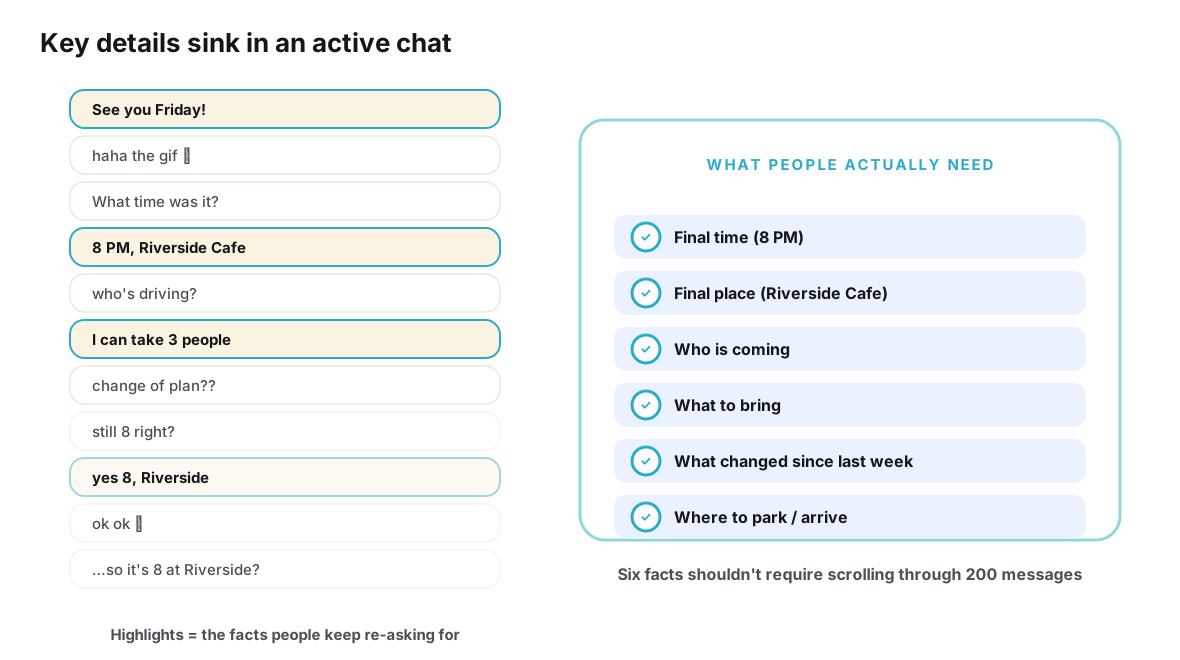
The logistics layer has a repeating structure. Someone proposes options; the group negotiates; attendance gets collected by tally; information sinks and gets re-requested; details change and get re-broadcast. Each pattern multiplies messages, and the patterns stack — an activity with two undecided options and one venue change will cycle through all of them before it’s done.
Consider a completely ordinary example. Tom proposes a Saturday hike: one message. Four people reply with conditions and counter-proposals: four messages, and now two dates are live. Someone asks what to bring; Tom answers; the answer sinks by evening and gets re-asked on Thursday: four more. A time gets changed once, which triggers a re-broadcast and two confirmations: three. The RSVP roundup runs twice, a week apart, because the first tally rotted: eight. None of these exchanges involved anyone being chatty — every single message was infrastructure. Yet the thread now holds two dozen logistics messages for a ten-person hike, before a single joke, and Tom has become the group’s unpaid dispatcher.
| Multiplier | Why it multiplies | Low-message replacement |
|---|---|---|
| Option negotiation | Every proposal invites counter-proposals from everyone, in prose, at once | Options listed on a record where votes accumulate visibly |
| Attendance roundup | “Who’s in?” must be asked repeatedly as answers drift and sink | A per-person going / maybe list guests update themselves |
| Information re-requests | Facts sink under chatter, so each late reader re-asks them | One link that always shows the current facts |
| Update re-broadcasts | Every change must be re-sent until it has reached everyone | One edit behind the link; a one-line nudge at most |
| Day-of coordination | “Where are you?”, “we’re inside!”, “parking?” — multiplied by every participant | The record holds meeting point and time; messages carry only the human parts |
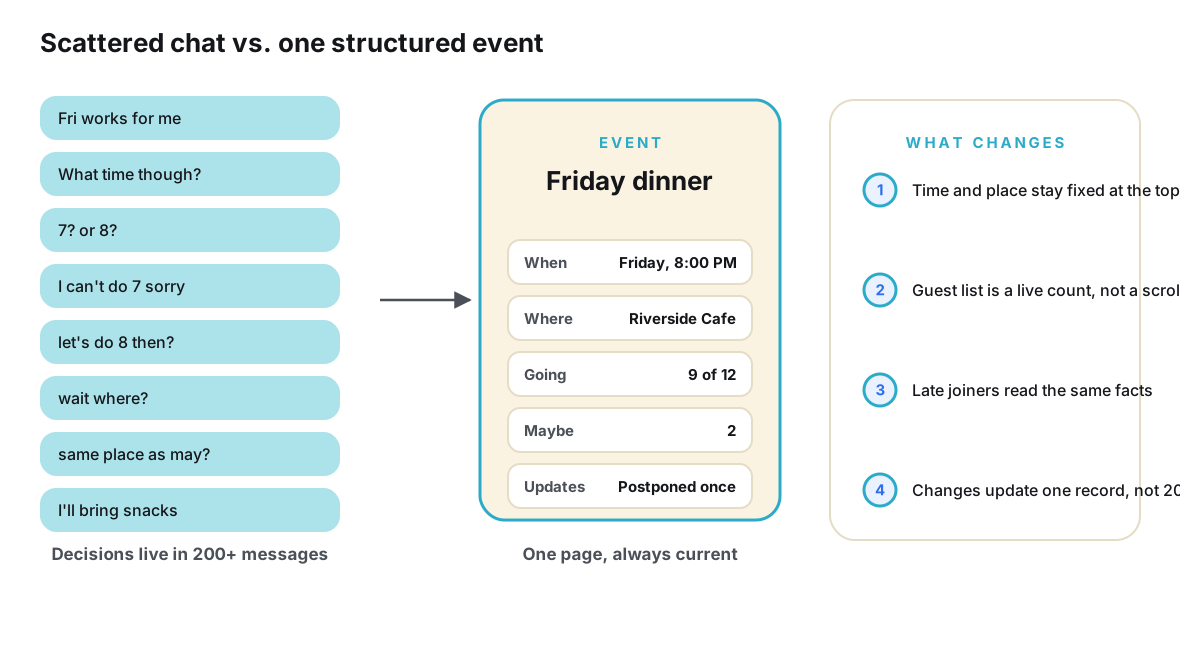
Look at the right-hand column and a pattern appears: every replacement is the same object — a record with an address — doing a different job. That is the entire secret of low-message planning. You are not asking people to talk less; you are giving the logistics somewhere else to live. The reason threads bloat in the first place, with all five multipliers feeding each other, is laid out in why WhatsApp groups become messy when planning events; the rest of this article is the way out.
The principle: decide once, publish once, answer with a link
The workflow rests on three rules, and each one deletes an entire category of messages.
Decide once. Most threads decide the same question several times — Friday is settled on Tuesday, re-litigated on Wednesday, re-confirmed on Thursday — because no decision was ever visible as final. Deciding once means the decision lands in a field that says “final” by its very nature, with a deadline attached while it is still open. A vote that closes at a stated time does not need a consensus conversation around it; the tally simply becomes the field’s value.
Publish once. The complete plan — time, place, cost, meeting point, what to bring — is published exactly once, at one address. It is never re-typed, because re-typing is where versions fork and where re-broadcast obligations are born. If the address always shows the current plan, there is nothing to re-publish, ever.
Answer with a link. Every question that arrives in the chat gets the link as its answer. This feels terse the first two times and liberating from the third: the asker gets the complete, current answer instead of a summary typed from memory, and the group is spared another round of broadcast. The link is not a brush-off; it is a complete answer that is always correct.
The low-message workflow, step by step
- Frame the activity privately with one or two people. Before anything reaches the group, settle the skeleton with a co-conspirator in direct messages: what the activity is, the two or three viable options, a rough budget, and the decision deadline. A frame that arrives mostly formed needs one conversation to ratify; a frame that arrives as an open question needs a week of negotiation.
- Create the record before the first message. Set up the activity’s page — its what, when, where, cost, and meeting point — leaving the undecided fields open as votable options rather than blank. The record must exist before the invitation, because the invitation’s whole job is to carry its link. Creating it takes minutes; it is the difference between announcing an event and starting a discussion.
- Send one invitation message with the link. One warm message to the group: what the activity is, what is already decided, what still needs a vote, the deadline, and the link. Pin it if you can. Everything the group needs for the next phase is now in a single message that will still be accurate in a week, because the facts live behind it rather than inside it.
- Let options and RSVPs accumulate in silence. From here, the correct amount of group messaging is approximately zero. Votes land on the options; going and maybe statuses get set on the guest list; both accumulate on their own schedule, including from people who would never have typed a reply. Silence here is not neglect — it is the system working.
- Set a decision deadline and finalize on schedule. When the deadline passes, close the options: the winning time and place become the record’s final fields, and the vote disappears in favor of facts. Announce finalization in one line with the link — “Locked in! Saturday, 19:00, details here.” The deadline is what makes deciding once possible; without it, options stay open and drift forever.
- Publish the final plan exactly once. The finalized record is the publication. Resist the traditional “FINAL DETAILS (for real this time)” message — the record is the final details, and it cannot be wrong about itself. If something changes after finalization, edit the field and, for big changes only, post a one-line pointer: “venue changed — link updated.”
- Let reminders and day-of updates come from the record. The day-before reminder points at the record; the morning-of message points at the record; the “we’re at the corner table” update is a one-liner with the record behind it. Every message the group receives in the final week is a pointer, which means every message is short, accurate, and never needs repeating.
Count the messages this workflow actually requires of the group: the invitation, the finalization line, perhaps one update pointer, the reminder, a day-of line or two. A handful of broadcasts, each of them short, all of them accurate at the moment they are read — because none of them carries facts that can go stale. Everything else happens where messages are not needed.
| Phase | What the chat sees | What the record handles | Message load |
|---|---|---|---|
| Framing | Nothing — direct messages between organizers | Nothing yet | None in the group |
| Invitation | One warm message with the link, pinned | The plan so far, open options, guest list | One message |
| Deliberation | Jokes, anticipation, the social texture | Votes accumulating, statuses updating | Whatever the group wants |
| Finalization | One line: locked in, link | Options close; final fields fill in | One message |
| Changes (if any) | At most a one-line pointer per change | The edit that makes the pointer true | Zero to a few |
| Final week | A reminder pointing at the link | Current details, headcount for the organizer | One message |
| The day | Human traffic: photos, “here!”, banter | Meeting point, time, the plan behind every link | The fun kind only |
A week in the low-message life
The workflow is easiest to believe as a timeline, so here is a full cycle for that ten-person hike. Friday evening, Tom and Priya frame it in direct messages: two candidate Saturdays, a rough budget, a decision deadline of Tuesday night. Nothing reaches the group yet.
Saturday morning, Tom creates the record — the hike, the meeting point, the cost, the two date options open for voting — and posts the single invitation message with the link, pinned. One message. Saturday through Tuesday, the group chats about everything and nothing; a few people vote, a handful set going or maybe, and the thread carries jokes while the record quietly carries the tally. Zero logistics messages, because nothing needs asking.
Tuesday night the deadline passes: Saturday wins, the fields finalize, and Tom posts the line — “Locked: Saturday, 9:00, details here.” Thursday brings the one surprise, a closed car park, handled with an edit to the meeting point and a one-line pointer. Friday, the reminder goes out from the record. Saturday morning, one last line: “we’re at the north gate — link updated.” The complete logistics footprint of the week: five messages and one edit, and every one of them was accurate at the moment someone read it.
Writing messages that close conversations
The few messages this workflow does send carry a disproportionate share of its success, so they are worth crafting. A message that closes a conversation has four properties: it is complete, it asks one thing, it carries a deadline, and it points at the record.
Complete means the reader needs no other message to act. Compare “drinks next week?? 🎉” — which invites a week of clarifying questions — with “Drinks next Friday or Saturday evening, city center, around twenty euros, vote by Wednesday night: [link].” The second message answers the questions the first one generates. Every unanswered question in a message becomes a thread of its own; every answered one never does.
One thing per message is a discipline of kindness. A message that asks three questions gets one answer and buries two; a message that asks one question gets answered. Deadline matters for the same reason — an open-ended invitation to “vote whenever” competes with nothing, and nothing wins. And pointing at the record means your message can be brief without being insufficient: the link is where the completeness lives, and it stays complete even after circumstances change.
The invitation deserves special care, since it is the workflow’s one big broadcast. A workable skeleton has five elements: what the activity is and for whom; what is already decided; what is open and how to vote; the deadline; the link. Two or three sentences, done. This is also where tone gets set — the same five elements can read as a form (“kindly complete the poll by Tuesday”) or as a friend (“hike! two Saturdays to pick from — vote by Tuesday so I can book: link”). Identical facts, identical workflow, completely different levels of group goodwill.
What still deserves to be in the chat
It is worth being explicit, because groups sometimes hear “low-message planning” as “no fun allowed.” The opposite is the goal. Banter, jokes, anticipation, trash talk about who is bringing the good snacks, photos from the last time — all of it belongs in the chat, and all of it gets better when the logistics leave. A thread where every fifth message is “what time again?” is not more social; it is more admin, wearing a party hat.
The distinction is not serious-versus-fun. It is durable-versus-perishable. Durable information — anything that must still be true next week — goes on the record, where durability is its nature. Perishable communication — anything whose whole value is its moment: the joke, the celebration, the “omw” — belongs in the chat, which is built for moments. When each kind of message lives where it belongs, the group’s notification pattern changes shape: fewer routine pings, more messages that are actually worth interrupting someone for.
There is also a quieter benefit that organizers mention once they have run the workflow a few times: the chat becomes skimmable again. A thread used for pure conversation can be caught up in a minute, because nothing in it is load-bearing. Members who had muted the group drift back, since the notifications that remain are, by construction, worth something — a plan confirmed, a date moved, a friend saying they are in. The low-message workflow does not quiet the group; it removes the reason the group had become something to escape.
If you must stay inside WhatsApp
Some groups will not adopt anything beyond the chat, and a disciplined pure-WhatsApp version of this workflow still beats the default. Use the group description as the pointer (“the plan: pinned message”), maintain exactly one pinned canonical message, run the one genuine decision through a group poll, and hold the line on the three rules — decide once at a stated time, publish the complete plan once, answer repeats with “it’s pinned.” It works, with effort, for a single small activity.
Know the ceiling, though. The pinned plan is a frozen snapshot that must be manually re-pinned on every change; the poll captures preferences at one moment and cannot track how plans shift; the description is a label, not a list; and nothing in the thread can show who is actually coming. The WhatsApp Help Center is straightforward about what each feature does — and reading the descriptions as an organizer makes the boundaries obvious. For one dinner, the ceiling rarely matters. For anything recurring, or anything with a real headcount attached, the manual version quietly becomes a second job.
That is also the honest framing for the dedicated-tool version of this workflow: it is the same seven steps with the manual labor removed. A service like Ontaym gives each activity its own link with the fields, option voting, and going or maybe statuses built in, plus reminders sent from the record — but the workflow is the point, and any tool that respects the record-plus-link shape serves it. If your group’s real bottleneck is purely finding a date, a scheduling poll may suffice, and Doodle has covered that one job for years; the full workflow earns its keep when there is more to hold than a date.
Why this gets easier every time
The first low-message activity is the hardest, because the group is learning a new reflex: that the link is the plan. Expect a few questions in the thread during the first deliberation phase anyway — answer them with the link, warmly, every time, and count each one as a lesson delivered rather than a failure of the system. By the second activity, the reflex exists: people who experienced one clean cycle start going to the record first, the way they already go to the thread first for everything else.
One reassuring observation from groups that have run the loop a few times: the questions never fully disappear, but they change character. The first activity’s questions are procedural — where do I vote, what does maybe mean, is Saturday final? The second activity’s questions are social — can I bring my sister, is there a shorter route, who’s driving? Procedural questions are workflow failures; social questions are the entire point of planning together, and they are what the thread should be spending its messages on.
By the third, the workflow compounds. The frame takes minutes because you know the group’s patterns; the record takes minutes because the last one is a template; the deliberation phase runs itself because the group has learned that votes, not arguments, move the plan. This is the compounding quiet that recurring organizers describe: each activity costs less than the last, while the chat between activities gets more purely social — it has nothing left in it but conversation.
There is a conceptual anchor that makes all of this click for some people: a conversation and an event are different kinds of objects, with different storage needs — the argument made in the difference between a conversation and an event object. The low-message workflow is simply that distinction, operationalized: talk in the place built for talking; keep the object in the place built for objects.
Frequently asked questions
Isn’t 200 messages an exaggeration?
For some groups, certainly. But the count is a composite of patterns, not a measure of chattiness: two undecided options, one round of RSVP collection, one venue change, and normal late-reader questions will carry most active groups past it comfortably. The exact number is beside the point — the point is that the majority of those messages are logistics that a different workflow generates none of.
What if people don’t click links?
Most people who “don’t click links” are objecting to links that waste their time — dead documents, stale pages, chains of forwards. A link that reliably answers their question trains the opposite reflex fast. For the few who genuinely never will, nothing is lost: they still get the invitation message, the finalization line, and the reminder, which between them carry everything essential.
What do I do with the “maybe interested” replies?
Point them at the maybe status. Maybe is a legitimate, durable state — much of any guest list lives there until the final days — and the record is where it can live without being re-stated in the thread. The organizer can then read the real shape of the group: firm commitments, honest maybes, and quiet, instead of a thread in which all three look identical.
Doesn’t a WhatsApp poll already do this?
A poll covers one multiplier: option negotiation. It does not hold the final facts, track who is coming, survive a change, or remain current for a late joiner — a vote cast in week one says nothing about week three. Use a poll for the decision if it’s the best tool at hand, then move the result into the record where it can actually live. The workflow replaces the other four multipliers too; the poll replaces one.
What’s the single biggest message saver?
The published record. Every other saving is a consequence of it: re-requests stop because the answer is always reachable, re-broadcasts stop because edits replace announcements, attendance roundups stop because the list maintains itself. One address holding current facts deletes more traffic than any amount of messaging discipline ever will.
Does this work for recurring activities?
It works better for them. Each occurrence starts from the last record as a template, the group already knows the reflex, and the vote-and-deadline rhythm becomes the group’s normal way of deciding. Recurring activities are also where pure-chat planning hurts most, since every new cycle re-generates the full message load from zero — the compounding described above runs in exactly the opposite direction.
Conclusion
A loud planning thread is not a sign of an enthusiastic group; it is a sign of a missing object. When the activity’s facts have no home, every fact becomes a message, every message becomes a notification, and every change starts the cycle again. Give the activity a record with a link and the cycle never starts: one invitation, one decision deadline, one finalization line, one reminder — and a chat left free to do the only thing messages were ever good for.
Start with your next activity and treat the message count as the metric. Not as a virtue in itself — a quiet, badly-informed group is no victory — but as a proxy for whether the workflow is holding: when the thread is full of jokes and empty of logistics, the plan has a home and the group has its evenings back. Decide once, publish once, answer with a link. Everything else follows.
Plan the activity in one message — plus the link that answers everything else.
Plan it with Ontaym