
How Messenger Groups Can Be Used for Event Coordination
Messenger groups have a knack for becoming the improvised operations center for an occasion — the birthday squad, the reunion committee, the weekend crew. With a handful of deliberate patterns, they genuinely can carry event coordination. The skill is knowing which pattern fits which plan, and recognizing the wall every pattern eventually hits.
Quick answer
Messenger groups coordinate events well when you match the pattern to the plan. Use an announcement thread — one clear voice posting details, everyone else asking questions — when a single host owns the occasion. Use a poll when the group must settle one contested choice like a date or venue. Use a spin-off planning group when a big social group needs a small operations team. All three patterns share the same ceiling: none produces a durable record of the event itself. Headcounts gather as scattered reactions, changes bury themselves in the scroll, and late joiners wade through history. When a plan outgrows that, keep the group for conversation and give the event one dedicated page that holds the current plan.
The social physics of a Messenger group
Messenger, Meta’s messaging app, tends to hold a particular layer of social life: the wide circle. These aren’t the five people you text daily; they’re the twenty-five people you’d genuinely love to see — old classmates, former colleagues, the extended friend group that assembles for occasions. Occasions, in fact, are exactly what these groups exist for. The group often forms around the event itself, christened with a name like “Tom’s surprise planning” or “reunion 2026!!”, and its whole reason for being is coordination.
That origin shapes how planning behaves inside it. First, membership is assembled rather than habitual: people are added for the occasion, so attention is high at the start and decays as the thread grows. Second, the group mixes enthusiasm with logistics in one stream — the same room holds “CAN’T WAIT” and “what’s the parking situation”, and the second message is much easier to lose. Third, there’s usually one de facto organizer, the person who created the group, and everyone else orients around them whether or not that was agreed.
None of this is a defect. It just means the group has a natural shape, and coordination goes best when you work with that shape instead of against it. The three patterns below are the ones experienced hosts converge on, whether or not they’ve ever named them. Each solves a different failure of raw chat-based planning, and each carries its own limit — so it’s worth knowing all three, and knowing how to tell which one your occasion actually needs.
Pattern one: the announcement thread
The simplest workable structure is also the most common: one person acts as the voice of the plan. The host posts the essentials — what, when, where, what to bring, when to reply by — and the thread becomes a broadcast channel with a question-and-answer section beneath it. Everyone else replies with questions or signals, and the host re-posts the definitive details as a fresh message when enough has changed to justify it.
The pattern has real strengths. It concentrates authority, so there’s always one answer and one place it comes from; ambiguous group-consensus drift simply can’t happen. It scales socially — a thread of forty people stays manageable because only one person is expected to speak with authority. And it matches how occasion groups actually behave: most members want to be told the plan, not to co-author it.
The costs are the mirror image. Everything depends on the host’s stamina for re-answering, re-posting and privately chasing, which is exactly the labor the pattern was supposed to save. The authoritative details live as messages, so each repost buries its predecessor and someone always holds the older version. And a broadcast thread collects questions beautifully but commitments poorly — “sounds fun!” tells the host nothing about how many tables to book. The announcement thread works best for one-shot occasions with a clear host and no headcount pressure: the surprise party, the game watch, the neighborhood potluck where overflow is fine.
Pattern two: the poll for the contested decision
When the plan hinges on one genuinely contested choice — which Saturday, which restaurant, afternoon or evening — a poll inside the chat is the right tool, and groups that use one spare themselves pages of proposal-argument-counter-proposal. A poll converts a meandering debate into a visible tally; it lets quieter members participate without crafting a diplomatic reply; and it produces an artifact people can point at afterwards (“we voted, it’s settled”).
Treat it as a decision instrument, not a planning system. A poll captures preference at one moment, and occasions are full of things a poll can’t hold: the person whose answer changes when the winning date shifts by an hour, the vote cast before the venue was announced by someone who would opt out now, the second-round question every first-round poll spawns. And a poll answers to the group that voted in it — which becomes a problem the moment the guest list isn’t identical to the group roster.
The poll pattern is at its best when the decision is genuinely one-dimensional and the electorate is exactly the guest list. Pair it with a stated rule — “poll closes Thursday, majority wins, I’ll book Friday” — so the vote resolves rather than lingering. What it can never become is the system of record: a tally of past preferences is not a list of who is coming.
Pattern three: the spin-off planning group
The third pattern handles a specific tension: the big social group where the occasion is announced, and the small set of people who will actually do the work. Rather than let logistics spam forty people or, worse, die quietly in a corner of the big thread, the organizer creates a spin-off — “Tom’s party — ops” — with the four people booking the venue, organizing food and managing the playlist. The big group gets the announcement and the excitement; the small group gets the spreadsheets-in-message-form and the decision-making.
This is pattern recognition of something real: planning has an audience problem, and separating audiences solves it. Most people want the outcome, not the process. The spin-off keeps the main thread pleasant while letting the ops group be as boring and detailed as the work requires.
Its failure modes come from the boundary itself. Whatever the ops group decides must be transported back to the big group as announcements, so the plan exists in two rooms at two levels of detail, kept consistent by hand. Members of the big group reasonably ask questions the ops group settled a week ago; members of the ops group start answering as if everyone saw the deliberation. And when someone bridges both rooms — the plus-one who’s in neither group, the friend added late to the big thread — they fall straight through the gap between audiences. The spin-off works, in short, exactly as long as its outputs are re-published faithfully somewhere everyone can see.
| Pattern | Best for | What it gives you | Inherent cost | Typical failure |
|---|---|---|---|---|
| Announcement thread | Hosted, one-shot occasions | One authoritative voice, tidy Q&A | Host does all re-posting and chasing | Details buried under their own reposts |
| Decision poll | One contested choice | A visible tally, fast closure | Snapshot of preference, not commitment | “We voted” mistaken for “we know who’s coming” |
| Spin-off planning group | Big social group, small ops team | Logistics without spamming everyone | Two rooms, hand-carried consistency | The big group misses or contradicts ops decisions |
Used deliberately, these three patterns cover a surprising share of real occasions. What they can’t cover is each other’s weaknesses — you can’t poll your way out of a buried announcement, or spin off your way out of a headcount problem. Those weaknesses share a single root, which is worth naming precisely because it’s invisible while things go well.
The wall all three patterns hit
Every pattern above coordinates conversation well and records events poorly. The announcement, the poll and the spin-off are all made of messages, and messages have three properties that no pattern can manage away. They age in place, so the newest important fact looks identical to the oldest outdated one. They address the group uniformly, so there’s no way to see what any single person’s current answer is. And they demand reading to yield information, so every question — what time, whose car, can I still join — bills the asker in scroll-time.
You can watch the wall arrive in any occasion group’s final week. The host posts the last confirmed details; the thread moves on; by the day before, “what time are we meeting?” is being asked by people who were in the group when the details were posted. Reactions accumulate on three different messages and mean different things. Someone changes their mind in a reply that reads like a joke. And the headcount — the one number the venue actually needs — exists only as the host’s running mental arithmetic. The group did everything right; the format did what formats do.
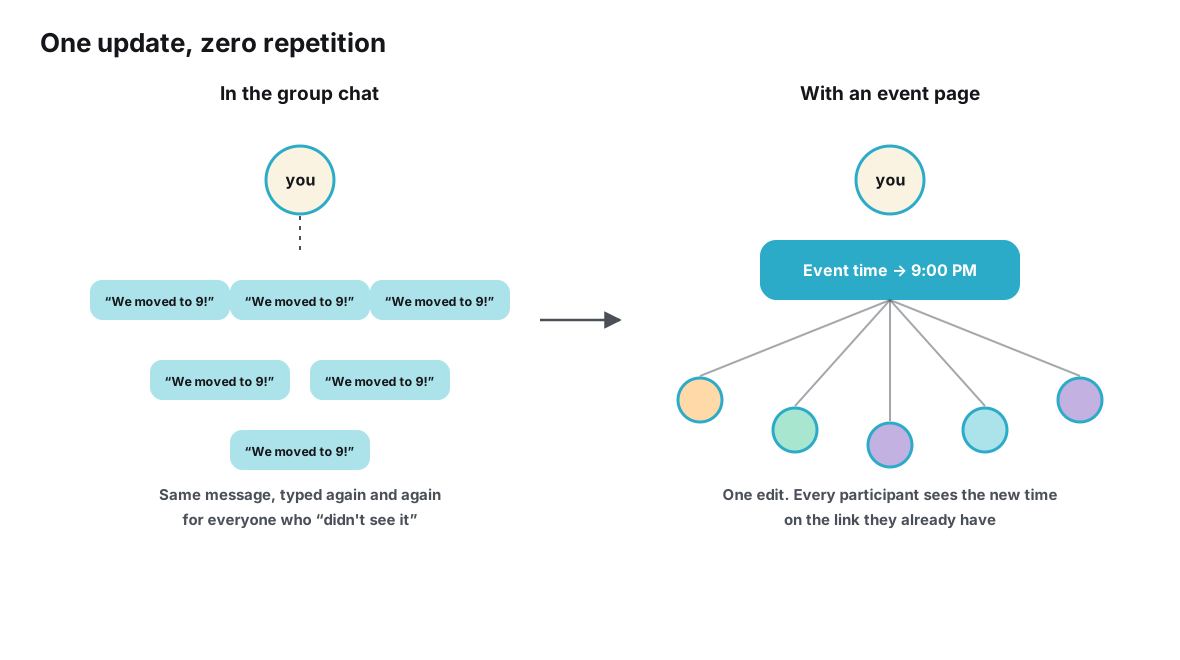
Meta documents the chat-side features — the reactions, polls and group tools these patterns lean on — in the Messenger Help Center, and the app itself is at messenger.com. Read as an organizer, the boundary is the instructive part: the features are all instruments for talking to the group. The record of the occasion — one current version, named guests, a history of what changed — is a different kind of object, and no arrangement of messages adds up to it.
The reach question: who isn’t in the room
Messenger groups inherit a membership assumption from the social layer they live in: that the guest list and the app’s user base overlap. For wide friend circles they usually do. But the assumption breaks at the edges that matter — the friend who deactivated their social accounts years ago, the colleague who never joined, the aunt on a plain phone, the partner who uses other apps entirely. The occasion doesn’t shrink to fit the app; instead the organizer starts running side channels: a parallel text thread here, a forwarded screenshot there, a verbal briefing at work.
The cost of side channels isn’t the effort, it’s the divergence. Each copy of the plan ages independently, and the moment one is updated without the others, the group holds two versions of the occasion without knowing it. This is the general cross-app problem — we cover it in full in what happens when an event is planned across multiple messaging apps — and the occasion-group version of it is especially sneaky, because the main thread feels so authoritative that nobody checks whether the side channels agree with it.
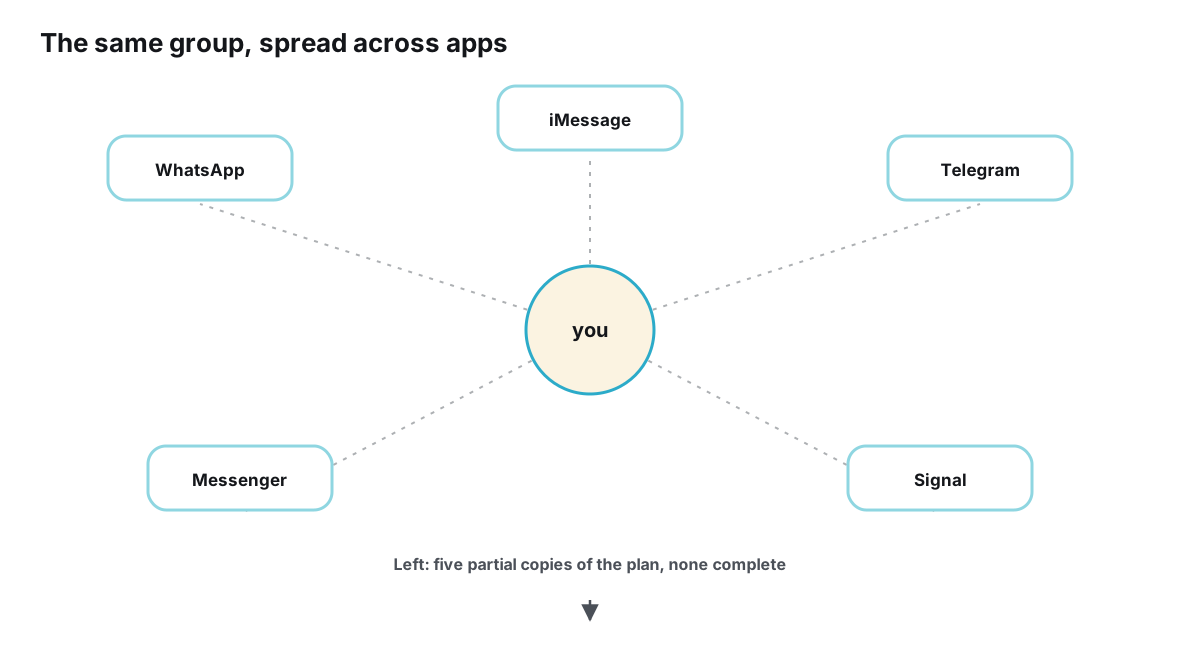
The remedy is the same one that works for the record problem: give the occasion an address that doesn’t belong to any app. A link opens anywhere there’s a browser, so the Messenger group remains the lively center of attention while everyone outside it reads the same current plan. No parallel thread to maintain, no screenshots, no divergence — the group just stops being the only door.
| Limit | How it shows up | Workaround inside the chat | Structural fix |
|---|---|---|---|
| No live headcount | Host counts reactions and “sounds fun” replies by hand | Ask everyone to reply with a specific word | Per-person RSVP statuses that roll up automatically |
| Details age in place | Older versions of the plan keep resurfacing | Repost final details; remind people to check the top | One page whose edit is instantly the latest version |
| Late joiner onboarding | “Scroll up” answered with dread | Host re-types the essentials per newcomer | A link showing current details in one screen |
| Reach beyond the app | Parallel threads and screenshots for outsiders | Designate one person to sync channels | A neutral event link shared in every channel |
| Mixed signal types | Enthusiasm reads as commitment, jokes as drops | Host privately confirms each guest | Commitments expressed as explicit statuses |
A week in the life of an occasion group
Put the three patterns together and you can watch a typical occasion unfold. Day one: the group forms around the idea, enthusiasm floods in, and the would-be host posts the first real proposal — a date range, a neighborhood, a budget shape. Day two: the contested choice surfaces, someone posts a poll, and the group votes. So far, genuinely good coordination: fast, inclusive, low-friction. This is the stretch where a Messenger group feels like the best planning tool ever made.
Day four is where the seams show. The poll settled the date, but the venue search now belongs to three people doing detail work forty members don’t need to follow, so a spin-off forms. The big group keeps its energy; the ops group starts making real decisions. Then the venue calls back with a constraint — forty seats, final count needed by Friday — and the occasion acquires its first true RSVP requirement. The host asks the big group for numbers. What returns is a wave of reactions, three replies that say maybe, two questions about parking, and one person answering a poll from three days ago.
By the eve of the event, the host is running three workflows at once: reposting final details in the big group, syncing the ops group, and privately confirming the maybes one by one. Every step is reasonable; the patterns are all being used correctly. What’s missing was never a pattern — it was a place where “who is coming, as of now” simply existed. That absence is invisible on day one and decisive on day six, which is why groups so often feel both “fine” and exhausted by the same plan.
What the thread remembers afterward
Occasion groups have an afterlife, and it’s worth thinking about what they leave behind. After the party, the thread remains as a warm, funny, genuinely valuable record of the social experience — the banter, the photos, the in-jokes that will be referenced for years. As a record of the event, though, it’s nearly useless in reverse. Try reconstructing, a month later, the final guest list, what changed along the way, or who actually turned up, and the thread answers with every message ever sent, sorted by nothing. The information is technically present and practically inaccessible.
This matters more than it seems, because occasions recur. Next year’s reunion would benefit enormously from this year’s final headcount, the venue that worked, the caterer count, the lessons. A group that plans repeatedly in threads rebuilds this knowledge from scratch each cycle, or relies on whoever happens to remember. The recurring groups that feel calm year after year are almost always the ones where each occasion left behind a small, structured residue — a page per event that still says what it said, rather than a thread that says everything at once.
There’s a privacy dimension, too. An occasion group holds its history forever, visible to its members and searchable by them. For a friend group that’s a feature. But guest lists, dietary notes, who was invited and who wasn’t — details an event page can scope precisely — live in a thread with no granularity at all. The conversation deserves to be kept; the record deserves to be kept deliberately. Those are different jobs, and the thread can only do the first.
When the occasion deserves its own space
There’s a threshold worth respecting in both directions. Small plans — a spontaneous night out, a standing weekly thing among people who all read everything — don’t need anything beyond the group, and adding infrastructure to them is ceremony. But an occasion crosses a line when any of these become true: a third party needs a number, the details have changed at least once, the guest list extends past the app, or people keep asking questions the thread already answered. Past that line, the pattern that works is the one this whole library keeps returning to: the conversation stays in Messenger, and the event gets a space of its own — the argument in full is in why an event needs its own digital space.
In practice the split is light. The host creates one event page when the occasion firms up: options to vote on while things are open, RSVP statuses as invites go out, final details and updates as the date closes in. The Messenger group is told once — “plan lives here, chat stays here” — and from then on the announcement pattern, the poll pattern and the spin-off pattern all get easier, because each finally has somewhere to point. That’s exactly the workflow Ontaym is built for: one page per event, one link to share in any chat, and the group free to be what it’s good at.
For groups weighing this against other chat-first setups, the trade-offs run in the same direction everywhere — a neutral look at the criteria is in GroupMe vs dedicated event planning tools, and for circles where privacy is the first requirement, Signal groups and real-world event planning covers the same territory from that starting point. The app changes; the wall doesn’t.
Frequently asked questions
Can a Messenger group handle RSVPs on its own?
Partially, and unreliably. The group collects plenty of signals — replies, reactions, enthusiasm — but none of them is a named, current commitment. You can tighten it with rules, like asking everyone to reply with a specific phrase, but you’re still aggregating by hand and re-verifying near the date. When a venue or budget depends on the count, use a mechanism where each person’s status lives in one place and updates when they change their mind.
Should I create a separate group just for planning?
A spin-off planning group is the right move when there’s a real asymmetry: a large social group and a small team doing the work. It keeps logistics off the main thread and lets the ops group be detailed. Just be disciplined about publishing its decisions back to the big group — the pattern fails when the two rooms drift. If the “ops” is really just you, a separate group only adds a second place to check.
What’s the best way to post final details in a busy thread?
Post them once, clearly labeled, then make that message easy to return to — and accept that some people will still miss it. What genuinely solves the problem is moving the final details somewhere with a stable address, so “the details are at this link” is always true, no matter how much the thread grows afterwards. The message announces; the link endures.
How do I include guests who don’t use Messenger?
Avoid the parallel-thread reflex — maintaining a second conversation by hand works until the first time the two copies disagree, and they always eventually do. Instead, give the event itself a link that opens anywhere: the Messenger group keeps buzzing, and the guests outside the app read the same current plan as everyone else. One plan, many doors.
Are polls good enough for picking a date?
For a single, simple date choice among exactly the people attending, a poll is the right instrument — fast, visible and fair. Declare the rules when you post it: when it closes and what happens on a tie. Its limits appear when the question isn’t one-dimensional: attendance that depends on the winning option, or plans that change after the vote. Poll the preference; track the commitment separately.
When has a plan outgrown the group chat?
Three reliable markers: someone outside the group needs a number from you; a detail has already changed once; or you’ve answered a question the thread already contains — twice. Any one of these means the plan now has a “current state” problem, and current state is the one thing a message stream cannot hold. That’s the moment to give the occasion a page and post the link.
Conclusion
A Messenger group is a legitimate coordination tool — not because the app was designed for events, but because skilled hosts have evolved patterns that route around its limits. The announcement thread concentrates authority where it belongs. The poll turns a circular debate into a decidable tally. The spin-off group separates the workers from the well-wishers. If your occasion is modest, these patterns are genuinely enough, and using them deliberately beats drifting.
What no pattern routes around is the absence of a record. Messages age indistinguishably, address everyone at once, and charge for every read. So the strongest setup combines both worlds: run the patterns in the group for what they’re good at, and give the occasion one page that holds the vote, the guest list and the final version — one link, posted once, true every time it’s opened. The chat keeps its energy. The occasion gains a memory. The host, finally, gets to attend their own event.
If you take one rule from all of this, make it a diagnostic: whenever you find yourself repeating information the group already contains, the problem is not the people — it’s that the information has nowhere stable to live. Give it that place once, and every pattern you already use gets simpler. Skip it, and every pattern eventually becomes a workaround for the same missing page.
Let the group chat carry the buzz — put the plan on one page.
Plan it with Ontaym