
Signal Groups and Real-World Event Planning
Signal is the messenger people move to on purpose — for its privacy-first design rather than because everyone was already there. That choice shapes everything about how its groups plan real-world gatherings: who joins, what gets shared, and how much structure the organizer has to build around the conversation.
Quick answer
Signal groups are a strong base for real-world event planning when privacy matters — community groups, organizing circles, or friends who simply prefer not to scatter their data. Groups can hold up to 1,000 members, so scale is rarely the constraint. The constraint is structure: Signal’s groups are built around conversation, so the parts of planning that need state — comparing options, tracking who is actually coming, keeping one current version of the details — have to come from somewhere else. The clean pattern pairs the Signal group with one neutral event page: the group keeps discussion private, the page holds the RSVP list, final details and updates, and a single invite link connects the two without exposing anyone’s contact information.
Why groups choose Signal in the first place
Almost every other messaging app arrives by default — it came with the phone, or everyone else was on it. Signal is different in a way that matters for planning: people adopt it deliberately, usually because they care about privacy. Some arrive out of principle, some out of profession, some after a sobering conversation about how much of their social lives lives inside advertising-driven platforms. The app’s site at signal.org leads with exactly this, and the community it attracts tends to know why it’s there.
That self-selection produces groups with a particular character. A Signal group is often assembled for a purpose rather than inherited from a social graph: the neighborhood watch, the cycling club, the volunteer shift, the study group, the friend circle that agreed as a group to move. Purpose-built groups are actually closer to event planning than most friend chats are — they have a reason, a scope, and usually an organizer. In that sense, Signal groups and real-world events are a natural pairing long before any feature discussion begins.
The privacy mindset also changes what isn’t in the room. There’s no profile to skim, no public presence to check, and often a norm of sharing as little identifying detail as necessary. For organizing, this is double-edged: it lowers the social cost of joining a group of near-strangers, and it removes the background information organizers quietly rely on elsewhere. Coordination in a privacy-first group has to be more explicit about things other groups infer — who is who, who is coming, what exactly is happening.
One more trait deserves mention because it shapes every event these groups run: commitment runs deep but attention runs selective. People who installed a privacy-first messenger on principle are unusually likely to show up when they say they will — and unusually likely to keep notifications off and read in batches. The organizer therefore can’t equate “no reply yet” with “not coming,” nor “no objection” with “support.” Explicit signals, gathered through a mechanism that asks for them, are worth more in this culture than in any other; silent assumptions are worth less.
Room to grow: what large groups make possible
Signal groups support up to 1,000 members, per the app’s own documentation. That number deserves a moment of appreciation, because it removes a constraint many people assume exists. A neighborhood association, a school class, a volunteer roster, a club with real membership — none of these will bump into a ceiling. The whole community can genuinely live in one conversation, which for privacy-minded organizers is often the entire point: one space, no copies scattered across platforms, everyone reached at once.
Size, however, changes the texture of planning more than people expect. In a twelve-person friend group, conversation scales: everyone reads everything, and details spread by proximity. In a three-hundred-person community group, that contract quietly breaks. Messages arrive at all hours from people who don’t know each other well; any interesting question spawns discussion; and the one message with the final meeting point competes with forty others for attention. The group that felt like a coordination tool at small scale starts behaving like a public square — lively, valuable, and progressively harder to extract a plan from.
The experienced organizers of large Signal groups tend to develop the same reflexes as admins of any large community: keep the big group for announcements and discussion, and push each actual event into its own container — either a focused subgroup or, more sustainably, a dedicated page with its own membership. What large groups teach, in short, is that scale turns structure from a nice-to-have into the load-bearing element of the plan.
| Planning need | How a Signal group handles it | What tends to happen as the group grows |
|---|---|---|
| Reaching everyone at once | One message to the whole group, up to 1,000 members | Stays strong — reach is the group’s best property |
| Discussing date or venue options | Open conversation in the thread | Options scatter; consensus becomes hard to identify |
| Knowing who is coming | Replies, reactions and private messages to the organizer | Headcount becomes guesswork at scale |
| Keeping one current version | A correction posted as a newer message | Older versions resurface; members hold different facts |
| Onboarding late joiners | Reading back through the thread | Backscroll grows with the group; catch-up worsens |
| Protecting member privacy | Strong defaults; minimal data in the group itself | Stays strong — privacy is native, not bolted on |
Where planning still needs structure
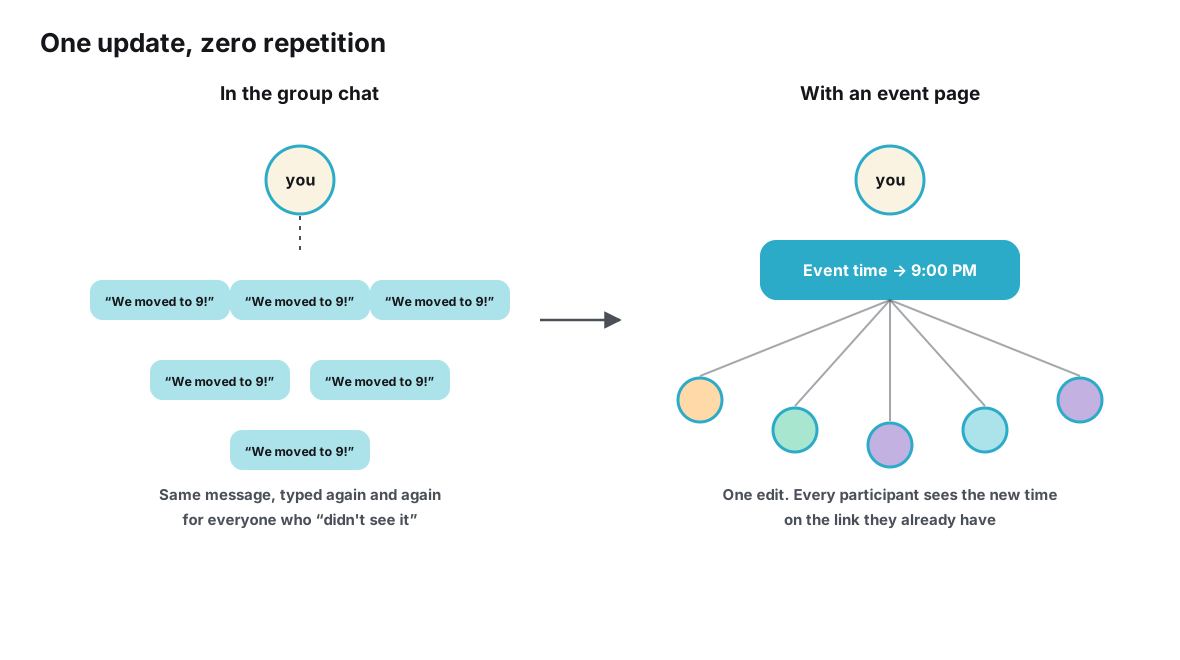
None of the table’s strains are privacy problems — they’re the standard gap between a conversation and an event record, arriving in Signal’s clothes. A message stream holds everything ever said and nothing currently true. The final time exists as the most recent message that mentioned it; the guest list exists as an aggregation of replies and reactions no one can reliably perform; the changes exist as layers, each new one burying rather than replacing the old. We’ve made this argument at length elsewhere — see why messaging apps were never designed to be event databases — and it applies to Signal exactly as it applies to any chat app, encryption notwithstanding.
Encryption deserves a specific clarification, because privacy-minded groups sometimes assume it solves more than it does. End-to-end encryption protects the conversation: who said what, in transit and at rest. It does nothing for coordination, which is a data-structure question — can the group see the current plan without reading the history? Can the organizer get a headcount without counting? Can a late joiner get the final details without the back story? A perfectly private stream of messages is still a stream of messages. The plan needs a shape, and no cipher provides one.
The practical consequences are familiar from every other platform, with one Signal-specific twist: the community groups most drawn to Signal — volunteer rosters, neighborhood associations, advocacy circles — are precisely the ones whose events have real logistics. Shifts to fill, rooms to book, counts to give. The mismatch between privacy-first conversation and structure-needing events is therefore not hypothetical for these groups; it shows up at the second event, every time.
It helps to be concrete about what “structure” means, because the word can sound abstract until it’s unpacked. In practice an organizer needs exactly three capabilities that a thread cannot supply. First, aggregation: the ability to see a total — headcount, votes per option — without assembling it by reading. Second, currency: the ability to change one detail and know that everyone’s next look reflects the change, including people who join later. Third, addressability: a stable somewhere that “the plan” refers to, so questions have a one-word answer. Everything else — the polls, the RSVP statuses, the update feeds — is these three capabilities wearing interfaces. A group that has all three stops feeling busy and starts feeling organized, whatever tools provide them.
Privacy and the event record: a genuine tension
Here is the interesting part, and the reason this article isn’t just the standard chat-versus-page argument wearing a different logo. For most groups, moving an event onto a dedicated page is an unambiguous upgrade. For a privacy-first group, it raises a fair question: doesn’t a page with a guest list, timestamps and RSVP statuses create exactly the kind of data trail the group chose Signal to avoid?
The question deserves a real answer rather than a wave of the hand. The honest starting point is that personal data — names, phone numbers, attendance — is exactly what privacy law thinks about. Europe’s GDPR and California’s CCPA both exist because this information can identify people, and both push in the same practical direction: collect what you need, keep it only as long as it serves the purpose, and don’t spread it further than necessary. Regulators like the UK’s Information Commissioner’s Office publish plain-language guidance to the same effect. A friend group isn’t a company and shouldn’t be run like one, but the underlying principle travels well: an event needs very little data to work, and the less it collects, the less there is to leak, misuse or regret.
Seen through that lens, the tension resolves more gracefully than expected. A well-designed event record is smaller than a group chat, not bigger. It asks for a name or nickname and a going/maybe status, and nothing else — no phone number required to participate, no member list exposed to every other member, no permanent mixing of the event with years of unrelated conversation. Compared with adding twenty near-strangers to a group where they see every message and everyone sees them, a minimal event page is arguably the more privacy-preserving choice. Privacy-first groups shouldn’t ask whether to add structure; they should ask whether the structure respects the same values the group already holds: minimal data, bounded visibility, participant control.
Cross-app reach for a privacy-minded crowd
Signal’s deliberateness has one structural consequence for organizers: it is nobody’s default. A community’s Signal group is usually a subset of the community, because someone — the neighbor with the simple phone, the volunteer who never migrated, the new member who hasn’t been convinced yet — is on something else. The organizer who treats the Signal group as the complete guest list discovers the gap the usual way: good turnout in the thread, missing faces at the venue.
The standard repair is the one every cross-platform group reaches for, and it ages just as badly here: a parallel thread in the second app, maintained by hand. Every update gets posted twice; every question gets answered twice; and the two copies drift apart on a schedule set by the organizer’s tiredness. The general shape of this problem — one plan, many apps, one exhausted human in the middle — is covered in what happens when an event is planned across multiple messaging apps, and privacy-first groups get no exemption from it.
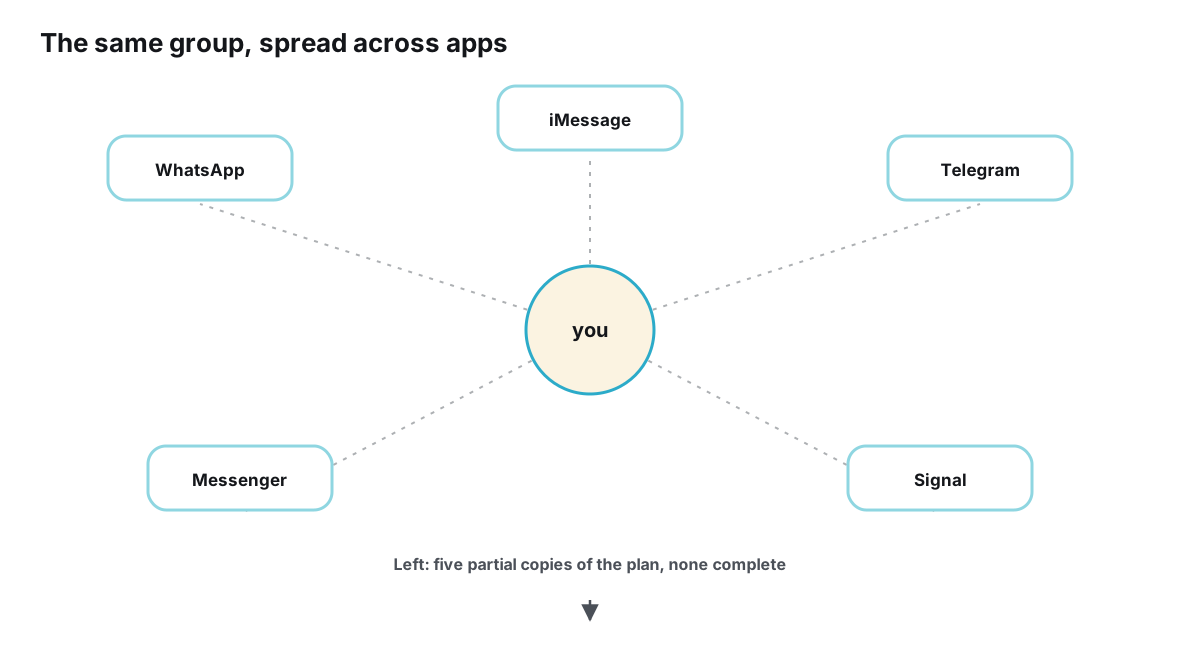
The structural repair is a neutral event address — a link that opens in any browser, requires no particular messenger, and shows the same current plan to everyone. The Signal group remains the private heart of the community; the link simply extends its reach without extending its membership. There’s a pleasant symmetry in this for privacy-minded crowds: the event link shares the plan without sharing the group. People participate in the gathering without joining the community, a separation with its own virtues — we develop it in the comparison between chat groups and event invitations.
It’s worth pausing on why this repair suits the privacy-first temperament better than the parallel-thread reflex. A second group chat asks every outsider to join a new community, accept its norms and inherit its history; an event link asks them for nothing but a look. The smaller ask is not just more convenient — it is more respectful of the outsider’s boundaries, which is the same value that made the group choose Signal in the first place. Tools that minimize what participation demands are, in that sense, the ones most consistent with the community’s instincts.
| Situation | Signal group alone | Signal group plus an event page |
|---|---|---|
| Small circle, everyone reads everything | Works well; structure would be overhead | Unnecessary — enjoy the simplicity |
| Community group with real logistics | Details scatter as the thread grows | Final details and headcounts stay readable |
| Event needing a firm headcount | Organizer counts replies by hand | RSVP statuses aggregate on their own |
| Guests outside Signal or off messengers | Parallel threads, manual syncing | One link reaches everyone equally |
| Privacy-sensitive membership | Joining exposes the member list | Participation requires no group membership |
| Recurring events over months | Each event buries the last | Each gathering keeps its own clean record |
A community group, from thread to hall
Consider a shape that repeats wherever Signal-centered communities exist. A neighborhood resilience group — four hundred households, organized around mutual aid — runs its whole social life in one Signal group. When someone proposes a first-aid workshop at the community hall, the thread does what threads do: forty messages of enthusiasm in the first hour, a debate about Saturday versus Sunday, a question about whether children can attend, a side conversation about parking, and — buried in the middle — the one message where someone actually books the hall for Saturday.
The organizers, experienced enough to know how this ends, act differently at the second event. The workshop gets its own page before the debate peaks: Saturday and Sunday become two options people vote on; attendance becomes an RSVP status each household sets for itself; the question about children becomes a line on the page instead of a branch of the thread; and the hall’s capacity — the number the booking actually depends on — is visible to the organizers at a glance, every day, without anyone counting messages. The Signal group hears about all of it through one link, posted once.
Notice what didn’t happen. Nobody left Signal; nobody joined a new social network; nobody’s phone number traveled anywhere. The conversation stayed in the community’s chosen private space, exactly as encrypted as before. What changed is that the event — a thing with a date, a capacity and a guest list — stopped trying to exist as a region of a conversation and got a container sized to fit it. The two-hundred-happy-messages problem disappeared because the thread went back to being what it’s for: people talking to people.
A checklist for privacy-respecting coordination
For groups that want a compact standard to hold their planning setup to — whatever tools they end up using — the following questions capture most of what matters. Each one has a structural answer, not a discipline answer: if the honest response depends on everyone behaving perfectly forever, the setup is fragile.
- What must a participant reveal to take part? The ideal is a name or nickname and a status — no phone number, no app installation, no membership in the community itself.
- Who can see the guest list? Attendance is sensitive in its own right; visibility should be a considered choice, not a default inherited from the chat.
- Where does the final version live? One page, one address, always current — so the truth never depends on having read the right message.
- What happens when the plan changes? One edit that reaches everyone, including people who join after the change.
- What remains after the event? A small, scoped record of this gathering — not a permanent merge with years of community conversation.
- Who does the work of keeping it true? Preferably the structure itself. If the answer is “the most tireless volunteer,” that person will eventually rest.
A privacy-respecting workflow
Putting the pieces together, a workflow that honors both the group’s values and the event’s needs looks like this. The Signal group stays the home: announcements, discussion, community. Each real event gets its own page, created early, holding the options while they’re open, the RSVP statuses as they fill in, and the final details as they firm up. The invite link goes to the group once, and from then on “what’s the plan?” is answered with the link. Changes are made on the page — once — rather than announced in the thread three times. Late joiners and second-app friends open the same link as everyone else and are instantly current. The organizer reads a headcount instead of estimating one.
Tools like Ontaym exist precisely for this middle layer: one page per event with voting on options, going/maybe RSVP statuses, updates and reminders, reachable through a single link from any chat app. For a Signal-centered community, the useful test of any such tool is the one this article has been building: does it ask for the minimum data the event needs, and does it keep participation separate from membership? If yes, the privacy-first group gains structure without giving up the reason it chose its messenger.
Run it once and the division of labor becomes self-reinforcing. The group notices that the link is always right; the organizer notices that the counting has stopped; late joiners notice that catching up took five seconds. By the second or third gathering, the community has a quiet convention — plans live at their link, everything else stays in the conversation — and the convention, unlike organizer heroics, survives contact with a large group, a changed venue and a rainy-day cancellation in the same week.
For groups still weighing where structure should come from, the decision rarely hinges on the chat app itself — the same criteria apply whether the conversation lives in Signal, GroupMe or anywhere else, which is why the neutral comparison in GroupMe vs dedicated event planning tools transfers cleanly to this context. Judge the layer, not the logo.
Frequently asked questions
How many people can a Signal group hold?
Signal groups support up to 1,000 members, according to Signal’s own documentation. For real-world event planning that ceiling is generous — neighborhood associations, volunteer rosters and large friend circles all fit comfortably. The practical limit isn’t capacity but readability: the larger the group, the harder it becomes to find the current plan inside the conversation.
Is Signal a good place to plan events?
As the conversation layer for a privacy-minded group, yes — it’s private by default, purpose-oriented, and big enough for whole communities. As the complete planning system, no chat app qualifies, Signal included: options, RSVPs and a single current version of the details need structure a message stream can’t hold. The strong setup pairs the group with one event page it links to.
Can I invite people to an event without adding them to the Signal group?
Yes, and for privacy-first communities that’s usually the better default. Sharing an event link lets people see the plan, RSVP and receive updates without joining the group — which means no exposure of the member list, no backscroll of community conversation, and no pressure to adopt a particular messenger just to attend one gathering.
Does end-to-end encryption help with coordination?
It protects the conversation — who said what — in transit and at rest. It doesn’t give the group a headcount, a live option tally, or one authoritative version of the details. Those are structure problems, not confidentiality problems. Encryption is a reason to like Signal for discussion; it isn’t a planning feature, and treating it as one leads to the same scroll-archaeology as every other chat.
What does a privacy-respecting event page look like?
Minimal by design. It asks for what the event genuinely needs — a name or nickname and a status — and nothing more. It doesn’t require a phone number to participate, doesn’t expose the full member list to everyone, and doesn’t tangle the event with unrelated conversation history. The direction of privacy law, from GDPR to CCPA, points the same way: collect little, keep it briefly, share it narrowly.
How do I run one event for people on Signal and people elsewhere?
Give the event one address that belongs to no app: a link that opens anywhere and always shows the current plan. Post it in the Signal group and wherever the others are. The group keeps its private discussion; the outsiders get the same facts at the same moment; and nobody — especially not the organizer — has to keep multiple copies of the plan synchronized by hand.
Conclusion
Signal groups are one of the best homes a privacy-minded community can choose for its conversation: deliberate, capacious at up to a thousand members, and aligned with the values that brought everyone there. What they can’t be is the event’s memory — and for privacy-first groups, that limitation is easier to accept once it’s stated honestly. Encryption protects words in transit; it doesn’t compare options, count commitments or keep the final details on top.
The refinement worth adopting is small and faithful to the group’s principles. Keep the Signal group as the group. Give each gathering a minimal page of its own — little data, bounded visibility, one link — and let that page carry the options, the RSVPs and the changes. The community loses nothing it values and gains the one thing conversation can’t hold: a plan that stays current for everyone, member and newcomer alike, without anyone surrendering more of themselves than the event actually needs.
Keep the conversation private — give the plan one shared link.
Plan it with Ontaym