
GroupMe vs Dedicated Event Planning Tools
“Should we just use the GroupMe group, or set up a real planning tool?” It’s the wrong question asked the right way — these two categories aren’t rivals but specialists. This comparison scores them honestly on four criteria that actually decide the outcome: structure, RSVPs, cross-app reach and history.
Quick answer
GroupMe wins on conversation: it’s where the group already lives, with zero setup, basic polls for small decisions and likes for quick signals — unbeatable for casual plans among active members. Dedicated event planning tools win on state: structured details, real RSVP tracking, one current version of the plan, and a link that reaches people outside the app. On the four deciding criteria — structure, RSVPs, cross-app reach and history — GroupMe is stronger exactly where plans are simple, and event tools are stronger exactly where plans have moving parts. Most real groups are best served by both: the group for talk, one event page per plan as the record.
Two tools, two jobs
Start with what each thing actually is, because most disappointing tool choices trace back to a category error. GroupMe is Microsoft’s group messaging app — a home for ongoing group conversation, with basic polls and likes layered on for light coordination. A dedicated event planning tool is a record system: its unit of work is not the message but the event itself, with fields for time and place, option lists, RSVP statuses and a change history. One is optimized for presence and immediacy; the other for persistence and correctness.
Neither design is a defect. GroupMe’s lightness is why groups adopt it so easily and stay for years — conversation is the product, and conversation doesn’t want heavy machinery. Event tools carry more ceremony precisely because their job is to remain correct when nobody is watching: the headcount at midnight, the final room number after the third change, the record a newcomer reads six weeks late. Asking either tool to do the other’s job produces the familiar complaints — “the chat is chaos” and “the planning app feels like homework” — that are really descriptions of mismatch, not quality.
The fair comparison, then, isn’t “which is better.” It’s “which properties does my plan actually need?” The four criteria below are the ones that consistently decide it. For each, we’ll say plainly what GroupMe does well, what event tools do well, and which situations should tip your choice.
Criterion one: structure
Structure means the plan’s pieces live as labeled, separate, comparable things — an option list you can look at, a details page whose fields hold time and place, a status that says what’s decided and what’s open. With structure, questions have locations: the date is where dates live; the open question is visibly open. Without it, every fact lives inside prose, and reading the plan means reconstructing it from sentences.
GroupMe’s structure is conversational plus one widget. The stream itself carries everything anybody says, in order, with equal weight; polls give a single decision a moment of tabular clarity; likes mark agreement on a particular message. For a plan of one or two decisions, that’s adequate structure — the poll settles the date, the stream carries the rest, done. It fails as plans compound: multiple open questions interleave in one thread, decided options stay mixed with dead ones, and “the plan” becomes a reading comprehension exercise over the group’s recent history.
Event tools put structure first. Options are comparable rows while they’re live and one final value afterwards; details sit in named fields; changes update the record instead of appending to it. There’s even a standards-level version of this idea: schema.org’s Event type defines events as structured objects with places, times and attendees — the shape the whole web agrees an event has. A scheduling-poll service like Doodle shows the same instinct in miniature: one narrow field (date and time) given just enough structure to settle across many calendars. Dedicated tools generalize that move to the whole event.
Criterion two: RSVPs
An RSVP is a strange, specific thing: a named, personal, current commitment that can change and must be counted. Venues need the count. Team captains need the count. Anyone splitting a cabin deposit needs the count. The quality of an RSVP system is measured weeks after the initial invitation, when enthusiasm has cooled and reality has intervened — which is exactly where chat-based signal and structured RSVP diverge.
In GroupMe, RSVP-shaped information arrives as replies (“in!”, “hopefully”, “what time?”) and likes on a proposal. Every signal is genuine and none is durable: a like means support at a moment, a “maybe” means nothing about the future, and silence is unreadable. Near the date, the organizer re-asks, counts by hand, and messages people privately — the system works, but the organizer is the system. Polls don’t rescue this: a poll option isn’t a person, and the person who voted three weeks ago isn’t bound by their Tuesday self.
Dedicated tools make the commitment the unit. Each guest holds a going/maybe/not-going status; changing it updates the headcount instantly; the organizer reads a number instead of assembling one. This is also where structure pays off socially: people decline a status far more easily than they decline a message thread full of enthusiasm, so headcounts built on statuses tend to be more honest, not less. For any event where a number leaves the group — a reservation, a booking, a per-head cost — this criterion alone usually settles the comparison.
One nuance keeps the comparison fair: chat’s weakness here is real, but so is its speed. For the first forty-eight hours of a casual plan, the stream’s fuzzy signals — the wave of likes, the “I’ll try”s — do something a status list can’t: they create momentum. The mistake isn’t using chat for that phase; it’s expecting the same fuzzy signals to still mean something on the eve of the event. The strongest groups let enthusiasm happen in the thread and then ask for a clear status once the plan needs counting. Signal first, commitment second, and each medium used for its moment.
Criterion three: cross-app reach
The guest list rarely matches the app. There’s always a friend on something else, a parent on a basic phone, a teammate who never joined the group. Cross-app reach measures how gracefully a plan includes people who aren’t in the room where it’s being discussed — and it’s the criterion groups most often discover only after the hurt.
GroupMe’s reach ends at its membership. Adding someone means getting them into the app and the group — reasonable for the team that lives there, invasive for the acquaintance attending one dinner. The workaround is the universal one: a second thread in the other app, maintained in parallel, with all the copying that implies. One plan becomes N copies, and the organizer becomes the sync mechanism between them — a role with a documented failure rate, explored in what happens when an event is planned across multiple messaging apps.
There’s also a quieter reach cost that shows up inside the group itself: joining a GroupMe group is a commitment, and for an occasional guest it’s a disproportionate one. The classmate who would happily attend the reunion has no reason to install an app and enter a standing community for a single night. Every organizer has felt the hesitation when they say “I’ll add you to the group” and watch the face fall. A link removes the micro-negotiation — attending stops implying joining, and the yes comes easier.
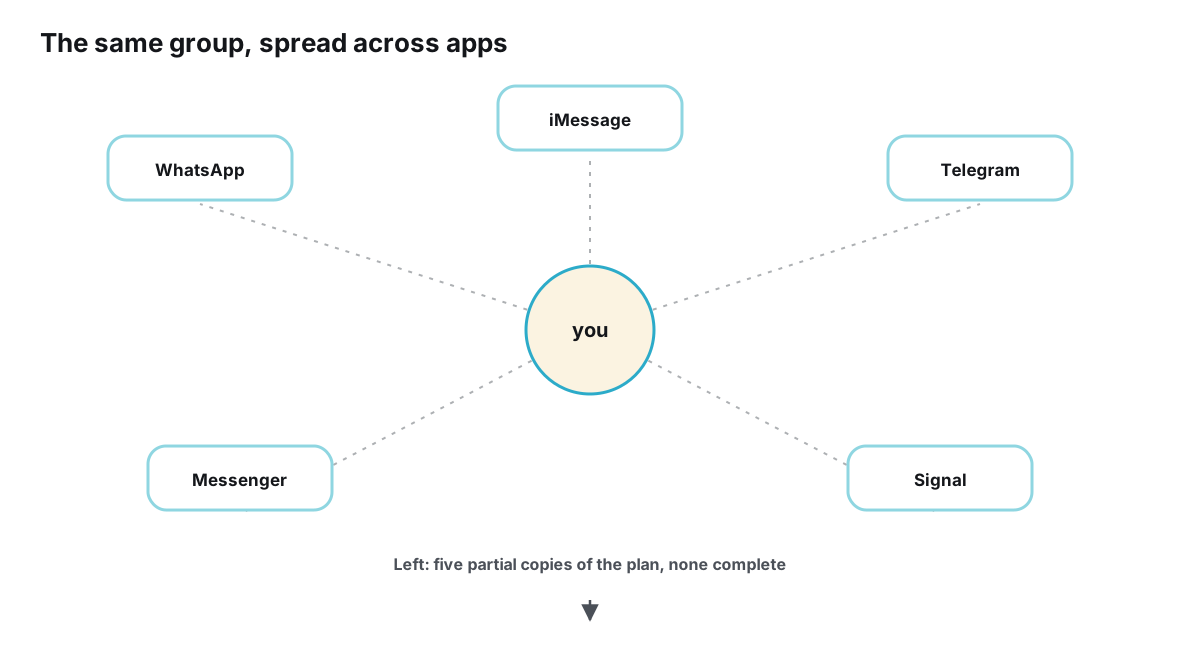
Event tools reach through the link. A page with its own address opens wherever there’s a browser — no app to install, no group to join, no account to make. The GroupMe group can stay the center of gravity for the inner circle while the link carries the same current plan to everyone else. To be fair, this cuts both ways: GroupMe’s closed membership is also a feature — a private clubhouse for people who chose each other. The question isn’t which model is right; it’s whether your guest list is coterminous with your group chat. When it isn’t, only the link model works.
Criterion four: history
History sounds academic until the third recurrence of the same event. What did we book last time? Who came? What went wrong at 8 PM that we swore to fix? A planning system’s history is the difference between a group that learns and a group that re-lives. It also matters in the smaller sense during a single event: what changed, when, and what’s the current state.
GroupMe’s history is a conversation archive: complete, warm, and ordered by nothing but time. It preserves everything anyone said and nothing anyone decided — the final time exists as whichever message mentioned it last, the guest list as an inference from a hundred messages, the change log as a diff every reader performs mentally. The same holds for every chat app; the record-keeping argument is made at length in why chat conversations don’t make ideal event records, and GroupMe is a textbook instance.
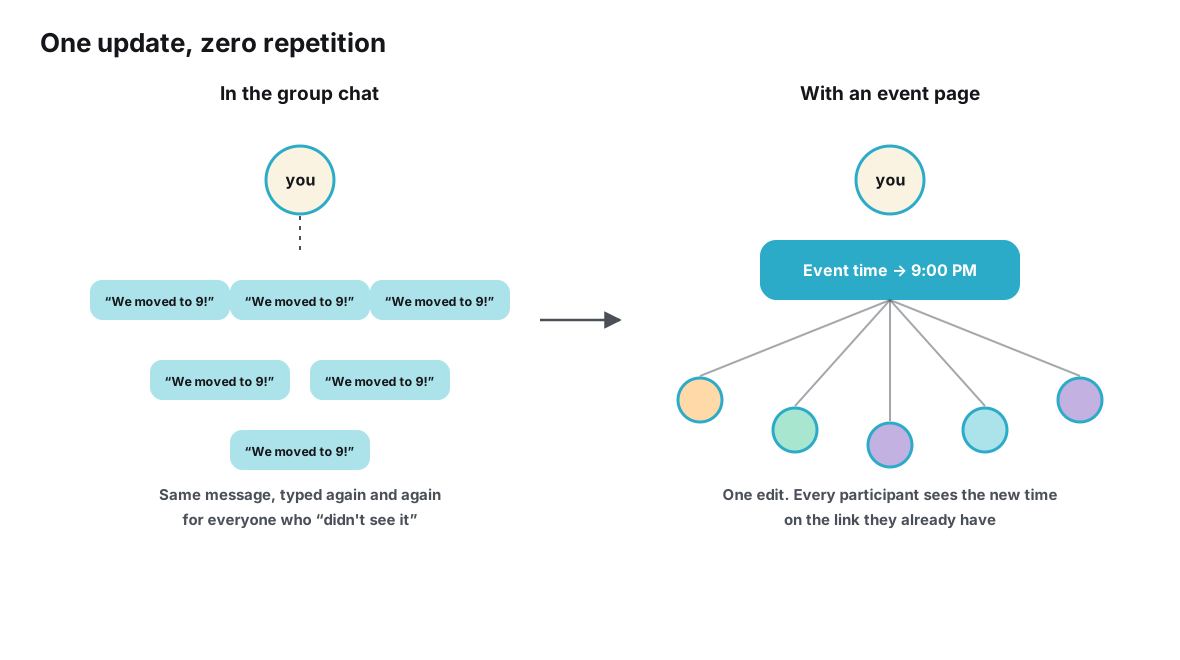
Event tools hold history in the useful direction: backwards. Each event keeps its own record — details, RSVPs, changes — so last season’s headcount is a lookup, not an excavation, and a recurring group accumulates knowledge instead of folklore. Within a live event, the same property shows up as update mechanics: a change made once on the page is the version everyone gets next, versus a correction message that competes with its own predecessors.
| Criterion | GroupMe’s honest strength | Dedicated tool’s honest strength | Tips toward GroupMe when… | Tips toward a tool when… |
|---|---|---|---|---|
| Structure | Zero-ceremony conversation; polls for single decisions | Labeled fields, option lists, one current version | The plan is one or two decisions | Multiple linked decisions are in play |
| RSVPs | Fast social signals from people who read the thread | Named, changeable statuses that aggregate into a count | No one outside needs a number | A venue, captain or budget needs a count |
| Cross-app reach | A private clubhouse the group already inhabits | A link that opens anywhere, joins nothing | Guest list equals the group | Anyone you care about is outside the app |
| History | A warm archive of everything said | A structured record of each event, reusable later | The event is one-off and soon forgotten | The event recurs or details will change |
Two plans, scored
Criteria are abstract until they’re applied, so run them across two plans a real group might hold in the same month. Plan A: Thursday trivia at the bar the group goes to every other week. Structure — one non-decision; the plan is a habit with a timestamp. RSVPs — the bar doesn’t take counts and the group doesn’t need one; whoever shows, shows. Cross-app reach — the regulars are all in the group; that’s practically the definition of regulars. History — nobody will consult this plan again. Four criteria, four clear verdicts for GroupMe, and the dedicated tool would be pure overhead. Score it honestly: chat 4, tool 0.
Plan B: a surprise sixtieth birthday, twenty-two guests drawn from four corners of the family, at a restaurant requiring a final count, with a hard secret to keep. Structure — venue, date, dietary notes, arrival choreography: linked decisions that will change. RSVPs — the restaurant needs a number that stays true until the night. Cross-app reach — the family spans at least two messaging apps and one member who uses none. History — the planner will be asked “how did you pull that off?” and will want the answer. Same four criteria, same honest scoring: tool 4, chat 0 as the record — while the group chat, where it exists, remains perfect for the conspiracy-the-plot part.
Notice what the exercise reveals: the answer isn’t a property of the group or of the tools. The same fourteen people, in the same apps, ran both plans in the same month and correctly used different machinery for each. The criteria route plans, not identities. When a group internalizes that, the recurring argument about tools dissolves — each plan simply goes where it belongs, and the group stops paying for structure it doesn’t need or improvising the structure it does.
Where GroupMe is the better choice
It’s worth stating the honest cases, because tool maximalism is its own failure mode. If your group already lives in GroupMe and the plan is small — the usual place, the usual people, maybe one decision — a dedicated tool adds ceremony without benefit. The poll is right there. The people are right there. The plan lives comfortably inside shared attention, and structure would be a solution looking for a problem.
GroupMe is also the better choice whenever the conversation is the event’s value. A standing game-night group where the thread itself is the social glue — the banter between Tuesdays, the photos afterwards — should protect that, not route it through an app built for logistics. And for groups with members who are wary of new software, one more app is a real cost; a chat they already enjoy is a real asset. None of these groups are doing it wrong. They’re matching the tool to the plan, which is the entire argument of this article.
Where a dedicated tool earns its keep
The flip cases are equally concrete. When a plan has linked decisions — date, venue, cars, food, a deposit deadline — structure stops being luxury and becomes the thing preventing the plan from dissolving into the scroll. When an outsider needs a number, you need RSVPs with names on them. When the guest list extends past the app — the plus-one, the visiting friend, the teammate’s partner — you need a link, not a recruiting pitch for a messaging app.
Recurring groups feel it most. A club that plans monthly in one standing thread accumulates plans like sediment; each new event buries the last, and the group re-derives everything annually. The same club with one page per event builds an archive: what we booked, how many came, what to change. Late joiners feel it too — arriving mid-plan into a structured record takes a glance; arriving into a 400-message thread takes an archaeology degree. And organizers feel it every time a detail changes: once on a page, or repeatedly in a stream, forever.
A subtle fourth trigger deserves its own sentence: delegation. The moment organizing stops being one person’s job — a co-host, a committee, a rotating cast of planners — the stream’s informality becomes a liability, because two organizers answering from the same thread produce slightly different answers with no way to reconcile them. A shared record is how a second organizer gets up to speed without a two-hour handover call. Groups that rotate planning duties figure this out fast; it’s often the actual reason they finally adopt a tool, more than any single event.
| Scenario | Recommended setup | Deciding criterion |
|---|---|---|
| Spontaneous drinks, the usual crowd | GroupMe alone | Structure — one decision, no ceremony needed |
| Restaurant birthday with a fixed headcount | GroupMe + an event page | RSVPs — the restaurant needs a number |
| Weekend trip with deposit, cars and groceries | Event page as the plan of record | Structure — linked decisions need fields |
| Mixed crowd, several apps in play | Event page, linked from every chat | Cross-app reach — the link joins nothing |
| Recurring club or team season | Group for community, one page per gathering | History — each event keeps its own record |
| Plan already changed twice in the thread | Move it to a page now | All four — the stream is past its design load |
The honest verdict: most groups need both
Run the criteria across a real month of group life and the pattern that emerges is division, not victory. The GroupMe group handles the ambient coordination — the quick hangs, the standing things, the talk — and no event tool should try to replace that; conversation is genuinely load-bearing. The plans that graduate — anything with a headcount, a change, an outsider, or a next time — get a page of their own, and the group drops a single link. On GroupMe’s own site the app describes its world as group messaging; the event tool describes a world of structured events; your group lives in both, and the boundary between them is the four criteria above.
That combined pattern is exactly what Ontaym is designed for: event pages with options, RSVP statuses and updates, each with one link to drop into whatever chat the group uses, so the conversation and the record each keep their job. The same boundary logic appears across every messenger — we trace it for Apple’s corner of the world in the comparison between chat threads and event invitations — and the underlying method, deciding once where the truth of a plan lives, is the subject of how to create one source of truth for a group event.
If you want the whole comparison reduced to a pocket rule, use this: chat for momentum, page for truth. The group chat is unmatched at generating a plan — enthusiasm, negotiation, the shared feeling of something coming together. The page is unmatched at preserving it — one current version, countable commitments, a door anyone can walk through. Groups get in trouble only when they ask one side to do the other’s job: momentum asked to also be the record, or a record asked to also be a party. Keep the jobs separate and both tools stop competing, because they were never really opponents.
Frequently asked questions
Is GroupMe bad for planning events?
No — that framing is the category error. GroupMe is very good at the job it was built for: hosting a group’s conversation, with polls and likes for light coordination. Plans that fit inside shared attention — small, simple, single-decision — are genuinely well served by it. Difficulties appear only when a plan needs a persistent record, and that’s a property of message streams generally, not a fault of this one.
What does a dedicated event tool do that GroupMe doesn’t?
Three things, fundamentally: it holds the plan as structured fields instead of prose, it tracks RSVPs as named statuses that update and aggregate, and it gives the event its own address that works outside any messaging app. Everything else — reminders, option polls, change histories — follows from those. If your plan doesn’t need any of the three, the tool is overhead; if it needs even one, the group chat can’t substitute.
Do we have to leave GroupMe to use a planning tool?
No, and you shouldn’t want to. The pattern that works keeps both: the group remains the conversation, the tool becomes the record, and the bridge between them is a single link posted in the chat. Members keep using the app they like; the plan gains a stable home. Groups that treat it as either/or lose either their social space or their record.
Can GroupMe polls replace RSVPs?
Not for anything with consequences. A poll records a preference at a moment; an RSVP holds a commitment that can change and must be counted. Polls are excellent for choosing between options — that’s their job. For “who will actually be there,” you need per-person statuses. Using one for the other is the single most common planning failure in chat-based groups.
Which is better for a recurring group?
Both, in their roles — and the recurring case makes the split clearest. The standing group carries identity and continuity, which no per-event tool can. The per-event pages carry records, which no thread can: last time’s headcount, the venue that worked, what to change. A club that keeps the group and adds one page per gathering gets the strengths of both and the weaknesses of neither.
What should we use for a one-off casual hangout?
The group chat, full stop. If the plan is a single decision among people who are already reading, structure is ceremony — propose, confirm, show up. Reach for a dedicated page only when one of the four criteria bites: a count someone needs, a detail that will change, a guest outside the app, or a reason you’ll want to remember it later. Most social life stays comfortably below that bar.
Conclusion
Scored on the criteria that matter, neither side sweeps. GroupMe is unbeatable at presence: the conversation, the standing group, the low-friction poll, the plan that lives inside shared attention. Dedicated event tools are unbeatable at state: labeled structure, honest RSVPs, reach beyond the app, and a history the group can actually use. The four criteria — structure, RSVPs, cross-app reach, history — aren’t a ranking; they’re a routing table. Each plan you organize can be matched to the home it needs.
In practice, mature groups stop choosing and start dividing. The chat keeps what only a chat can give a group of friends, and every plan complicated enough to deserve it gets one page, one link, one current version. The test is simple and reusable: the moment a detail changes, a count matters, or a guest can’t open the app — hand the plan a structure of its own. Everything else can stay exactly where your group already loves it.
Your group chat keeps the conversation — give each plan its own page.
Plan it with Ontaym