
Telegram Group Planning: Chat vs Structured Event Information
A Telegram group can hold every word ever said about your event and still not hold the event itself. This is the complete comparison: what a chat stream stores, what a plan actually requires, and where Telegram’s design helps before it stops helping.
Quick answer
Telegram is built around two containers: channels for one-to-many broadcast and groups for many-to-many conversation, with supergroups supporting up to 200,000 members. That architecture is superb for discussion at scale, but a plan is not a discussion — it is a small set of structured facts: one final time, one place, a definitive who’s-coming list, and a change history. A chat thread holds those facts only as words inside messages, so every member reconstructs the plan by reading, and different people reconstruct it differently. Pins, polls and channel announcements soften the symptoms without creating a current state. The reliable fix is a division of labor: keep Telegram for conversation, and give each event its own structured record that always shows the plan as it stands now.
What Telegram groups are genuinely built for
Telegram makes an architectural distinction that most platforms blur: channels are one-to-many broadcast, groups are many-to-many chat. That split is a real piece of design intelligence. A community can shout once to everyone without triggering five hundred replies, and the conversation that follows has its own dedicated home. Supergroups scale to 200,000 members according to Telegram’s own FAQ, which puts Telegram among the very few platforms deliberately shaped for genuinely large communities. Polls can be anonymous or public with visible votes, and can even run quiz-style for lighter moments. As a home for community life, this is a strong toolkit.
It is also why so many communities plan their real-world events inside Telegram. Nobody migrates anywhere — the group already exists, the members already open it daily, and the announcement channel already reaches everyone. Planning where the people already are is not laziness; it is the most sensible default available, and for the first stretch of any plan it works. Someone floats a date, three people agree enthusiastically, a venue gets suggested, and momentum builds precisely because participation costs nothing.
The trouble arrives with the second kind of information. Community chat is open-ended: it has no final answer, only an ongoing conversation. A plan is the opposite — a small, closed set of facts that must stay current: when, where, who, what changed. Telegram’s containers are shaped for the first kind of information. When the second kind flows into them, it gets stored in a format that every reader must decode by hand, for as long as the event exists.
The event object scattered across the thread
Here is a test worth trying on any group that recently ran an event. Open the thread and, using the messages alone, write down the plan as it currently stands: the final time, the final place, who is definitely coming, who dropped out, and what a brand-new member would need to know. Time the exercise. Then imagine doing it while two hundred unread messages tick upward.
What you find is that the thread does contain the event — in fragments. The time exists as four separate messages, of which only the last is true. The venue exists as a debate followed by a decision that reads like a suggestion. The guest list exists as an aggregate of short replies, thumbs-up reactions and telling silences, and silence is the least interpretable signal there is: is the quiet member coming, or merely inundated? The change history exists only in the gaps, because a plan that moved from Friday to Saturday leaves all of Friday’s messages exactly where they were, still confidently asserting Friday.
Notice that no message is wrong and nobody misbehaved. The thread is performing perfectly as a thread. The information simply lives in a shape that must be reassembled by every reader independently — and the busier the community, the deeper the plan gets buried under the general discussion that the group exists to host. Reconstruction cost grows with every message, which is backwards: a plan should get easier to check as the event approaches, not harder.
| Planning task | What Telegram offers | Where it stops |
|---|---|---|
| Announcing the event | A channel post that reaches every subscriber at once | Broadcast works; the gap opens right after, when replies begin |
| Discussing options | A fast, familiar many-to-many group | No conclusion gets recorded anywhere — decisions stay conversational |
| Choosing a date | Polls, anonymous or with visible votes | Captures preference at one moment; never becomes a commitment |
| Keeping final details visible | Pinned messages | A frozen snapshot that goes stale the moment the plan changes |
| Knowing who is coming | Replies, reactions and poll tallies | An ambiguous aggregate with no per-person current status |
| Bringing in a late joiner | “Scroll up and catch up” | Reconstruction work, repeated for every newcomer |
| Sharing beyond the community | Forwarded messages and screenshots | Copies of a plan, not the plan — they stop tracking the original |
Read down the third column and a pattern emerges. Telegram’s features are either frozen snapshots, moment-in-time aggregations or copies. What none of them produce is a living, addressable object that always equals the current plan. That object is the one thing an evolving event actually needs.
How people actually read a busy group
The reconstruction problem would be manageable if everyone read every message, but nobody does — and the way people actually read makes fragmentation worse, not better. Most members read the tail of the thread: they open the group, see the last twenty messages, and treat what they find there as the state of the world. If the venue decision happened three days and four hundred messages ago, the tail tells them nothing. Some members read selectively, following reply chains that interest them and skipping the rest, which means two people reading “the same thread” have effectively read two different documents.
Then there is the group that has been muted — often the majority in a large community. These members drop in only when mentioned or when the event crosses their mind, effectively arriving as late joiners no matter how long they have been members. Their reading pattern is not scrolling; it is searching, and search runs on words rather than meaning. Searching the group for “Saturday” returns the proposal, the confirmation, the cancellation and the joke about Saturdays, ranked by nothing in particular. What the searcher wanted was the current value of one field, and no keyword query can return that, because the thread never guaranteed that its words were fields.
The result is a quiet sorting of the community into information classes: a few people who track everything, a larger group that reads the tail, and a muted majority that asks rather than reads. A structured record collapses all three classes into one — everyone from the most active member to the most dormant mute opens the same address and sees the same current plan.
Channels broadcast, groups discuss — an event is neither
A channel is a megaphone. One voice, many ears, no chatter — ideal for “the meetup is on the 14th.” A group is a town square. Many voices, constant overlap — ideal for arguing about whether the 14th or the 21st suits more people. Both are streams: ordered sequences of utterances where the newest item defines what you see first. An event, by contrast, is an object with state. It has a time that gets revised, a guest list that shrinks and regrows, a location that firms up from three candidates into one address. Objects and streams are different categories of thing, and no amount of cleverness inside a stream turns it into an object.
This is why bolting features onto the two containers never quite closes the gap. A pin is a stream feature: it elevates one message, but the message remains a frozen sentence rather than a current value. A poll is a stream feature: it attaches a tally to one moment. Even a well-run channel-plus-group pair — announcement above, discussion below — simply splits the stream in two. The plan still doesn’t exist anywhere as a plan; it exists as an ongoing negotiation between two streams.
If you want the platform-neutral version of this argument, it is worth reading why messaging apps of every kind were never designed to be event databases: the mismatch is not a Telegram quirk but a consequence of storing structured state inside a chronological stream. What makes Telegram interesting is that its genuinely superior community architecture makes the mismatch more visible, not less — the better the discussion tool, the more discussion buries the plan.
Polls measure preference, not commitment
Telegram’s polls deserve their popularity. They take seconds to create, they can be anonymous for sensitive questions or public when the community benefits from visible votes, and quiz-style polls add levity that keeps a group lively. For what they are — a snapshot of group preference — they are excellent.
A headcount, however, is a different instrument answering a different question. “Who will be at the restaurant on Saturday at eight?” is not a preference; it is a personal commitment that each member must make, hold, and sometimes revoke. A poll vote carries none of that structure. It costs nothing, obligates nobody, cannot be updated without revoting, and — in anonymous mode — cannot even be attributed to the person you would gently chase for a confirmation. The vote count and the door count are measuring different things, and treating one as the other is how organizers end up reserving tables for people who expressed a mood on Tuesday. The distinction is stable enough that the structured-data web models it explicitly: schema.org defines RsvpAction as a type in its own right — a named commitment, categorically unlike a tally of opinions.
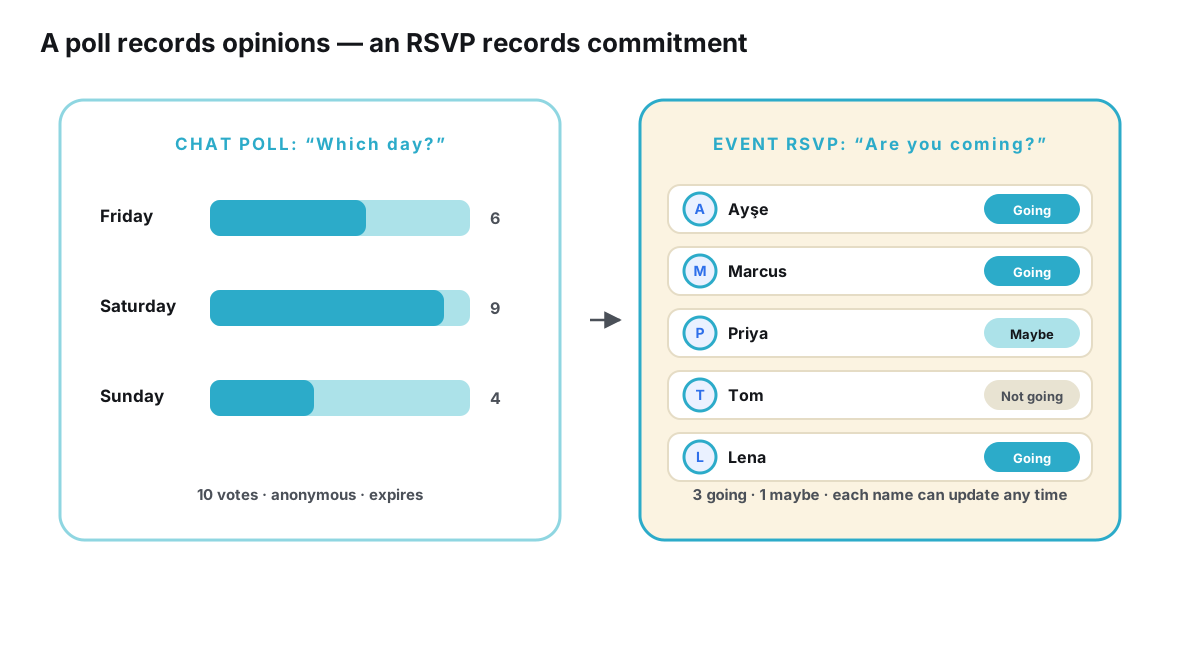
The mechanics of this divergence — anonymity, zero obligation, and the quiet decay of votes as real life intervenes — deserve their own treatment, and they get one in why Telegram polls don’t tell you who will actually attend. The short version for this comparison: a poll is a survey instrument living inside a stream, while an RSVP is a per-person state that must persist and update until the event ends. Structured event information is what turns the first into the second.
How far pins, edits and forwards stretch
To be fair to the tool, Telegram’s stream features do cover some of a plan’s needs. A pinned message keeps one fact findable for weeks, which is genuinely useful for a meet-up point that never changes. Editing a message lets a sender correct details in place rather than stacking corrections below. Forwarding lets a member carry the plan to a friend in one tap.
But each feature has a ceiling, and the ceilings share a shape. A pin is frozen: when the pinned time changes, someone must remember to pin the new message, and everyone who saw the first pin but missed the second keeps the old fact. An edit is quiet: it corrects the message for whoever opens it later, but it does not announce itself to people who already read the original and moved on. A forward is a fork: the moment the plan changes, every forwarded copy silently becomes a record of a past version of reality. Stream features move information through time; they cannot hold information still at a stable address while it changes. That is the specific job structured event information exists to do.
When the plan changes, the thread keeps both versions
Watch a single realistic change move through a Telegram group. The organizer writes that the picnic moved from Friday to Saturday. The message enters the stream and immediately begins sinking under whatever follows — memes, a side debate about rain, an unrelated question from another member. Friday’s messages do not disappear; they remain in place, still fully readable, still asserting the old plan with total confidence. Anyone who opens the group the next morning must now determine, by position and timestamp, which version won. Most will manage. A few will not, and the few become the story of the event: the friend who arrives Friday, certain the group confirmed Friday.
The deeper problem is that corrections in a stream are addressed to readers, not to the plan. The plan itself — the thing everyone relies on — has no form that can be amended. So the correction becomes one more message among thousands, and the group’s collective accuracy depends on every member having read every correction. Structured information inverts this: the change is applied once, to the record, and every future reader encounters Saturday as the only time that exists. The correction cost is paid once instead of being re-paid by every member forever.
Watch what this does to the organizer over time. Because the thread cannot answer “what is the plan?”, the organizer becomes the answer. Questions arrive as private messages and mentions: still Friday? can I bring a friend? where exactly? Each question is reasonable and each answer is a manual re-broadcast of facts that already exist somewhere in the stream. The organizer ends up operating as a human query interface over a database nobody else can query — a role that is flattering for a week and exhausting for a season. Many community hosts quietly scale back their events not because interest faded, but because answering the same five questions per event consumed the enjoyment of hosting.
| Situation | Better in the Telegram group | Better as structured event information |
|---|---|---|
| Exploring three possible dates | Yes — debate, jokes and negotiation belong in conversation | No — options are discussed, then decided |
| The final time after the decision | No — it will sink and be re-asked | Yes — one labeled field, always current |
| Gauging enthusiasm for the idea | Yes — reactions and energy are honest signals of mood | Partly — a poll can help, if read as mood |
| Counting heads for a reservation | No — tallies mix moods with plans | Yes — per-person going / maybe / not-going status |
| Day-of logistics (“use the side entrance”) | Briefly — one timely message works | Yes, if it must survive re-reading all day |
| Community life between events | Yes — this is exactly what the group is for | No — the record is for the event, not the community |
The table is not an argument against the group; half of its rows belong to chat and always will. It is an argument about placement. Groups that put each kind of information in the container shaped for it stop experiencing the mismatch, because conversation stops being asked to double as a record.
Scale multiplies the cost, not the difficulty
For a group of six friends planning dinner, all of this is a rounding error. The thread is short, everyone reads everything, and social memory patches the holes. The reconstruction tax exists, but it is too small to notice.
Scale changes the arithmetic without changing the mechanism. A supergroup can hold up to 200,000 members, and even the fraction of a large community that cares about a given event can outnumber a small town. Every additional participant adds messages, adds changes, adds late joiners and adds people who will arrive holding a version of the plan they assembled weeks ago. The per-reader cost of reconstruction stays constant; the number of readers does not. This is why large communities feel the gap first and loudest — not because Telegram fails at scale, but because a stream-based plan’s costs scale with people while a record’s costs stay flat. Open one page; read the current state; close it.
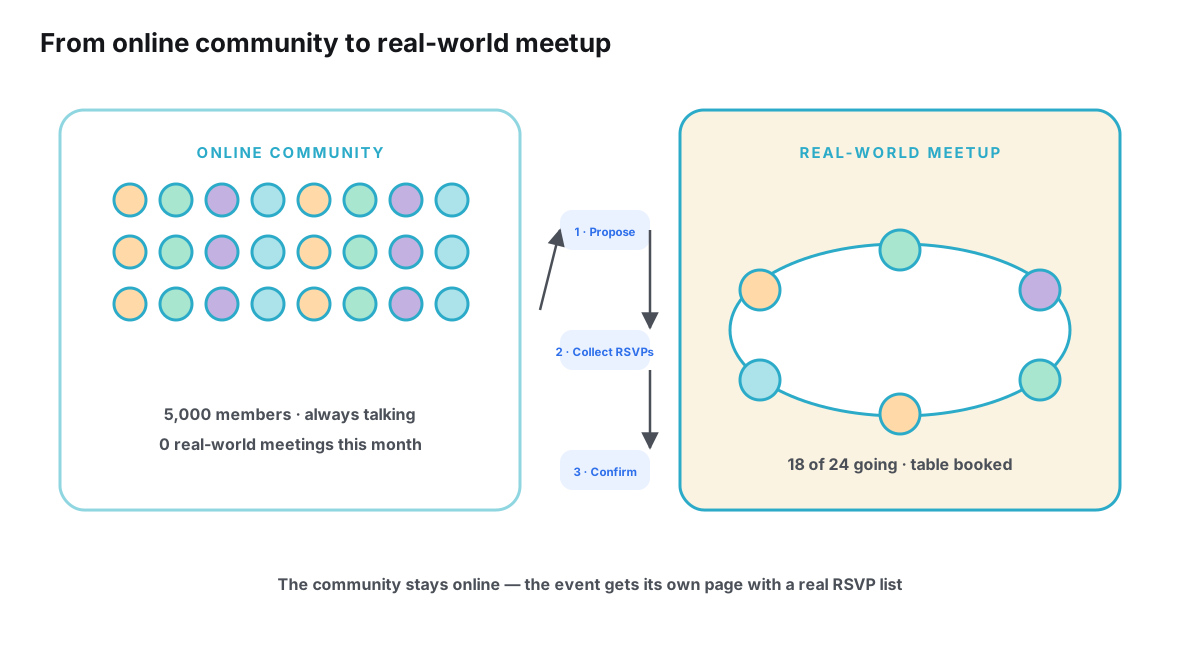
There is also a second, quieter scale effect: online communities scale far beyond what their offline events can hold. A group of thousands can only fit a fraction of itself around any real table. The meetup is therefore a selection from the community, and selection requires exactly the per-person, per-event bookkeeping — who is in, who is out, who moved to maybe — that a stream cannot maintain. How large communities handle that selection in practice is covered in how Telegram communities handle real-world meetups.
The pattern that works: conversation in Telegram, state beside it
None of this counsels leaving Telegram, which would be absurd — the community lives there, and community is the hard part. The pattern experienced organizers converge on is a division of labor, and it takes four habits:
- Create the record early. As soon as an event is more than talk, give it a structured page with whatever is known — even if half the fields read “to be decided.” What matters is that a current-state address exists before the discussion floods in.
- Debate in the group, decide into the record. Let the Telegram group do the arguing, joking and persuading it excels at. When the group settles a question, write the outcome into the record as a field, not as another message.
- Answer with the address. When someone asks what the plan is, reply with the link to the record, not a summary. Every link answer trains the community on where truth lives and starves the re-explanation loop.
- Change by editing, not announcing. When facts move, update the record once. A single chat message pointing at the update is fine; re-broadcasting the whole plan is what made the stream unreadable in the first place.
Tools that implement this split exist — Ontaym, for example, gives each event its own page with votes on options, going and maybe RSVP statuses, one shareable invite link and reminders, while the Telegram group stays exactly what it is. But the pattern matters more than any particular product: any system that gives an event a stable, structured, current-state home will do, and the community keeps its chat.
Frequently asked questions
Is a Telegram channel or a group better for organizing events?
Both, for different jobs — and that is Telegram’s strength. The channel announces to everyone without noise; the group hosts the discussion. Neither holds the plan itself as current state, so the healthiest setups add a third element: a structured record per event that the channel points to and the group argues around.
Can I rely on a poll to know how many people are coming?
Not for a headcount. A poll records preference at a moment — anonymously or with visible votes — and carries no obligation, no update path and no reminder. Use polls to shortlist dates or venues, then collect explicit RSVPs for the final count. The distinction is unpacked in the article on polls versus actual attendance.
Do pinned messages solve the buried-details problem?
They postpone it. A pin keeps one message visible, but the message is a snapshot: when the plan changes, the pin must be manually replaced, and everyone who saw the first pin but missed the replacement holds stale facts. Multiple pinned facts changing at different times multiply the maintenance and the risk.
Couldn’t a bot automate this inside Telegram?
Bots can help with prompts and posting — Telegram’s platform documentation covers what automation can reach — but they operate inside the same stream. The information still lands as messages that scroll, compete for attention and get re-read rather than a current state that gets checked. Automation changes who does the work of maintaining the plan in chat; structure changes where the plan lives.
Does structured planning mean abandoning our Telegram community?
The opposite. The community stays in Telegram — it is the social engine. Structure only takes over the narrow job of holding each event’s current facts: time, place, guest list, changes. Groups that adopt the split usually find the chat gets better, because it returns to being conversation instead of a filing system.
When is chat-only planning good enough?
Small, stable, single-app plans: a handful of people, one proposal that never changes, everyone present from the start. The moment a plan has changes, late joiners, a headcount that matters, or guests outside the group, the reconstruction tax starts compounding — and that is the signal to give the event its own record.
Conclusion
Telegram’s channel-and-group architecture is one of the better answers anyone has built to the problem of community conversation at scale, and nothing here should be read as a case against it. The case is narrower and more useful: a plan is not a conversation. It is a small set of facts that must remain current, attributed and addressable while everything around it churns — and streams, however well designed, store utterances, not states.
The comparison in this article reduces to one sentence: chat carries what was said, structure carries what is so. Communities that keep the two apart — debating freely in the group while every event holds its facts in a structured record with one address — get the best of both. The group stays alive, the plan stays findable, late joiners onboard in seconds, and the organizer stops being a search engine for their own event. Telegram remains the town square. The event finally gets a front desk.
Keep the conversation in Telegram — give the plan its own address.
Plan it with Ontaym