
Why Messaging Apps Were Never Designed to Be Event Databases
Group chats remember everything that was said about your event. They just don’t remember the event itself — and that difference is why planning in chat falls apart as soon as a plan gets complicated.
Quick answer
Messaging apps are designed to store a chronological stream of messages. An event is a piece of structured state: a final time, a final place, a definitive guest list, and a history of changes. A chat can contain all of that information as words inside messages, but it cannot hold it as data — so every reader has to reconstruct the current plan by reading the thread, and people reconstruct it differently. Pins, polls and announcement features soften specific symptoms without changing the underlying mismatch. The reliable fix is to give the event its own address — a page or link that always shows the current state — and let the chat go back to being a conversation.
The convenience trap
Nobody decides to plan an event “in a database.” It happens by drift. Someone mentions Friday drinks in an existing group, two people reply with enthusiasm, a time gets suggested, and before anyone notices, the plan lives in the thread. It’s the path of least resistance: everyone is already there, replies are instant, and for the first ten messages it genuinely works.
The trouble starts when the plan acquires the properties that make plans hard: multiple options, people joining late, changes of time or place, and guests who don’t reply. Each of those forces the group to answer a question that chat is structurally bad at answering: what is the current state of this event?
In a conversation, the only way to answer that question is to read. Read how far? Until you’re confident you’ve seen the latest decision — and “confident” is doing a lot of work in that sentence. If you joined the group after the discussion, you read backwards. If the decision was phrased as a question (“shall we say 8?”), you have to infer whether it was accepted. If two contradictory messages exist, you have to work out which one won.
This is why the same thread produces different beliefs about the same event. It’s not that anyone misread anything. It’s that the thread never contained a single authoritative record — it contained a series of statements, each true at the moment it was sent.
What an event record actually needs to be
Strip away the apps and think about what information a real event requires. A restaurant needs a headcount. A teammate needs to know whether the match is on. A friend bringing a plus-one needs to know the final time. In every case, they need current values, not the history of how those values came to be.
A usable event record has a handful of properties that are worth spelling out, because they explain exactly where chat falls short:
- One current value per field. The event has one final time, not a sequence of proposals.
- Explicit attributes. Time, place, guest list and status are labeled fields, not sentences buried in prose.
- Controlled mutation. When something changes, the old value is replaced everywhere, not superseded only for people who saw the newer message.
- Stable identity. The record has an address that keeps working, so “check the event page” is always an answer.
- Separate read and write. Everyone can check the plan without generating a message everyone else must read.
Compare that with what a group chat provides. The table below puts the two side by side.
| Information | What the record needs | What a chat thread provides |
|---|---|---|
| Final time | One labeled, current value | A proposal, a reply, a counter-proposal and a “confirmed?” scattered across messages |
| Final place | One current value with an address or map link | Options discussed in prose; the winner implied by the last related message |
| Guest list | A definitive going / not-going / maybe list per person | Reactions, one-line replies, and silence — which is ambiguous |
| Changes | The new value visible to everyone, including late lookers | A newer message that supersedes older ones only for whoever reads it |
| Entry point for late joiners | The current state, readable in seconds | “Scroll up” — an archaeology exercise |
| Who to contact | An organizer identified by role | Whoever happens to be most active in the thread |
None of this is a criticism of the messages themselves. Every individual message is doing its job perfectly. The failure is architectural: the information the group needs is being stored in a format optimized for a different purpose.
The data model hiding inside your group chat
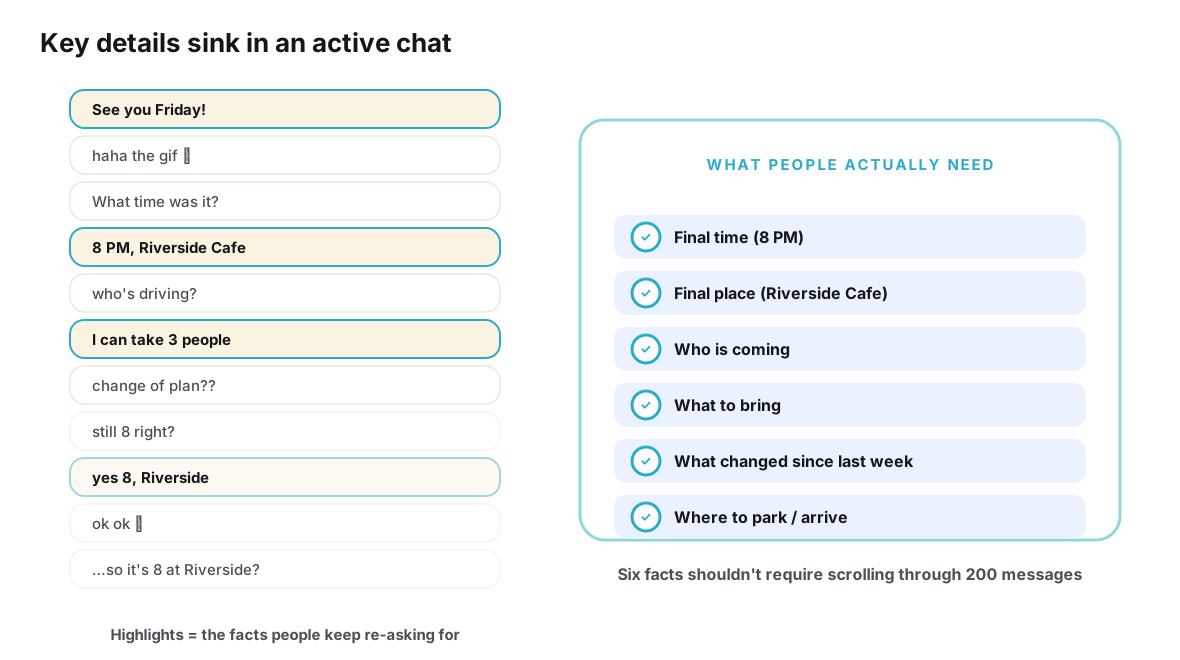
Here is a useful mental exercise. Take any group chat that planned a real event and try to write down the event’s final details from the thread alone: time, place, who came, what changed along the way, and what a newcomer would need to know.
What you’ll find is that the thread contains an event object in fragments. The time exists — as three separate messages, of which only the last is correct. The place exists &mdquo;as a reply to an earlier question, which means anyone skimming sees the question first. The guest list exists as an aggregate of emoji reactions, individually interpretable and collectively incomplete. The change history exists, but only in the gaps between statements: a plan that moved from Friday to Saturday leaves Friday’s messages in place, still asserting Friday.
This fragmented representation has a practical consequence: reading the plan is O(n) in the number of messages. The more active the group, the more expensive it is to know what’s happening — which is precisely backwards. Activity should make an event easier to follow, not harder. In a well-structured record, reading the plan is constant: open the page, see the current state, close the page.
The fields that suffer most
Some fields degrade faster than others in chat. Time survives reasonably well, because people re-ask it and someone re-answers. Place degrades quickly once there are options. The guest list is the worst: it’s the field that changes most often, is expressed least explicitly, and matters most to the organizer, who needs a headcount for the reservation. A reaction to a message is not an attendance record, and a thumbs-up from three days before the event tells you nothing about tonight.
Change history is the quiet casualty. A record should be able to say “this event changed time once, from 8 to 9.” A thread says it only implicitly, and every member has to perform the diff themselves — against whatever slice of the thread they happened to read. For more on this specific failure mode, see how event changes behave when everyone holds a different version of the messages.
Why chat apps can’t fix this by adding features
A fair objection: messaging apps have noticed this problem and shipped features for it. WhatsApp lets you pin messages and run polls, and its Communities include an events feature for members; Telegram has polls, pinned messages and scheduled posts; Discord has server events with interest markers. These are real improvements over raw chat. So why doesn’t the problem go away?
Because each feature patches one symptom of the state-vs-stream mismatch without introducing the state itself. A pinned message freezes one message at a point in time — as soon as the plan changes, the pin is either stale or manually replaced, and both outcomes reproduce the original problem. A poll aggregates opinions at one moment; it doesn’t track commitment as it evolves, and it usually can’t tell the organizer who ultimately showed up. An in-app event listing helps members of that one app — but the moment your group spans two apps, or includes someone who doesn’t want to join the community at all, the listing stops being the shared record.
| Feature | What it genuinely does well | What it can’t represent |
|---|---|---|
| Pinned message | Keeps one message visible at the top of the thread | Current state after the pin goes stale; multiple pinned facts that change at different times |
| Group poll | Collects preferences at one moment with a tidy tally | Commitment over time; per-person updates; the difference between a vote and an RSVP |
| Emoji reactions | Fast, low-friction signals on a specific message | A named, current attendance record; anything once the message scrolls away |
| In-app event listing | A structured event for members of that one platform | A record shared across apps, or visible to people outside the community |
| Group description | A short static note about the group’s purpose | Per-event detail; frequent updates; per-guest state |
The pattern across the table: every feature is either a frozen snapshot, a moment-in-time aggregation, or a container scoped to one app’s membership. An event record needs to be a living, cross-app object. That’s not a feature you can bolt onto a message stream; it’s a different kind of thing.
If you want to go deeper on one platform’s version of this, Telegram’s own documentation of polls and groups describes what those tools are designed for — see the Telegram FAQ — and WhatsApp’s Help Center does the same for its community features at faq.whatsapp.com. Read as an organizer, the boundaries become obvious: these are conversation tools with conveniences, not event systems.
The retrieval problem: newest-first vs. most-important
Every messaging interface shares a deep assumption: the most recent message is the most relevant one. For conversation, that assumption is correct — it’s what makes chat feel alive. For an event, it’s exactly inverted. The most important information is a small, stable set of facts (when, where, who, what changed), and its importance doesn’t decay no matter how many messages follow it.
Chat apps can’t reorder by importance, because importance is not a property messages carry. A message saying “changed to 9!” is just as ephemeral-looking as a message saying “lol” — same bubble, same font, same half-life. The interface gives the organizer no way to say: this is the plan, and everything else is commentary.
There’s a second retrieval problem that’s less obvious: search works on words, not on state. Searching a thread for “Friday” returns every message containing Friday — the proposal, the confirmation, the cancellation and the joke about always choosing Fridays. What you wanted was the field date with its current value. Words can’t be queried like fields because they were never guaranteed to be fields.
Late joiners and the archaeology problem
Every organizer eventually meets the late joiner: the person added to the group four days in, or the friend who was told about the trip verbally and only now wants the details. In a chat, their onboarding is “scroll up” — and their experience is archaeological. They dig through jokes and side conversations to reconstruct facts that could have been stated in five lines.
Worse, the archaeology is lossy. The late joiner doesn’t know which messages were superseded. They find the Friday message before they find the Saturday correction. They see twelve enthusiastic replies from people who then quietly dropped out, and reasonably conclude the event is bigger than it is. The thread gave them the raw history and none of the interpretation — and interpretation is exactly what a newcomer lacks.
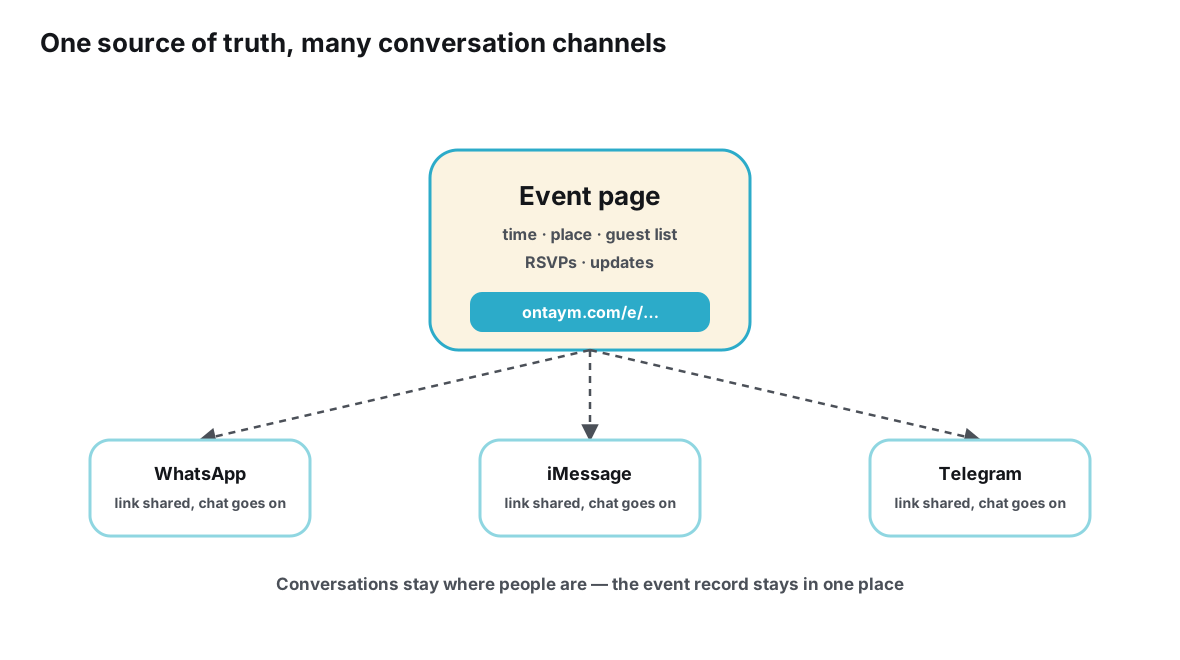
A record solves onboarding by making it trivial: one link, current state, no history required. The history remains available for whoever wants it, but it’s no longer the only door. This single property — joinable at any time without reading the past — is one of the strongest arguments for giving an event its own address, and it compounds: the more people an event touches, the more often someone arrives late.
Updates as messages vs. updates as edits
Consider the humble act of changing a time from 8 to 9. In a database, that’s an edit: one field changes, and every future reader sees 9. In a chat, it’s an announcement: a new message enters the stream, and now the group contains both “8 PM” and “actually 9 PM” as first-class facts, distinguished only by their positions.
The announcement model has a hidden cost curve. Every update is read by every member as a new message, so updates feel expensive — and organizers, being polite, start batching or softening them (“probably still 8, will confirm”). Ambiguity enters not because information was missing but because the medium made stating it clearly feel noisy. Then, because announcements decay with scroll, the same update must be repeated for everyone who missed it, and the repetition itself is what makes the channel noisy. The medium taxes exactly the behavior an evolving plan needs.
An edit-based record inverts the incentives: stating a change is cheap (one field), complete (everyone sees it on the same page), and permanent (late readers get the new value, not the old message). The update never needs to be repeated, because it never scrolls away. For a longer treatment of this dynamic — including how to run changes when the group is already split across apps — see how to send one event update without repeating it twenty times.
The practical pattern: conversation and record, side by side
None of this means abandoning the group chat. Chat is genuinely the right tool for what chat does: banter, negotiation, side conversations, the social texture that makes a group a group. The pattern that works is a division of labor — and it’s how most experienced organizers already behave once they’ve been burned once:
- Create the record first. Before the discussion heats up, give the event a page or link with its known facts — even if half of them are still “to be decided.” The record can start nearly empty; what matters is that it exists and has an address.
- Debate in the chat, decide in the record. Let the conversation range freely. When the group settles a question — a time, a place, a headcount rule — update the record. The chat stays the arena for persuasion; the record becomes the ledger of outcomes.
- Share the address, not the conclusions. When someone asks “what’s the plan?”, answer with the link. Every time the link is the answer, the record gets one step more authoritative and the thread gets one repetition less.
- Let updates be edits. Change the record when facts change, and mention it in chat in one line if the change is significant. Nobody needs to diff the thread, because the diff has already been applied.
- Onboard late joiners through the record. New participants get the link and are immediately current — no scrolling, no archaeology, no “wait, which day is final?”
This pattern is exactly how Ontaym is designed to be used: the event page holds the structured state — options, votes, RSVPs, final details — while the group chat keeps doing what it’s good at. But the pattern matters more than any particular tool; it works with any system that gives your event a stable, current-state address.
Why this matters more as groups grow
For a dinner among four friends, chat-based planning is fine — the thread is short, everyone reads everything, and social memory covers the gaps. The mismatch only becomes visible at scale: more participants, more messages, more changes, more late joiners. Each multiplier increases the cost of reconstruction while doing nothing to increase the quality of the record.
That’s why the largest coordinated groups — recurring clubs, gaming communities with thousands of members, neighborhood associations — are invariably the first to abandon pure chat planning. The point isn’t that chat failed them; it’s that they outgrew what a message stream can represent. Two of the most common growth paths are covered elsewhere in this library: what happens to event information when a WhatsApp group gets huge, and how Telegram events behave with hundreds of participants.
Signs your group has outgrown chat-based planning
Because the drift into chat planning is gradual, most groups don’t decide to change their workflow — they simply suffer it. The warning signs are recognizable, and they tend to appear in a rough order as an event or a group grows:
- The same question returns. “What time are we meeting?” asked by three different people in one week is three people independently discovering that the thread has no readable current state.
- The scroll-to-find reflex. When someone asks for the address, the answer is a screenshot of an older message — a screenshot being a copy of history pasted back into the stream, a medium doing a database’s job.
- Plans fork silently. Two subsets of the group hold different final times, and the divergence only surfaces on the night. This is the costliest sign, because it converts directly into empty seats and annoyed venues.
- The organizer becomes a human API. One person privately answers every “where/when/who” question because the thread can’t — and quietly burns out on hosting altogether.
- Updates get softened. The organizer stops posting crisp changes (“moved to 9”) and starts hedging (“still probably 8, I’ll confirm tomorrow”) because each announcement costs the whole group’s attention. Ambiguity is being priced in by the medium.
- Newcomers stall. Someone joins the group, asks nothing for two days, and eventually messages the organizer privately — because reading the backlog to catch up felt harder than asking a human.
Two or three of these on a one-off event is nuisance. All six, recurring on every plan, is a system telling you it has no system. The fix is not more discipline about pinning and re-posting — that’s labor simulating the record — but an actual record with an address, which is precisely what the rest of this article argues for.
Frequently asked questions
Doesn’t pinning the final plan solve this?
Pinning helps until the plan changes — then the pin is stale, someone has to remember to re-pin, and members who saw the first pin but missed the re-pin hold the old facts. A pin is a frozen snapshot of one message, not a living record; it’s the cleanest possible demonstration of the difference.
My messaging app has an events feature now. Isn’t that enough?
For a group whose every member lives inside that one app, an in-app event feature is a real improvement — it adds exactly the structure chat lacked. The remaining gaps are boundaries: it usually requires joining the community, it doesn’t reach people on other apps, and the event’s address isn’t a neutral object you can send anywhere. Whether those gaps matter depends entirely on whether your group spans more than one app — which, for friend groups, is most of the time.
Isn’t this overkill for small plans?
Often, yes — a two-person coffee doesn’t need infrastructure. The pattern earns its keep when any of these are true: more than roughly eight participants, more than one app in play, details that changed at least once, or people joining after the plan formed. Small plans fail gracefully in chat; medium plans fail expensively.
What’s the difference between a poll and an RSVP?
A poll records an opinion at a moment in time, usually anonymously and usually without obligation. An RSVP records a personal commitment that persists, can be updated, and rolls up into a headcount. Groups that poll when they need commitments discover the gap on the night, when votes and attendees don’t match. The distinction is covered in detail in event RSVP vs. group chat reaction.
How do I move an event that’s already buried in chat?
Extract the current facts — final time, place, list of likely attendees, open questions — put them on a fresh event page, and post the link once with a single sentence: “From here on, the plan lives here.” The thread stays as history. The step-by-step version is in how to move an event from WhatsApp to a dedicated event page.
Conclusion
Messaging apps are among the best software ever built for their actual job: letting people talk in real time. Expecting them to also serve as the system of record for plans asks them to be something their architecture — an append-only, newest-first stream — was never shaped to be. Pins, polls and event listings are conveniences on top of that stream, not a change to it.
The working pattern is a split: let conversation live in chat, where it belongs, and give every event a small, structured, addressable record that always shows its current state. Debate anywhere; decide once; share the address. Groups that adopt the split don’t plan more — they re-read less, repeat less, and lose fewer people to the gap between what was said and what was decided.
Give your next event one address instead of a hundred messages.
Plan it with Ontaym