
What Happens When a WeChat Group Becomes Too Large?
A WeChat group of fifteen friends can plan a weekend hike in an afternoon of messages. The same group at three hundred members can barely plan lunch — not because anyone got worse at organizing, but because of what scale does to a conversation.
Quick answer
WeChat group chats support up to 500 members. Between the small group that works and that ceiling, several things change at once: every message costs more total attention, decisions scroll away faster, event details lose their place in the thread, and moderation shifts from occasional to constant. The group’s center of gravity drifts from conversation toward announcement, and the coordination the group was often created for migrates into private chats and side groups. None of this is a defect of WeChat; it is how any message stream behaves as membership grows. The workable response is structural: split the community by purpose, give each event its own address instead of its own flood of messages, and let the big group do what it still does well — belonging.
The road to five hundred members
Nobody founds a giant group on purpose. A hiking club starts as eight friends, works well, and acquires friends-of-friends because the trips are good. A neighborhood group starts with two buildings and slowly absorbs a third. An alumni circle starts with one graduating class and inherits the next one. Growth is the sign of a healthy community — and because every member is also a potential inviter, it compounds quietly, one “I’ll add him, he hikes too” at a time.
WeChat group chats support up to 500 members, which sounds abstract until you watch a community approach it. The ceiling arrives faster than most organizers expect, and it does not announce itself. There is no morning when the group officially stops working. Instead, the habits that made the small group function — everyone reads everything, decisions stick because everyone saw them, a question asked is a question answered — quietly stop being true one at a time.
This article is about that transition: what actually changes as a WeChat group grows toward its cap — for signal, for noise, for the person who owns the group, and for the events the group presumably exists to run. The short version is that the group doesn’t break. It transforms into something else, and the trouble comes from still expecting the original thing.
How noise scales faster than signal
The core mechanic is an asymmetry between writing and reading. Sending a message costs the sender almost nothing — a thought and a tap. Reading it costs every other member a slice of attention. In a twelve-person group, that total bill stays trivial. Multiply the membership and the bill grows with it, while each individual contribution stays just as small. This is the classic shape of a commons problem: individually reasonable behavior, collectively unmanageable volume.
Run the arithmetic on a modest hypothetical. Take a three-hundred-member group that is quiet by any standard — the kind where most people never post at all. If only one member in thirty writes something on a given evening, that is still ten messages before dinner. If a tenth of the membership reacts, replies, or adds a joke over the course of a day, the thread has moved thirty times since morning. Nobody in this scenario is misbehaving. The volume is simply what three hundred loosely connected people produce, and it is enough to bury any single fact by lunchtime.
The deeper problem is that relevance shrinks as the group grows. In a circle of fifteen, nearly every message concerns everyone — it is their hike, their dinner, their in-joke. In a group of three hundred, the fraction of messages relevant to any one member gets smaller even as the total number of messages gets larger. The stream becomes, for every participant simultaneously, mostly not for them. That is not a mood; it is arithmetic.
People respond rationally: they mute. Muting is the correct personal defense against a stream that is mostly irrelevant, and it is fatal to the group’s coordination role, because a muted group cannot carry information that matters — it can only carry information that is nice to notice. The second coping behavior is re-asking. A member who missed the trailhead discussion asks “where are we meeting Saturday?”, which is individually sensible and collectively additive: it presumes the answer is findable, when the reason nobody can find it is that the thread has buried it.
Scale also redistributes who speaks. In any large group, a modest share of members produces most of the messages, while the majority reads occasionally or not at all — a pattern familiar from every community that has ever grown past a certain point. This is healthy and inevitable, but it quietly changes what the group is: the thread stops reflecting the community and starts reflecting its most vocal fraction. The organizer who reads the room through the thread is reading a biased sample of it, and the silence of the rest is ambiguous — disinterest, busyness, or a muted notification all look identical from the inside of a chat window.
What breaks first is the plan
Events are the most fragile cargo a chat carries. An event is a small set of stable facts — a time, a place, a cost, a headcount — and a message stream is a machine for making facts flow past. In a small group the mismatch is tolerable because the flow is slow. In a large group, the half-life of any message collapses, and the facts people actually need become the easiest things in the thread to lose. This is the specific mechanism behind the broader pattern of WeChat group chats becoming difficult for event coordination: it is not that chat got worse, it is that the group got bigger.
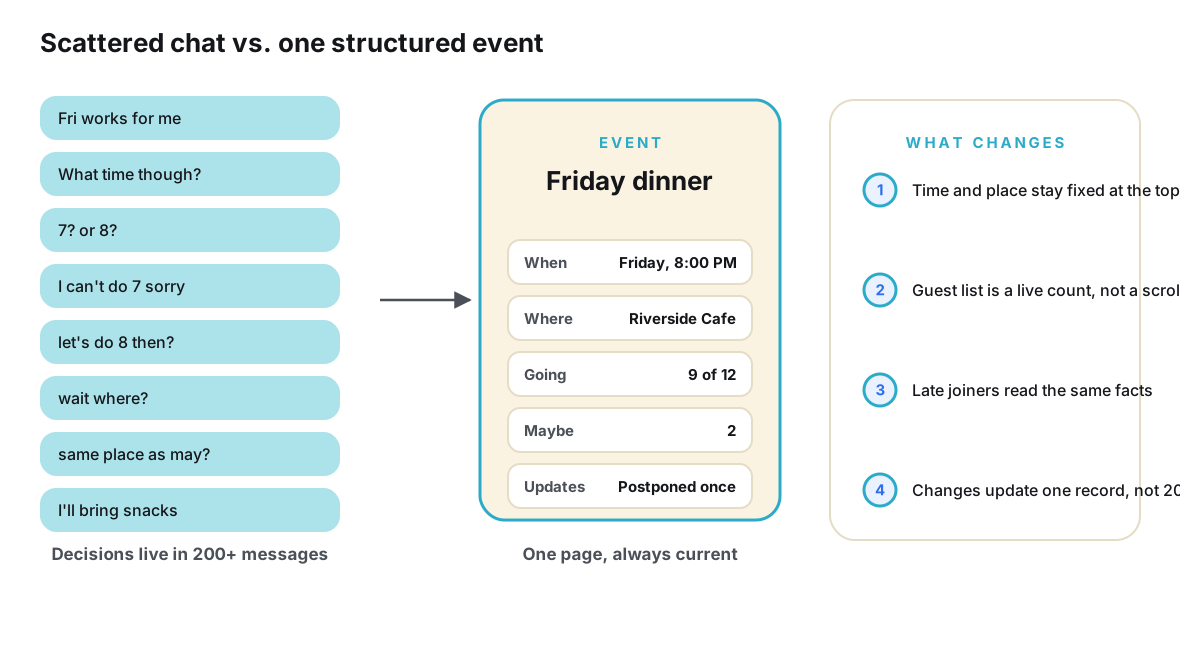
Watch what a large group does to a single time change. The organizer posts the new meeting time. Within an hour it is forty messages up, behind a debate about car seats and a run of photo reactions. Someone quotes the old message to ask if it is still accurate. Someone else screenshots the correction and pastes it back in — a copy of a fact, reinserted into the stream that lost it. By evening the thread contains the original time, the corrected time, a question about the original time, and a screenshot of the correction, and every member has to do archaeology to reconstruct which one is live.
Then the coordination quietly emigrates. The organizer starts answering people one-on-one in private messages, because it is faster than watching the question get buried again. A carpool splits into its own small chat. The veterans stop reading the main thread at all. The big group is still there, still nominally the home of the community — but the actual planning has left the room where the community lives, which means new members can no longer watch planning happen and learn it.
There is a subtler casualty too: the group’s collective memory of itself. A small group remembers its own history — the trip where it rained, the dinner that ran late — because the members lived it and the thread is short enough to hold it. A large group’s history becomes unreadable in any practical sense; last month’s hike plan, with all its back-and-forth, is thousands of messages deep, indistinguishable at a glance from this month’s. The community gets amnesia not because anything was deleted but because nothing can be found. Photographs survive in the album; the plans that produced them dissolve.
| Rough size | What the group feels like | What happens to coordination |
|---|---|---|
| A handful to a few dozen | A circle: shared context, in-jokes, everyone visible | Chat planning works; decisions stick because everyone actually reads them |
| A few dozen to around a hundred | A gathering: side conversations appear, some faces blur | First re-asks and missed details; each event starts spinning off private side chats |
| Around a hundred to three hundred | A crowd: announcements outnumber conversation | Event details can no longer survive in the thread; admins and norms become necessary |
| Three hundred to the 500-member cap | A broadcast channel with a comment section | Each event effectively requires its own space; the group works as reach, not as a planning room |
The bands are illustrative, not measured — groups differ in culture and activity — but the progression they describe is consistent: somewhere on the way up, the group stops being a place where decisions can live and becomes a place where they are merely mentioned.
The moderation load nobody assigned
Every large group has a person who tends it. In WeChat that role centers on the member who owns the group: admissions and removals, the renaming of the group to match its current purpose, the small judgments about what belongs. At fifteen members this is nothing. At four hundred it is a standing unpaid job, and one that grows precisely because growth is the goal — every new member is a small addition to the moderation surface.
Moderation at scale is also socially expensive in ways small-group members never see. Removing a disruptive person from a twelve-member friend group is awkward; removing one from a four-hundred-member community is a small public event, with an audience and opinions. Declining a join request from someone’s cousin is a diplomatic act. The larger the group, the more the owner’s role shifts from participant to custodian, and custodians burn out for the same reason planners do: the work is invisible, continuous, and attributed to nobody.
Large groups also develop norms, which deserve to be recognized as what they are — a structural response to noise. Rules about what may be posted, when, and in what form are attempts to reduce the stream to something readable without requiring anyone to read it. Norms work, up to a point. But notice what their existence concedes: the group has already accepted that its members cannot keep up, and is now managing their attention by policy. That is a reasonable adaptation, and it changes the character of the group from a conversation into a commons with rules — a different, still useful, thing.
Every platform draws a line somewhere
WeChat’s 500-member ceiling is worth comparing with its neighbors, because the comparison reveals what the number is really about. WhatsApp group chats support up to 1,024 participants — roughly double. Telegram supergroups support up to 200,000 members, and Telegram explicitly separates channels, a one-to-many broadcast medium, from groups, a many-to-many conversation. These are different design points on the same curve, and each is a trade-off between liveliness and scale rather than a ranking of quality.
The comparison also shows that a bigger ceiling does not solve the coordination problem — it postpones it. A ten-thousand-member conversation is not ten times more useful than a thousand-member one; it is a different medium entirely, closer to a stadium than a room. The question that matters to an organizer is not “how many people can join?” but “what can this container hold?” A group of any size holds members and messages. No size of group holds a final time, a definitive roster, or a change history — those need a different kind of container.
There is even a fair argument that WeChat’s earlier ceiling is a quiet kindness to organizers. It forces the structural question — should this really be one group? — at three hundred members instead of fifty thousand. Telegram’s channel-and-group split is the same insight expressed as architecture: at scale, broadcasting to a community and conversing within it are different jobs that deserve different rooms. Either way, the platform is hinting at the truth this article keeps arriving at: community size and planning capability are separate axes.
Why splitting the group doesn’t fix coordination
The reflex response to an oversized group is to split it, and it is half right. Splitting by city, by language, or by activity level genuinely reduces noise — each sub-group gets closer to that fifteen-member circle where reading everything is feasible again. As a move for conversation, it works.
As a move for planning, it trades one failure for another. The Saturday hike now needs to be announced in three groups, because membership overlaps but is not identical. Someone cross-posts; someone else forgets to. The members who belong to both groups see the plan twice and cannot tell which copy is current. The members who belong to neither see nothing at all. You have replaced “one loud room where the plan got lost” with “three quieter rooms holding three slightly different plans” — noise has become divergence, and divergence is the more expensive failure, because it only reveals itself on the night.
The reason splitting can’t fix this is that it multiplies containers of the same kind. What the plan actually needs is a container of a different kind — not another conversation, but an object: something with a time, a place, a roster, and one current version. That distinction — between a stream of talk and a thing with state — is laid out in the difference between a conversation and an event object, and it is the load-bearing idea in every fix that follows.
| Symptom | What it really means | Structural response |
|---|---|---|
| The same question asked again and again | The thread has no readable current state | A single address per event that always shows the latest facts |
| Screenshots of old messages pasted back in | History is being used as a record | A living record that replaces the screenshot with a link |
| Members learn about events after they happened | Reach is being mistaken for attention; the group is muted | Per-event invitations and links people can check on purpose |
| Two subgroups arrive with different details | Parallel copies of the plan have diverged | One source of truth referenced by every sub-group |
| The owner spends evenings answering privately | The organizer has become a human switchboard | Self-serve event information that survives without retelling |
| Join requests outpace actual events | The community has outgrown a single container | Purpose-based sub-groups plus events with their own homes |
Read down the middle column and a pattern emerges: none of these symptoms is really about the number of members. They are about a single container being asked to be community, forum and record at once. Size merely makes the contradiction impossible to ignore.
A big community is an audience, not a room
Here is the reframe that makes the whole situation workable. A three-hundred-member WeChat group is a failure as a planning room and a triumph as an audience. It is where the community’s life is visible, where belonging happens, where a photograph from Saturday’s hike reminds four hundred people that they know each other. Expecting it to also be the place where the next hike gets planned asks it to be two things at once — and it will always be better at the first.
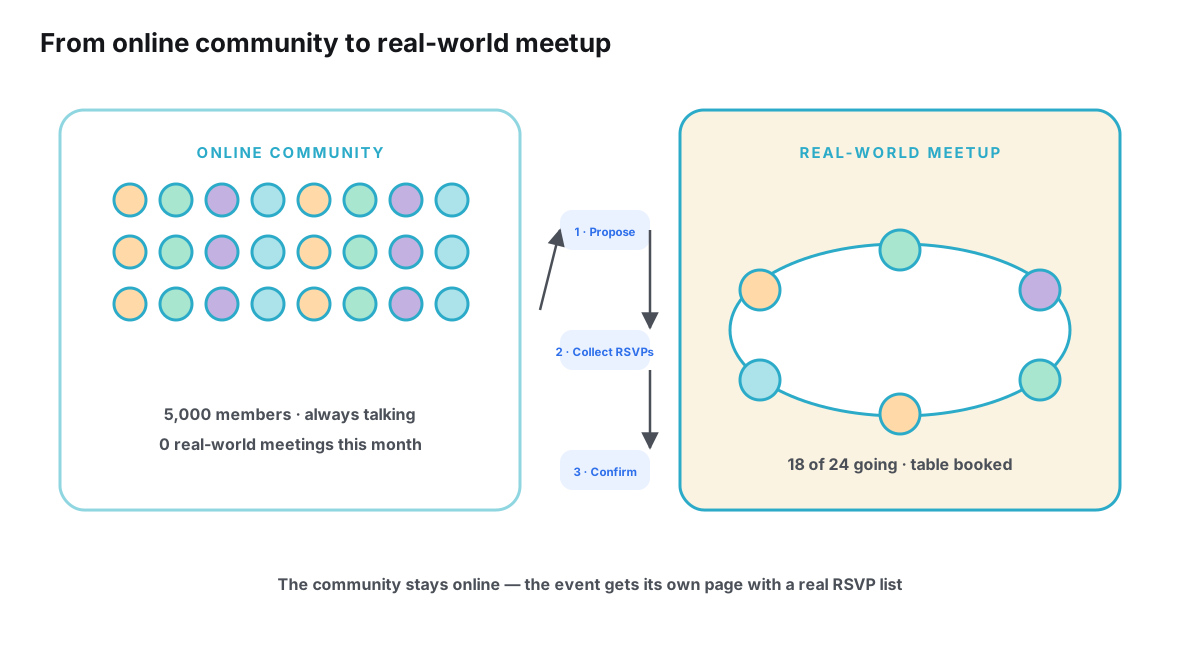
Picture the funnel a large community actually operates. Hundreds of members see an announcement. Some fraction is interested enough to open the link. A smaller fraction commits — actually says they are coming, to themselves and to the group. And a smaller fraction still stands at the trailhead at seven in the morning. Each of those transitions is a different conversation with different needs, and only the first one belongs in the big group. Interest, commitment and attendance each deserve their own mechanism — the middle of that funnel is exactly where a chat thread stops being able to help you.
This is doubly true for communities whose whole purpose is a rhythm of activities — the weekly hike, the monthly dinner — because a series multiplies the funnel. Every occurrence re-runs it with a different roster, which is its own engineering problem; the specifics are covered in how WeChat communities can organize recurring activities. What matters here is the conclusion both articles share: when each occurrence gets its own address, the big group’s role clarifies instantly. It announces, it links, it celebrates afterward. The noise drops not because anyone was shushed, but because the event finally stopped needing to live in the thread.
An architecture that survives scale
Putting it together, large WeChat communities that coordinate well tend to converge on the same layered shape. It is less a procedure than a division of roles:
- Keep the large group as the commons. Announcements, belonging, ambient community life, photographs afterward — the things an audience is for. Resist the temptation to also run logistics there.
- Split conversations by theme, not by membership. City chapters, activity types, the carpool people — sub-groups exist to make conversation readable again, and that is their only job.
- Give every event one address. A page that holds the current facts: time, place, cost, what to bring, and the RSVP list. It updates in place, so late lookers see the latest version, not the loudest one.
- Answer questions with the link. Every “what time?” gets the same one-tap reply. Consistency is what trains a group of any size to stop re-asking.
- Keep attendance on the event, not in the thread. Reactions and “+1” replies are moods; a named RSVP list is data. The restaurant needs the second kind.
This division of labor is precisely how tools like Ontaym are meant to slot into a WeChat workflow: each event gets a page with going and maybe statuses, polls for open options, updates and reminders, and one link that can be dropped into the big group — so the community keeps its gathering place while the event holds a state of its own. But the layering matters more than any particular tool; anything that gives events stable, current-state addresses will do the job.
None of this requires the community to leave WeChat, and that is the point. The group stays exactly where the people are. What changes is that plans stop being sentences in a stream and start being objects with addresses — and the moment that happens, the size of the group stops being the thing that determines whether Saturday works.
Frequently asked questions
How many members can a WeChat group chat hold?
WeChat group chats support up to 500 members. In practice, the limits of running an event out of a single conversation arrive long before the ceiling itself: details scroll away, members mute the thread, and the organizer ends up re-answering the same questions. Treat the cap as a reminder that a large community and a planning room are different things.
Should I split a large WeChat group into smaller ones?
Splitting helps with noise, and for conversation themes — city chapters, separate interests — it is often the right move. But splitting alone fragments plans: the same event then exists as several diverging copies. Pair any split with giving each event a single address that every sub-group links to, so the conversation can divide while the plan stays whole.
Why do members mute large groups, and what does that mean for organizers?
Muting is the rational personal response to volume — in a big group, most messages are not for any one member. For an organizer it means reach is not readership: a posted time reaches only whoever happens to be watching the thread. Event-critical facts need a place people check on purpose, such as an event page with its own link and reminders.
Do other messaging apps handle large event groups better?
They draw the line in different places: WhatsApp group chats support up to 1,024 participants, and Telegram supergroups up to 200,000, with channels kept separate for one-to-many broadcast. A higher ceiling changes how many people can join, not what a message stream can hold. The gap between conversation and commitment appears on every platform; only the size at which it appears differs.
How do I announce events to a large WeChat group without spamming everyone?
Announce once, with a link. One message carrying the event’s address — where time, place and RSVPs stay current — replaces the cycle of restating details and answering follow-ups in the thread. Significant changes get a single line pointing at the updated page; everything else stays quiet.
Conclusion
A WeChat group growing toward 500 members is not a problem to undo — it is a community succeeding. What fails is the assumption that the same container can keep serving as gathering place, discussion forum and system of record as it scales. The symptoms are familiar: repeated questions, screenshots standing in for facts, plans that diverge between subgroups, an owner answering everything privately at midnight. Each one is the stream politely explaining that it was built to flow, not to hold.
The fix is architectural, and it is the same at every size past the breaking point. Let the big group be what it has become — an audience, a commons, the visible life of the community. Give ongoing conversation themes smaller rooms where reading everything is possible again. And give every event its own address: a page with one current version of the time, the place and the roster, which any member of any sub-group can check in two taps. Communities that make this split don’t get smaller or quieter. They just stop confusing the place where people talk about Saturday with Saturday itself.
Give your big group a gathering place — and your events a home of their own.
Plan it with Ontaym