
How WeChat Communities Can Organize Recurring Activities
A weekly hike or a monthly dinner is not one event repeated — it is a series, and a series has needs a single plan never has: a rhythm, standing rules, and a fresh RSVP list for every occasion.
Quick answer
Recurring activities strain group chats for a specific reason: every occurrence restarts the whole logistics loop — announce, gather reactions, count heads, re-share the details — inside a thread that never stops moving. What a series needs instead is structure that persists between occasions: a fixed rhythm (the same day and time window, so members can shape their lives around it), standing rules written once (difficulty, cost, cancellation norms, what to bring), and a separate RSVP record for each occurrence, because the twelve people who come this Saturday are not the same twelve as last time. Your WeChat community remains the audience and the social home; each occasion is a commitment object with its own address, headcount and update history. Keep those roles separate, and a series can run for years on a fraction of the effort that the first chaotic month suggested.
The community that meets every Saturday
Picture the shape of the thing before diagnosing it. A hiking community lives in a WeChat group — say, a hundred and fifty members accumulated through friends inviting friends, exactly the way healthy groups grow (up to the 500-member ceiling WeChat allows for group chats, per the platform itself). Every Thursday or Friday, someone posts the question: hike this Saturday? Which trail? Who’s in? By Friday night there is a tangle of replies, corrections, reactions, a route change, a debate about the weather, and a carpool forming in a side conversation. On Saturday, some number of people shows up at the trailhead, and nobody is quite sure until they arrive how many that will be.
The remarkable thing is that this works at all — for a while, on social energy alone. The first months of a series run on novelty: enthusiasm is high, the organizer is fresh, and the group is small enough that memory substitutes for records. Communities can coast on that energy for a surprisingly long season. But the season ends, and it ends for structural reasons, not because anyone stopped caring.
The diagnosis is that a series is a different object from an event, in the same way an event is a different object from a conversation. One dinner is a plan; a monthly dinner is an institution, and institutions are made of things that outlast any single thread: a rhythm, rules, memory, and a roster that renews itself. A chat thread provides none of those durably. The general mechanics of why threads struggle to hold event details are covered in why WeChat group chats become difficult for event coordination; what follows is the specific way those mechanics compound when the event happens again and again.
The re-announcement treadmill
A one-off event asks its questions once. A series asks them every cycle. Where, what time, who’s driving, what’s the cost, is it still on if it rains — for a weekly activity, that entire block of logistics must be re-solved fifty-two times a year, and in a chat-first workflow it is re-solved by re-typing. The organizer becomes a calendar daemon: every week the same announcement, every week the same follow-up questions, every week the same assembly of a headcount from scattered replies.
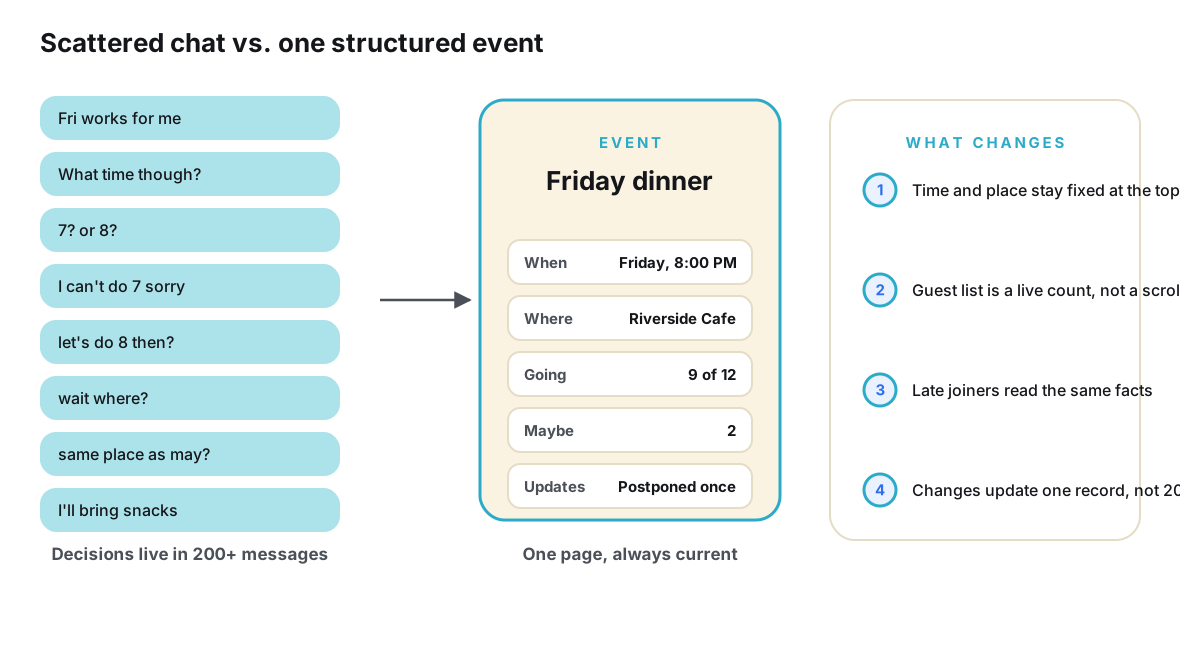
The treadmill has a corrosion pattern worth naming, because it attacks the two things a series needs most. The first casualty is the organizer’s stamina. Re-announcing is not hard once; it is hard the fortieth time, and series die most often not from lack of interest but from the one person who carried them getting tired. The second casualty is the members’ ability to tell this week from last week. Because every previous occurrence left its messages in the same scroll, a member catching up on Friday sees at least two sets of plans interleaved — this Saturday’s discussion and last Saturday’s, and possibly the one that got cancelled — with no structural way to distinguish the live one. The question “is this still current?” is answered, in a thread, only by reading timestamps and hoping.
There is a third, quieter cost: repetition flattens announcement value. In a healthy series, an announcement should carry information — this week’s trail, this week’s time. When the announcement must also re-explain the basics (where we meet, how we split costs, what to bring), members learn to skim it, and the skimming habit does not distinguish the week the time actually changed. The medium trains the community to ignore the very messages that matter.
| Aspect | One-off event | Recurring series |
|---|---|---|
| Announcement | Posted once, read once | Re-issued every cycle; must stay informative, not become wallpaper |
| Details | Settled once in the thread | Re-negotiated or re-stated each time; last occasion’s facts still in the scroll |
| RSVPs | One list, one window | A fresh list per occasion; commitments decay between cycles |
| Newcomers | Rare; usually known to everyone | Constant; each occasion is someone’s first |
| Rules | Implicit, carried by the group’s memory | Must be written and stable, or re-explained forever |
| Failure mode | One spoiled evening | Organizer burnout; the series quietly stops |
Read the right-hand column as a requirements list rather than a list of complaints, and it describes precisely the artifacts a recurring activity needs in order to stop depending on heroics: a rhythm that is fixed, rules that are written, an RSVP process that resets itself, and an onboarding path for the person experiencing it all for the first time.
Designing a rhythm that survives
The strongest recurring communities converge on the same small set of design decisions. None of them requires new software on its own; all of them require deciding once instead of deciding weekly:
- Fix the slot before anything else. Same weekday, same start window, every time — Saturday mornings, first Thursday of the month. A series that moves is a series members cannot plan around, and people who cannot plan around a thing eventually stop trying. Where the slot itself is contested, settle it once with a proper scheduling poll rather than a thread debate.
- Write the standing rules once. Difficulty and expected fitness, what to bring, how costs are split, the cancellation norm, whether plus-ones are welcome. Put them somewhere stable that new members can read — not in a message that will scroll. The test of good standing rules is that the tenth new member gets the same answer as the first, without anyone repeating themselves.
- Give each occasion its own record. Every hike, every dinner, gets its own page with its date, meeting point, that occasion’s details, and its own RSVP list. The record is where this Saturday lives; the group is where the community lives. When the two are confused, both suffer.
- Announce by linking, not by re-explaining. The weekly announcement becomes short by design: the occasion’s link, one line on what’s special this time. Everything durable lives behind the link. The announcement stays informative precisely because it stopped being a manual.
- Close each occasion briefly. A headcount of who came, a photo or two, and the next date. Closing the loop feeds the next cycle’s energy and, over months, builds the series’ real asset — a visible history that tells newcomers this is a thing that reliably happens.
The rhythm itself deserves one more word, because it is the piece organizers most often underestimate. A fixed slot is a promise the community makes to itself: this exists, regularly, and you may arrange your life around it. That promise is what converts a series from an event that keeps happening into a fixture of members’ weeks — the difference between “should I check whether the hike is on?” and “see you Saturday, as always.” Irregularity has real costs too, and sometimes cannot be avoided, but every deviation should be understood as spending some of the trust the rhythm accumulated.
Membership is not per-occasion attendance
A recurring activity reopens the gap between belonging and committing, and it reopens it every single time. The hundred-and-fifty-member group is the community; the twelve at the trailhead are the occasion. Between the two sits a filter that runs weekly: this date against every member’s calendar, energy, family, work and enthusiasm — a different set of answers every cycle. This is not leakage to be fixed; it is the natural shape of a healthy series, in which the community is wide and stable while each occasion is small and rotating.
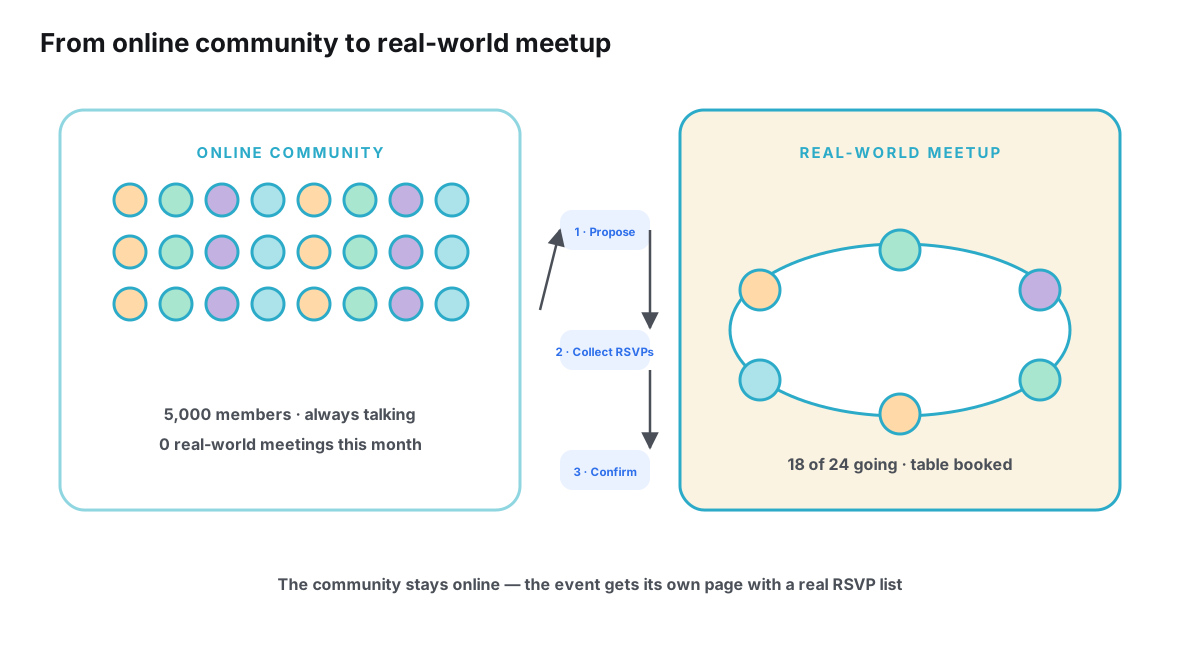
The organizing consequence is that per-occasion records are not bureaucracy; they are the only honest instrument for the thing being measured. Each occasion needs its own RSVP list — going, maybe, not — because commitments decay between cycles and must be re-collected fresh. Rolled into this is the deeper reason chat threads cannot serve: a thread’s reactions say nothing about which occasion they belong to. A fire emoji on Monday might mean this Saturday, or last Saturday’s photo, or hiking in general. An occasion page with its own RSVP list removes the ambiguity structurally — every answer is attached to one date. It is also a small instance of the larger argument that messaging apps were never designed to be event databases: the series needs state — per person, per occasion — and state is the one thing a message stream does not have.
Per-occasion records also change what the organizer can see. One week’s headcount is an anecdote; a run of them is a pattern. Which trail fills up and which needs a push; whether attendance dips when the start time shifts earlier; whether the month’s fifth Saturday is worth keeping. Series organizers who can see their own history make better series decisions — and, just as importantly, can hand the series to a successor without bequeathing a scrollback of folklore.
Newcomers and the standing invitation
A series that lasts acquires new members continuously — each occasion is somebody’s first, and for them the whole institution arrives at once. In a chat-first workflow, the newcomer’s experience is the worst in the group: they must infer the rhythm (“is it every Saturday? every other?”), the rules (“how hard is ‘moderate’?”), and this week’s plan from a scroll of insider shorthand. Many simply never convert from member to participant, and the community never learns why.
The fix is the standing invitation: one stable address that explains the series and leads to the next occasion. The newcomer reads the rules once, sees the next date, and RSVPs — without posting a nervous “sorry, new here, how does this work?” into a thread of a hundred and fifty strangers. The social warmth of the group still does the actual welcoming, on the trail or at the table; the structure just removes the barrier to arriving at all. And the distinction matters the other way too: joining one occasion should not require joining anything. Someone who wants to try a single hike before becoming a “member” of anything is the most common kind of recruit a series has, and the easiest to lose to friction.
| Task | Cadence | Where it should live |
|---|---|---|
| Series rules and what-to-expect | Written once, revised rarely | A stable page or pinned note linked from every occasion |
| The slot (day and time window) | Fixed; changed only deliberately | The series’ identity, visible on every occasion |
| Each occasion’s RSVPs | Every cycle | That occasion’s own record, reset fresh |
| Headcount for bookings or carpools | Per occasion, before a cutoff | Read from the RSVP list, not counted from the thread |
| Changes and cancellations | As they happen | Edited on the occasion’s record, announced in one line |
| Photos and recap | After each occasion | The community group, where the warmth belongs |
| Series health check | Occasionally, per season | Attendance history across occasions |
The right-hand column is deliberately split between two homes, and the split is the article’s whole thesis in miniature: the durable, informational pieces live at stable addresses; the warm, conversational pieces live in the WeChat group where the community actually talks. Trouble begins the moment either column drifts into the wrong home.
A week in the life of a well-run cycle
It is worth watching the rhythm operate at the scale of a single cycle, because the difference between a structured series and a treadmill one is mostly what happens on each day of the week. On Monday, nothing happens — deliberately. The slot is fixed, so there is no early debate to kick off. Midweek, the organizer posts the week’s only broadcast message: the occasion’s link, one line about what is special this time, and nothing else. Members who want to come mark themselves going or maybe on the occasion’s record over the next day or two, quietly, without generating messages for the other hundred and forty-eight people.
The rest of the week belongs to the group chat being a group chat — photographs from last time, jokes, someone asking whether the blue trail is muddy, and getting a human answer, which is exactly what a chat is for. On Thursday or Friday, anyone organizing carpools or a booking reads the RSVP list once and acts on it; the question “final headcount?” has an answer, and the answer is a number, not a scroll. If something changes — a storm front, a trail closure — the organizer edits the occasion’s record and posts a single line pointing at it; the correction does not need to out-shout anything, because it is not living in the shout-box.
Saturday happens. Sunday, the loop closes: a few photographs in the group where they belong, the occasion’s record shows who actually came, and the next date is already sitting at the same address it always sits at. Total organizer effort for the cycle: one link, one line, one edit at most. That is what the structure is for — not fewer events, fewer chores per event.
Money, venues and the series’ reputation
Recurring activities accumulate obligations that one-offs never meet. A restaurant that held fourteen seats for nine diners remembers. A coach company asked weekly for a bus “of about twenty” starts to discount your estimates. A deposit covered by the organizer and repaid “when everyone pays me back” is a small loan made on trust, repeated every month. None of these is a problem for the first occasion; all of them compound across a series, because the counterparty is the same and the record is the organizer’s memory.
This is the layer where per-occasion records stop being convenience and become credit. A series that can show a reliable headcount, honor its cutoffs, and settle its money promptly is building a reputation that venues can bank on — and reputation, for a community that books things, is infrastructure. It is also the layer where the no-show question gets its fair framing. People drop out of occasions; life intervenes; a healthy series does not police enthusiasm. What a healthy series does is make withdrawals visible — the RSVP list updates, the headcount the venue hears reflects reality, and the cost of a vacated seat lands where the group decides it lands, by a written rule rather than an awkward conversation invented on the spot each time.
The settlement mechanics can stay lightweight — a payment between friends is a solved problem inside WeChat, where payments sit beside messaging as first-class citizens. The unsolved part is not moving the money but reconciling it: who paid, who owes, for which occasion, against which final headcount. That reconciliation is bookkeeping, and bookkeeping needs a ledger — in this case, simply the occasion’s record, whose RSVP list and cost line up with what actually happened.
Choosing the slot, and choosing the tools
Two practical decisions remain, and both have well-worn answers. The first is settling the rhythm when the group’s calendars genuinely conflict. A thread debate about dates is the worst instrument for this — it produces the loudest schedule, not the most workable one. A structured scheduling poll, in the tradition of long-standing tools like Doodle, fits better: each member marks availability once, and the organizer reads the intersection rather than inferring it from a scroll of “Saturdays are tough for me but maybe.” The poll settles the slot; the slot then stops being a weekly question.
The second decision is where the series’ records live. Inside WeChat itself, the building blocks of a super app — messaging, payments, mini-programs, official accounts — offer pieces of the answer: conversation is native, payment is native, and embeddable services can cover specific needs like bookings. What the platform’s own pieces do not natively give a series is the commitment layer: one address per occasion with RSVPs, updates and history, shareable into the group and readable by the muted and the new alike. Each occasion is, in the vocabulary of the structured web, its own Event — a record with a start time, a location and a roster — and tools that treat occasions that way slot cleanly into a WeChat workflow. Ontaym, for instance, gives each occasion a page with going and maybe statuses, polls for the genuinely open questions, updates and reminders — one link dropped into the community group every week, standing in for the whole treadmill.
How that division of labor is run day to day — what stays in the chat, what goes on the record, and how to migrate a series that is already buried — is the subject of a companion piece on separating conversation from event information in WeChat. And the longer arc of where this is all heading — what it means that conversation, payments and services are converging inside super apps at all — is traced in the future of offline event coordination inside super apps.
Frequently asked questions
How do I run a weekly activity without re-explaining it every week?
Split the durable from the perishable. Everything that never changes — the rhythm, the meeting norm, the rules, what to bring — gets written once at a stable address. Every week, you post only what is genuinely new: this occasion’s link and one line. The re-explanation treadmill exists because the durable parts are being shipped as weekly messages; stop shipping them.
Should every occurrence really get its own RSVP list?
Yes, because the roster changes every cycle. The twelve who come this Saturday overlap but never equal last Saturday’s twelve, and commitments decay between occasions. A fresh going / maybe / not list per occasion is what makes headcounts honest, carpools plannable, and venue bookings reliable. One shared list or a running thread count measures the wrong quantity — enthusiasm, not attendance.
How do I handle maybes and no-shows in a recurring series?
Keep maybe as a real, visible status rather than an absence of information, and set a cutoff — a point at which the venue’s number comes from the going list alone. Make no-shows low-drama but visible: the RSVP list updates, and any cost rule was written in advance. A series polices nothing and records everything; that combination is what keeps both the warmth and the credit with venues intact.
Our attendance keeps dropping. What should we check first?
Check the rhythm before blaming the idea. An irregular slot is the most common cause of decay — members who cannot shape their weeks around the series stop trying. After that, check friction (how hard is it to find this week’s plan?), novelty balance (same trail every time versus never repeating anything), and the announcement itself — whether it still carries information or has become wallpaper the group has learned to skim.
Can we run the whole series inside WeChat alone?
The community side, yes — conversation, payment, photographs, belonging: that is what the group is for, and it is where a series’ social life should stay. The commitment side — per-occasion RSVPs, current details, change history, a newcomer’s entry point — needs records with addresses, which is usually a tool beside the chat rather than inside it. The link between the two is one message per week.
Conclusion
A recurring activity is the highest-value thing a community can build and the hardest thing to run on enthusiasm alone. The first occasions work on novelty; the fortieth works on structure — a slot people can plan around, rules nobody has to repeat, an RSVP list that resets itself every cycle, and a history that tells both regulars and newcomers that this is a thing that reliably happens. None of that structure is glamorous, and all of it is what keeps the load off the one person who would otherwise become the series’ single point of failure.
The division of labor is the same one that runs through every article in this series, sharpened by repetition: the WeChat group is the community’s home — the warmth, the photographs, the belonging — and each occasion is a commitment object with its own address, its own date, its own roster. Every week, the bridge between them is one short message carrying one link. Communities that make that split routinely run their series for years on the effort that chat-only groups spend re-announcing their first month.
Run your series on rhythm and records — not on one person’s stamina.
Plan it with Ontaym