
What Happens When Someone Changes Their RSVP?
A changed RSVP is not an edge case to be tolerated — it's the normal heartbeat of any real plan. This article traces what one change sets in motion, and makes the counterintuitive case: the easier your system makes changing an answer, the more accurate your final headcount becomes.
Quick answer
When someone changes an RSVP, the change propagates through everything built on their previous answer: the headcount, the booking, the budget split, logistics like carpools and seating, and other guests' own plans. In a system with real RSVP records, the propagation is automatic: the person's status updates, the count adjusts everywhere, and the organizer sees the new truth immediately. In a group chat, the change becomes a new message that must out-shout an old reaction, and the record quietly rots. The strategic insight is that change friction determines data quality: when changing an answer is cheap and shame-free, people update early and honestly; when it's awkward, they stay silent and no-show instead. Systems designed for graceful change collect better data — not because their users are more virtuous, but because honesty is the easiest path.
The change is the system
Most people imagine an RSVP as an event's front door: you answer once, and the answer stands. The opposite is true. A first RSVP is barely information at all — it's a forecast, made from a distance, about a future evening. The answers that matter are the second ones, the third ones, the going that became maybe on the Tuesday and flipped back on the Thursday. Life interferes with plans on a rolling basis: shifts get rearranged, children get sick, energy and transport and babysitters all wobble. An event's guest list is not a photograph taken at invitation time; it's a living thing that breathes until the doors open.
This reframes what a planning system fundamentally is. A system that only captures first answers is a camera. A system built for events is more like instrumentation — it exists to keep observing while the truth moves, so that at any moment the organizer can read current state rather than reconstructing history. Every design decision that matters flows from this: whether answers are bound to people, whether old answers get replaced or merely contradicted, whether changes notify anyone, whether the headcount is computed or remembered.
So the question “what happens when someone changes their RSVP?” is not a corner case of event planning. It's the best single test of whether your planning system is doing its job — because the answer describes everything the system does after the easy part is over.
One change, six ripples
Set aside software for a moment and trace the physics of a single change. Priya, one of fourteen confirmed guests for a Saturday dinner, switches to not going on Friday afternoon. What actually moves?
The headcount moves first. Fourteen becomes thirteen, and every threshold keyed to the count gets re-evaluated: does the group still clear the venue's minimum spend, still justify the large private room, still hit the critical mass that made the event worth running? The money moves. Per-person costs recalculate; a shared bill split shifts; a deposit question may open if the drop crosses a tier. The logistics move. If Priya was driving two others, a carpool just lost a car, and those two guests now have a transportation problem that is properly the event's problem. The social geometry moves. A seating plan reshuffles; a team-based activity rebalances; the friend who was most looking forward to seeing Priya recalculates whether Saturday still works.
Other guests' decisions move. This is the ripple organizers most often underestimate. Some guests were coming partly for Priya; her absence tips their own cost-benefit calculation, and the system may face a cascade — one change that begets two more. And the organizer's decisions move. The table is now sized for thirteen, the quantity orders adjust, and the marginal call — add the extra dessert course? cancel the second bottle service? — gets made against the new number.
Notice that none of these ripples is a problem. They're just consequences, and most are cheap when they're timely. The expensive version of every ripple is the same: the change arriving late, or not at all, so the decisions get made against a stale number and reality audits them at the door.
| Change | Immediate effect | What the organizer must weigh |
|---|---|---|
| Going → not going | Headcount drops; per-person costs rise; logistics rebalance | Minimums and thresholds; cascade risk among guests close to the person |
| Going → maybe | Firm count drops, soft count grows | Whether to plan for the upper or lower bound; whether to nudge for a decision |
| Maybe → going | Headcount rises within a prepared range | Capacity, seat availability, per-person quantities |
| Not going → going | A reversal; late additions often arrive with needs | Capacity and any hard booking limits; the welcome is worth more than the friction |
| No answer → maybe | A silent guest becomes visible as uncertain | How much of the guest list is still dark; whether a reminder wave is due |
How a chat absorbs a changed answer
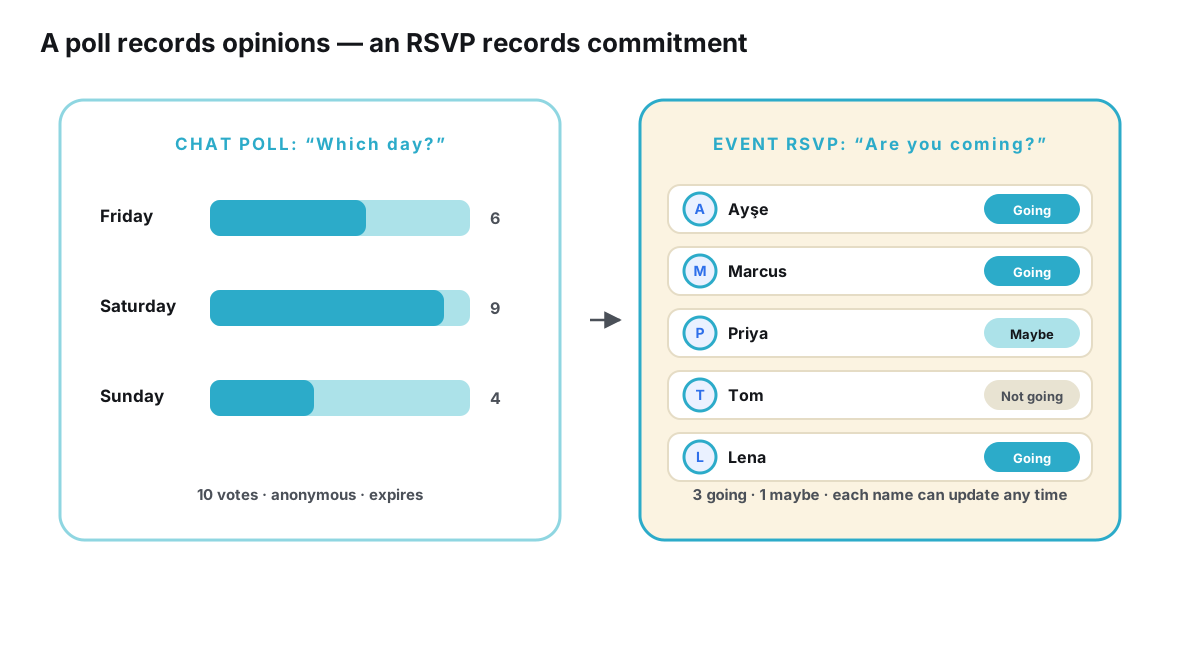
Now run the same Saturday dinner through a group chat. Priya's change arrives as a message — “so sorry, can't make it after all 😔” — and here the physics invert. The message is real and sincere, but it enters a stream that has no memory of answers, and so it does not update anything. The fourteen thumbs-ups from Tuesday's “final numbers please” message still stand, unblinking, directly beneath a contradiction.
What does the organizer hold now? Not thirteen guests, and not fourteen — an unresolved superposition that each participant resolves individually, by recall and scroll position. The restaurant gets told “thirteen, maybe fourteen.” The carpool riders see Priya's message or don't. And the guests who missed the message entirely continue planning around a Priya who has already left the plan. Nothing in the chat is malfunctioning; the chat is doing exactly what chats do, which is talk. It was never holding an answer to contradict.
The deeper damage is behavioral, and it compounds across events. Changing your answer in chat costs a public performance — an apology message, emoji and all, to a room of fourteen. That cost is precisely what many people won't pay twice. The rational adaptation is to skip the announcement: stay technically committed, let the night absorb the absence, apologize in person where it's cheaper. The chat's change friction, in other words, doesn't just fail to record changes — it trains them not to happen. Every organizer who has quoted “but you said you were coming!” has met the output of that training. The broader structural gap between reaction-gestures and real answers is covered in event RSVP vs group chat reaction; here, the focus is the aftermath.
Why graceful change produces honest data
This is the article's central claim, and it deserves to be stated plainly: the quality of an event's final headcount is a function of how cheap it is to change an answer. Not how diligent the guests are, not how many reminders were sent — how little friction, embarrassment and ceremony stands between “my plans changed” and the record reflecting it.
The mechanism is simple economics applied to social behavior. Every guest holds a private truth about their attendance that updates continuously. Whether that truth reaches the organizer depends on the price of transmitting each update. Where the price is a public apology to a group, guests batch their updates, soften them, and withhold the marginal ones — the resulting record lags the truth by days. Where the price is a two-second status flip, visible to the organizer without ceremony, guests transmit early and often, and the record tracks the truth closely. Same guests, same lives, same flakiness rate — different friction, different data.
This is why the “maybe” status is not a soft feature but a load-bearing one. In a binary going/not-going system, the uncertain face a costly choice: inflate the count with a yes they doubt, or pay the social price of a visible no for something they haven't decided. A maybe gives uncertainty a legitimate, visible parking place — and a maybe that later becomes a going or a not-going is a normal status transition, not a reversal that needs apologizing for. Systems without maybe don't get firmer guests; they get noisier data, with uncertainty laundered into false certainty.
The same logic extends to re-entry. In high-friction systems, a guest who declined early and later becomes free faces an awkward un-declining — messaging the organizer to reverse themselves, which feels like asking for favors. In graceful systems, not going → going is just another status change, and the organizer would genuinely rather have it. An event that welcomes reversals gets closer to its true demand; an event that taxes them systematically undercounts its own success.
Change history as information
A record that captures changes doesn't just stay current — it accumulates a second asset: the pattern of the changes themselves. An organizer watching a guest list evolve can see which events have soft middles and firm edges, which invitations stall as maybe and never resolve, which day-of-the-week plans reliably shed attendees in the final forty-eight hours. None of this is available to a chat, which sees only a sequence of statements, and none of it is available to a frozen form, which sees only the final answers. Only a system that records transitions can answer questions about transitions.
The practical uses are modest but real. A headcount that has been stable for a week is a different planning object from one that lost three goings since yesterday, even at the same number — the second is still moving, and the organizer should wait before committing. A cluster of going→maybe shifts after a venue change is a signal about the venue, worth reading before it becomes a cluster of going→not going. Late-joining guests — the not going → going and no-answer → maybe arrivals of the final days — are visible as what they are: late demand, often the difference between a thin event and a full one.
There's a fair objection to note: change history has a privacy dimension, and well-designed systems treat it as organizer information rather than group spectacle. A guest's wobbling should inform the headcount without being displayed as public drama. The chat, again, does the opposite by default — every change is a performance in front of everyone — which is precisely the friction that suppresses honest updates.
Who needs to know, and when
Propagation is not the same as broadcast. When an RSVP changes, three audiences have legitimate interests, and they differ. The organizer has an interest in every change, immediately — it's their headcount. The affected guests — the carpool mates, the plus-one who was riding with Priya — have an interest in changes that touch their logistics, and in those only. The whole group generally has an interest in major changes only: a cancellation, a venue move, a date shift, not the ordinary breathing of the guest list.
Chat has one propagation mode — broadcast to everyone — which fails in both directions: it over-notifies the group about trivia (training everyone to ignore the channel) and under-notifies the specific people affected (who may not connect a general message to their situation). A structured event record can target: the count updates silently for everyone, the organizer gets the signal, and significant changes go out as event updates to all participants, distinct from the ordinary chat stream. The distinction between noise and signal in event communication is exactly the territory of how event reminders differ from chat notifications.
| Trigger | System response | Who perceives it |
|---|---|---|
| Any status change | Person's current answer replaces the old one; headcount recomputes | Organizer; anyone viewing the event page |
| Going drops below a noted threshold | Count crosses minimums or quorum the organizer set | Organizer, flagged |
| Change in the final days | Updated headcount attached to the upcoming reminder | All participants, via the reminder |
| Major event-level change (venue, date, cancellation) | Event update pushed to all invitees | Everyone invited, explicitly |
| Maybe held past a decision deadline | Single targeted prompt to resolve | Only the holding guest |
The pattern to notice: the system's responses are graduated — most changes whisper to the count, a few speak to the affected, only significant ones shout to everyone. That gradation is what keeps everyone's attention calibrated, and it's something a single broadcast channel structurally cannot express.
The social weight of the second answer
Beneath the mechanics sits a genuinely human problem, and honoring it is what separates systems that get honest data from systems that get polite data. Changing an answer is, socially, a small loss of face — even when everyone involved is kind about it. The person changing feels flaky; the organizer feels stood up; both parties would often rather not have the exchange at all. Every mechanism that makes the change a bigger exchange — more public, more formal, more apologizing — pushes toward silence. Every mechanism that makes it smaller pushes toward truth.
Design can shrink the exchange dramatically. A status change addressed to the system rather than to the group removes the audience. An interface that frames maybe as normal rather than as weakness removes the stigma from uncertainty. An update path that never requires the person to justify themselves removes the apology tax. And a record that treats reversals as data rather than as betrayal removes the organizer's temptation to litigate — “but you said!” — which is the single fastest way to teach a group to stop updating.
Groups can change their own culture along the same lines, whatever tools they use. Thank people for early notice instead of mourning the change. Never relitigate a flip. Say out loud, once per group lifetime, that a maybe is welcome and a timely no is a gift. These sound like soft manners; they are, in fact, data-quality policy — the human layer of the same principle the software layer implements.
Watching the funnel breathe
Zoom out to the whole event and the changes stop looking like exceptions at all. What an organizer is really watching is a funnel that narrows over time — invited to interested to going to attended — and RSVP changes are simply the visible motion of people moving between its stages. A going→not going is the funnel narrowing at one point; a maybe→going is it widening at another; the day-of reshuffle is the funnel settling into its final shape. The event's job is to end with the funnel's output matching the physical world's preparation: seats, food, space, energy.

This is also why invitations and answers belong to different objects than messages. An invitation carries the event's facts and the social ask; the answer is a per-person state that must live and move; the change is a transition that must propagate. Schema.org's shared vocabulary even models the reply as its own typed action on an event — RsvpAction — as documented at schema.org/RsvpAction, a formal acknowledgment that the answer is an object with behavior, not a sentence in a thread. On the messaging side, platforms like WhatsApp are explicit about what their features are — conversational conveniences within groups, as the WhatsApp Help Center documents — and community platforms like Discord frame event interest markers as expressions of interest rather than commitments, per Discord's support documentation. The industry has, in effect, already conceded the point: attendance state is its own thing, and it changes.
Putting it together: a workflow that expects changes
The groups that handle churn well run a workflow that assumes changes from the start, and it fits in four moves. Collect answers against a record — an event page holding one current status per person, reachable by a link from any chat. Price changes at zero — any guest, any direction, any time, no ceremony; the record updates and the count follows. Graduate the notifications — count changes whisper, logistics changes speak to the affected, event changes announce to all. Decide late, on current state — bookings and quantities keyed to the count as it stands at decision time, with a final re-confirmation wave close to the date.
Ontaym's event pages were shaped around exactly this loop — RSVP statuses with going, maybe and not going, updates, and reminders behind a single shareable link per event — but the loop matters more than any particular tool. What the loop replaces is the alternative everyone knows: a front-door photograph of intentions taken a week early, defended by apology messages, audited by reality at the door. The photograph was never the plan. The living count is.
One caution for groups mid-migration: expect the culture to lag the tooling. A group trained by years of chat friction will under-use a free update path at first, out of habit. The organizer's best move is to demonstrate the norm — change statuses visibly, thank early notices, never relitigate — and within a couple of events, the guests discover that updating is easier than flaking, and the data starts telling the truth. That discovery, repeated across the guest list, is the whole game.
Frequently asked questions
Isn't a lot of RSVP churn just flakiness?
Some of it is, and some of it is life. The planning problem is identical either way: the organizer needs the truth to arrive early enough to act on. Systems that shame churn get less honesty, not less churn — the changes still happen, they just arrive as silence and no-shows instead of updates. Treat churn as weather: unavoidable, observable, and manageable if you can see it coming.
When should I lock the headcount for a booking?
As late as the booking allows. The final days before an event carry the most churn — and the most information — so every day you delay the lock captures motion you'd otherwise miss. Give yourself one re-confirmation wave close to the date, resolve the maybes you can, then commit. Locking early doesn't reduce change; it just guarantees you're holding yesterday's number.
How do I stop the cascade when one person drops?
Mostly, you don't — and shouldn't try to. Guests are entitled to weigh who else is coming. What you can do is keep the cascade visible and fast: if the count updates immediately, each subsequent guest decides against current truth rather than a stale fourteen, and the event settles quickly at its real size. Cascades are only catastrophic when they happen after the booking, in private.
What's the right number of reminders?
Few, targeted, and tied to real moments: one when the invitation lands, one at a stated decision deadline, one final wave near the date. The goal isn't repetition but resolution — each reminder should convert maybes and silences into answers, with the updated count visible. The mechanics of event reminders versus ordinary chat notifications deserve their own treatment, which we give in how event reminders differ from chat notifications.
Should guests see the current guest list?
Usually yes, in summary form — the count, and the going list where the group is socially comfortable with it. Visibility lets guests self-correct (“Priya's out? Then I'll take that ride with Tom”), which is the crowd sourcing its own logistics. What shouldn't be public is the churn itself: stage-by-stage change history belongs to the organizer, not to the group's entertainment.
Does all this matter for small friend groups too?
The stakes shrink but the principle holds. Five friends still book tables, still share cars, still have one person absorbing the reconciliation work. What changes at small scale is tolerance: memory and a single group chat can paper over the gaps, so the cost of bad change mechanics is mild friction rather than real money. The moment reservations, quantities or quorums enter — or the group spans a few apps, where no single chat sees the whole picture — the same physics apply at full price. For keeping one authoritative count across a scattered group, see how to create one source of truth for a group event.
Conclusion
A changed RSVP sets off a chain that runs through the headcount, the money, the logistics, other guests' calculations and the organizer's calls — and the chain is only dangerous when it fires late. The systems that handle this well are the ones that treat the change as a first-class event: a named person's status flipping on a persistent record, propagated instantly, visible where it matters, silent where it doesn't. The systems that handle it badly are the ones where a change is a message that must out-argue a stale gesture, performed in front of an audience.
The strategic lesson is the one worth keeping: friction is where data goes to die. Every ounce of ceremony, publicity or guilt attached to changing an answer converts directly into silence, and silence converts into no-shows and mis-booked venues. Make the second answer cheaper than the first, welcome the maybe, thank the timely no, and decide as late as the booking allows. Groups that do this aren't stricter or luckier than the ones coping with chronic no-shows — they've simply built, or chosen, a system where telling the truth is the easiest thing a guest can do.
Let answers change as freely as plans do.
Plan it with Ontaym