
How to Stop Important Event Details From Getting Buried in WhatsApp
The address is in there somewhere — posted once, eleven days ago, between a meme and a debate about parking. Details don’t get lost in WhatsApp; they get buried alive, and every guest becomes an archaeologist on the night.
Quick answer
Event details get buried in WhatsApp because a chat ranks information by recency, while an event’s key facts — final time, place and address, headcount, dress code, what to bring, what changed — are a small, stable set whose importance never decays. No amount of pinning fixes this permanently, because pins, recaps and re-posts are snapshots that age as soon as the plan moves. The reliable fix is structural: give the facts one permanent home — an event page or link that always shows current values — and let the chat point at it. Answer “what’s the address?” with the link, not a restatement. Update details as edits at that address rather than as new messages, and the burial problem stops regenerating itself.
The moment a detail becomes “buried”
It helps to define the failure precisely, because “buried” is not “lost.” The address was posted. It exists, verbatim, in the thread’s history. Nothing was deleted. And yet at 6:40 PM on the night, three people do not have it — one is scrolling with a thumb that is getting faster and less careful, one is asking the group, and one has decided it is easier to message the organizer directly.
That is the anatomy of burial: not data loss but retrieval failure. The information is present and inaccessible at the moment it matters, and the moment it matters is precisely when nobody has attention to spend on retrieval — a doorway, a taxi, a parking lot. A detail is “buried” when the cost of finding it exceeds what a guest will spend under real conditions. Every mechanism in this article is about that cost, and every real fix is about reducing it to zero.
It is worth noticing who pays that cost, because it is not distributed evenly. The guest pays in attention, at the worst possible moment. The organizer pays twice: once in the private messages that arrive when the group cannot find the answer, and once in the low-grade anxiety of knowing the thread is the only copy. The event itself pays whenever two people arrive with different versions of the facts. Retrieval failure looks like a small inconvenience and behaves like a tax on everyone involved — collected repeatedly, at the door.
Burial is also, notice, a property of success. Threads bury details because they are alive — because the group keeps chatting, and every new message covers the old ones a little more, the way snow covers a path without meaning to. A dead thread buries nothing. This is why the problem feels like betrayal: the group’s own health is what hides its own plan.
Three mechanics of burial
Underneath the everyday frustration, three specific mechanisms do the burying. Understanding them separately matters, because the popular workarounds each attack only one of the three.
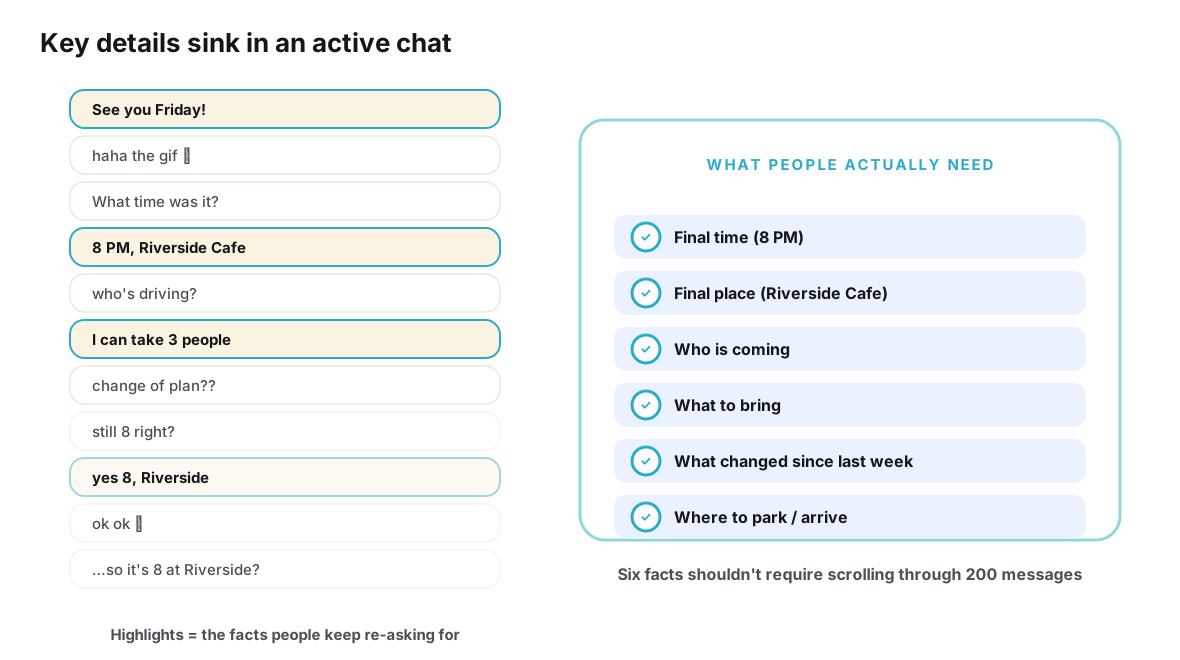
First, recency is the only ranking. A chat stream has exactly one ordering principle: newest first. For conversation this is correct — the latest message is usually the relevant one. For event facts it is exactly backwards: the address posted Tuesday and Thursday’s forty messages about something else are ranked as if Thursday mattered more, when in fact both are noise relative to the address. The interface cannot express “this message is load-bearing,” because importance is not a property messages carry. So the facts sink at the same rate as the jokes — no faster, no slower, and entirely regardless of how essential they are.
Second, search works on words, not on state. Guests do try the search box, and it half-works, which is arguably worse than failing outright. Searching the thread for “address” returns every message containing the word — the address itself, the question about the address, the joke about getting lost, and the correction of the address, ranked by recency, indistinguishable at a glance. What the guest wanted was a field — the current address — and what search offers is a bag of historically proximate words. Searching for “Friday” is even worse in a thread that discussed moving the event off Friday: both the live fact and the dead one surface, wearing identical bubbles.
Third, copies become artifacts. When details sink, the group improvises rescue: the address gets screenshotted and re-shared, the plan gets forwarded into the one-to-one chat, someone photographs the pinned message. Each copy is a small mercy in the moment and a liability afterwards — because now the truth exists in multiple places that will not update together. The screenshot on Tom’s phone still says 8 PM after the correction to 9; the forwarded plan in the couple’s private chat predates the venue change. Burial by scroll is replaced by burial by version, which is harder to notice and worse to debug.
Together these mechanics explain the paradox every organizer knows: the more actively a group communicates, the less findable its own plan becomes. The general decay this produces in planning threads is covered in why WhatsApp groups become messy when planning events; the rest of this article stays narrowly on the retrieval problem and its fixes.
The short list of facts that must never sink
The good news is that the burial problem is small, numerically. Guests do not need the thread — they need a handful of facts, stable and current. Everything else in the conversation is genuinely optional reading.
| Fact | Why guests need it | Where it usually ends up |
|---|---|---|
| Final date and time | Attendance, calendars, babysitters | Superseded by later corrections indistinguishable from the original |
| Place, with full address | Navigation, punctuality | A partial name (“the usual place”) or a screenshot of a map |
| Who is coming | Expectations, lifts, social comfort | Inferred from reactions and replies, never stated as a list |
| What to bring or wear | Participation without embarrassment | One message in the middle of a logistics exchange |
| Costs and how to settle | Practical participation | Discussed, agreed, and never summarized anywhere |
| What changed, latest first | Trusting the rest of the facts | Implicit in message ordering — the guest performs the diff |
Six facts. That is the entire payload of a two-week thread, minus the pleasure of the conversation. This ratio — six facts carried by several hundred messages — is worth internalizing, because it reframes the problem: you are not trying to make the thread searchable. You are trying to give six facts a home whose findability does not decay.
The workarounds, and why each one decays
Groups are resourceful, and WhatsApp gives them tools to fight burial — the WhatsApp Help Center documents pinned messages, group descriptions and polls among the features organizers lean on. Each workaround is rational. Each also decays on a schedule you can predict, because each is a snapshot fighting a stream.
| Workaround | What it achieves | How it decays |
|---|---|---|
| Pinned message | Keeps one message visible at the top | Goes stale on the first change; re-pinning leaves members holding the old pin |
| Group description | A stable note every member can open | Too small for event detail; invisible unless opened; edited silently |
| “FINAL PLAN” re-post | A fresh, complete snapshot | Ages immediately; two finals coexist after the second change |
| Poll for key choices | Closes one question visibly | Records the vote, not the outcome; cannot carry an address or an update |
| Screenshots and forwards | Rescues one guest, once | Copies drift from the source; the sender cannot update what recipients saved |
| Answering everyone directly | Always correct, always current | Concentrates all retrieval on the organizer — the human becomes the index |
Read down the failure column and a single theme emerges: every workaround ages, and the aging is invisible. Stale pins look identical to fresh ones; last month’s screenshot carries the same confidence as today’s. The workarounds do not fail loudly — they fail silently, into the pocket of whichever guest trusted them. This is why groups re-run the same rescue on every event without ever questioning the setting: each individual workaround genuinely helped, once, briefly.
Writing details that survive anywhere
Before the structural fix, a craft-level one — because whatever medium holds your details, badly written details bury themselves. The rules are few and unforgiving:
Write explicit values, not references. “The usual place” is a lookup into social memory that new partners and tired brains cannot perform. “Casa Verde, 14 Oak Lane” is a fact. The same goes for time: “8” and “tonight” and “after my thing” are all anchors that decay or depend on context; “8:00 PM, Saturday the 14th” is a fact that cannot drift.
Prefer text over images. A screenshot of a map or a photographed poster feels informative and retrieves terribly: it cannot be copied into a navigation app, searched by the thread’s search, or read aloud by a screen reader — which is not a niche concern, since the accessibility principles in the W3C’s WCAG standard exist precisely because text-in-images is invisible to a meaningful share of people and machines. An address as text serves everyone, including the guest dictating to their phone from a car.
Put each fact in one canonical form. If the address appears in the pin, the description and three messages, four things must be edited when it changes, and one will be missed. If it appears in exactly one place, exactly one thing must be edited. Canonical form is boring, and boring is what reliability looks like.
Finally, date your updates. When you must announce a change in chat, say what changed, the new value in full, and when the change was decided. “Update: we’re now meeting 9 PM (decided today, Thursday)” survives being screenshotted far better than “actually 9!” — the date lets a future reader notice the correction is newer than the original.
A single principle unifies these rules: write for the reader who wasn’t there. Every detail composed for the full context of the conversation — “the place we said”, “same time as before”, “after Tom’s thing” — silently assumes the reader followed along, and the reader most in need of the detail is precisely the one who didn’t: the late joiner, the muted, the partner forwarded a screenshot without commentary. A fact that stands alone, labeled with its field and its value, serves every reader equally, including the one holding it three weeks later under a streetlight with one bar of signal. Compression is for conversations; expansion is for records.
Give the facts one home
The craft rules buy robustness; the structure buys permanence. The structural move is to stop treating the thread as the place details live, and to give them an address instead — an event page or link whose whole job is to display the current values of the six facts. Then the thread’s job becomes pointing.
- Extract the facts. From the conversation so far, distill the six: final date and time, place with address, who is coming, what to bring, costs, and what has changed. Most of them will already exist in the thread — scattered, implicit, awaiting collection.
- Publish them at one address. Create the event page with the facts as labeled fields, not prose. Mark anything still open as open, so the page is honest about its own completeness.
- Post the link once, memorably. One message in the chat: the link, plus a sentence declaring it the permanent home of the plan. Make the declaration explicit — “from now on, everything final lives here” — because a norm stated once becomes the group’s reflex.
- Answer questions with the link. Every “what time?” gets the link, kindly, every time. This is not laziness; it is training the group’s retrieval behavior, and it is what stops the answer itself from becoming a new, decaying copy of the facts.
- Update facts as edits at the address. When something changes, change the page — then, if the change is significant, mention it in chat in one line that points there. The chat line announces; the page remains.
The pattern is tool-agnostic — it works with anything that holds current state at a stable link — and it is the design premise of event tools like Ontaym, where each event has its own page carrying the details, RSVPs and updates in one place, and one link that opens it from any app. What matters is less the tool than the invariant: one address, current values, always.
Expect the first event or two to involve some retraining, because the group’s reflexes were built by the thread. Someone will ask the question anyway; someone will answer with a restated fact instead of the link; someone will forward a screenshot of the page — which, at least, is a screenshot of something self-updating at its source. Correct gently and consistently: the link as the answer, every time, from everyone, including you. The reflex forms faster than you would expect, usually within one event, because the guests who adopt it are the ones who stop scrolling. Nothing teaches a new retrieval behavior like the absence of the old cost.
When the details themselves change
Burial has a twin: re-burial. A change handled as a new message does not just announce the new value — it re-creates the original problem, because now the old fact and the new fact are both in the stream, and the guest must once again perform the diff. The thread that was almost navigable becomes strictly worse with every update, which is the opposite of what updating should do.
This is why edits-at-the-address matters more than any posting discipline. An edit does not add to the stream; it changes what the stream points at. The guest who arrives late to the change does not need to have seen the announcement — they need only open the page, which has been showing the new value since the moment it was made. The full playbook for changes — including the messy case where the group has already fragmented across apps and versions — is covered in how to manage event changes when everyone has different WhatsApp messages.
Changes also interact badly with the burial of context. A correction that says “new plan: meet at the other entrance” presumes the reader knows which venue, which time, which entrance. The thread’s interleaving guarantees that some readers will find the correction without the context it amends — a failure mode unpacked further in what happens when someone joins a WhatsApp plan late. A page with labeled fields has no such ambiguity: “Entrance: north side” replaces its predecessor and stands alone.
When the plan spans more than one chat
Burial compounds when a group is not actually one group. Plenty of real events are planned across two or more conversations: half the friends in the WhatsApp group, one couple in an iMessage thread, the stragglers coordinated by SMS, a side debate in a private chat between two people who should probably just be in charge. Each additional chat multiplies the copies, and each copy ages independently.
The arithmetic gets ugly quickly. An update posted in one chat but not the other instantly forks the plan; the organizer must now remember which population received which version, which is exactly the kind of state a human should never be asked to hold. WhatsApp — whose product site presents, fairly, a messaging app organized around conversations — treats each group as its own world, and updates do not travel between worlds on their own. The guests experience the result as personal bad luck: two friends compare notes on the night and discover they attended slightly different events.
The one-home pattern dissolves this without asking anyone to consolidate their apps. A single address is app-neutral by nature: it opens in any browser, arrives intact through WhatsApp, iMessage, SMS and email alike, and updates everyone simultaneously because there is only one thing to update. The chats continue to chat, each in its own corner, all pointing at the same small set of facts. Fragmented conversation is a social reality worth keeping; fragmented facts are just an accident of where the conversation happened to start.
Retrieval, side by side
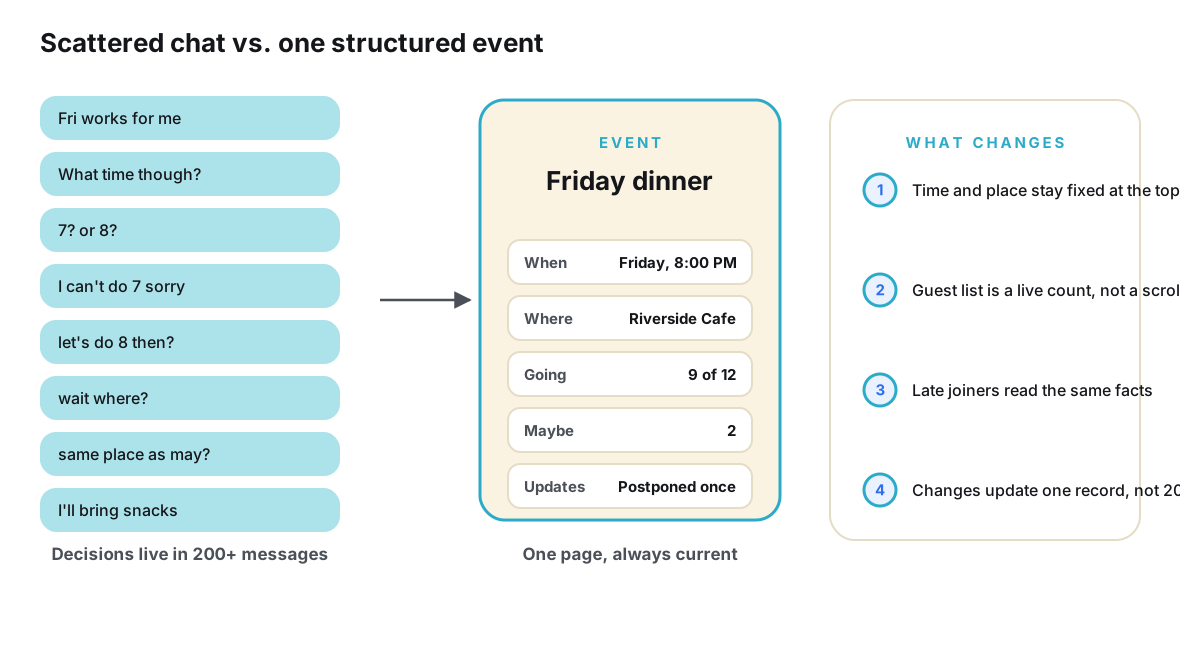
The clearest way to see what is at stake is to run the same guests through the same evening under both regimes — the thread that contains everything, and the address that shows the six facts.
| Moment | With the thread | With the event page |
|---|---|---|
| “What’s the address?”, 6:40 PM | Scroll, guess, or ask and wait | Open link, copy address into navigation |
| Late joiner, day before | “Scroll up” and archaeology | Open link, current in thirty seconds |
| Guest who muted the group weeks ago | Unlocks a backlog of hundreds of messages | Opens the one thing that was worth unlocking |
| Time changed yesterday | Two times in the wild; the diff is the guest’s job | One time, already updated |
| Organizer at dinner with family | Answers the same question privately, repeatedly | Points at the link once; dinner continues |
Notice that the thread column is not a story of stupidity or rudeness — everyone in it behaves reasonably, and the experience is still bad. That is the signature of a structural problem: reasonable people, following the interface’s own affordances, produce delay and error on schedule. The page column is not a story of better people either. It is the same people with the retrieval cost engineered out.
Frequently asked questions
Doesn’t pinning the details solve this?
Pinning solves burial for exactly as long as nothing changes. The first update makes the pin stale or forces a re-pin, and members who saw the first pin but missed the second hold outdated facts with full confidence. A pin is a snapshot at the top of a stream — useful, and structurally incapable of staying current.
Is WhatsApp’s in-chat search not enough to find things?
Search finds words, not facts. Searching “address” returns every message containing the word, ranked by recency, with the current value indistinguishable from questions and jokes about the address. It is a tool for finding conversations, and details are not conversations — they are values that need to be current, not present.
What should I put in the group description?
Use it for the pointer, not the payload: a single line naming the event and containing the link to the event page. Descriptions are stable and easy to open, which makes them an excellent signpost — and a poor database, since they are too small for detail and edit silently.
How do I stop people screenshotting the plan?
You cannot, and you should not try — screenshots are a rational rescue by guests the thread failed. You can only make the screenshot unnecessary and self-updating in effect: if the current facts live at a link that always shows current values, the screenshot becomes a convenience rather than a liability, because the source never goes stale.
Isn’t all this overkill for a casual dinner?
Often, yes — for a small, stable, one-fact plan, the thread is fine and the burial problem barely exists. The effort earns its keep when any of these hold: more than a handful of guests, details that changed at least once, people joining after the plan formed, or anyone who mutes the group by default. The cost of the fix is one page and one posted link; the cost of the failure is paid at the door.
What do I do when the details are already hopelessly buried?
One recovery message: extract the six facts from the thread, put them on an event page as fields, and post the link with a single sentence declaring it the home of the plan going forward. The old thread stays as history. The burying stops the moment the facts have somewhere better to live.
Conclusion
Details do not get buried because groups are careless. They get buried because a conversation orders everything by time, search matches words rather than facts, and every improvised rescue — the pin, the screenshot, the re-posted final — is a copy that starts aging on arrival. The harder the group works to keep facts visible inside the stream, the more copies of the facts it creates for the stream to lose track of.
The way out is to change where the facts live, not how hard everyone digs. Six facts — time, place, headcount, what to bring, costs, changes — written explicitly and given one address that always shows current values. The chat keeps everything that makes it worth being in: the jokes, the anticipation, the side conversations. It just stops being the place you go to find out where you are going. Groups that make this switch notice the same thing every time: the questions do not get answered faster so much as they stop being asked — which was the point.
Six facts, one link, zero archaeology.
Put your event on Ontaym