
How Telegram Groups Handle Event Coordination
Telegram groups are among the fastest ways to gather people around a plan: quick to create, enormous in capacity, generous with conveniences like polls, pins and bots. This is an honest map of what they genuinely do well for event coordination — and the seams that appear once a plan gets serious.
Quick answer
Telegram groups handle the conversational layer of event coordination very well: assembling people quickly, debating options, running polls, pinning the latest facts and scaling far beyond most messengers — supergroups support up to 200,000 members, according to Telegram’s own FAQ. What they don’t provide is the event as a structured object. A group stores the discussion about a plan, not the plan’s current state, so final facts live inside messages that scroll away, votes don’t function as commitments, and every late joiner must re-read history to work out what was decided. The seams show up as repetition, stale pins and headcounts nobody trusts. The durable fix is a split: keep the group for conversation and give each event one address that holds the current facts.
Why organizers reach for Telegram groups
Most events that end up in a Telegram group never started as a decision to use Telegram. A plan surfaces wherever the people already are, and in many circles — student clubs, expat communities, hobby groups, volunteer collectives — that place is a group chat that has existed for months. Creating a new group for the event takes seconds, the invite link travels anywhere, and nobody has to install anything new. That immediacy is a genuine strength, and it explains why Telegram has become a default venue for grassroots coordination in much of the world.
There is also the question of headroom. A small dinner doesn’t stress any messaging app, but organizers of bigger gatherings think about ceilings early, and Telegram’s are unusually high: a supergroup can support up to 200,000 members, as documented in Telegram’s own FAQ — dramatically more than the 1,024-participant limit WhatsApp documents in its Help Center. When a community expects its announcement group to keep growing, that capacity is a legitimate reason to choose the platform. It is worth saying plainly: scale of membership and quality of coordination are different things, and Telegram’s number addresses the first, not the second.
The third attraction is the feature set. Telegram treats groups as more than a shared inbox — there are polls, pinned messages, admin roles, message editing, discussion of every kind. For an organizer comparing bare-bones group chats with what Telegram offers, the difference feels like the difference between a hallway and a venue. Much of this article is about what happens when you actually host your event in that venue.
What a Telegram group does genuinely well for coordination
Instant assembly, frictionless joining
An event group can exist before the event has a name. Someone creates the chat, shares a link, and within minutes the relevant people are inside — no phone-number exchange for people who go by usernames, no per-person approval unless the organizers want it. For communities whose members already use the app, joining an event group costs one tap. This low-friction gathering is the single most underrated coordination feature any platform can have, because every later problem is easier when the whole audience is reachable in one place.
Identity that doesn’t cost a phone number
There is a quieter advantage that matters for events specifically: joining a Telegram group doesn’t require handing every stranger your phone number. People can participate under a username, admitted through a link an organizer shares, which lowers the social price of joining a group of semi-strangers — the exact situation most real-world events create. WhatsApp groups, by contrast, are built on phone-number identity, so a weekend hike with thirty acquaintances means thirty people who can now reach you directly forever. Anything that reduces the permanence of joining makes it easier for a community to say “come along” to its edges, and events live at those edges. For gatherings that mix friends, friends-of-friends and newcomers, that difference shapes who bothers to show up at all.
Polls with more nuance than most messengers offer
Telegram’s polling is genuinely thoughtful. A poll can be anonymous when the question is sensitive — “which day can everyone actually make?” — or public, with visible votes, when the group benefits from seeing who leans which way. There is even a quiz style, where one option is marked correct, which turns a poll into a lightweight way to confirm everyone has read something. As opinion-gathering instruments, these are well built, and organizers rightly lean on them. The limits appear later, when the votes need to turn into commitments, a distinction explored in depth in Telegram polls versus dedicated event decisions.
Pins, edits and admin structure
Unlike messengers that treat every message as permanent and equal, Telegram lets organizers pin the important ones, edit messages after sending, and hand out granular admin rights — someone can be allowed to pin without being allowed to remove members. These are real coordination tools. A pinned message can hold the current plan; an edit can silently correct an address without a corrective follow-up; admins can share the moderation load as the group grows. The trade-off is that all of these are manual disciplines layered on a message stream, and they decay the moment the humans maintaining them get busy. Pins go stale, edited messages still look like every other message, and admin structure says nothing about what the event’s facts currently are.
An open lane for automation
Telegram’s platform has long been unusually welcoming to bots, and community organizers use them for everything from welcoming new members to posting scheduled reminders; Telegram’s platform documentation describes the machinery in detail. For coordination, automation can genuinely help with the repetitive parts — a bot that re-posts the plan every morning, or collects RSVPs into a spreadsheet through a bot command. What automation cannot do is change the underlying shape of the container: a bot posting the plan is still a message entering a stream, subject to the same scroll and the same decay as everything else. It can repeat the state; it cannot be the state.
Put together, these strengths explain why so much real event coordination happens in Telegram groups, and why it mostly works. The table below summarizes how the container carries the actual jobs an event requires.
| Coordination job | How a Telegram group handles it | Verdict |
|---|---|---|
| Gathering the right people | Instant group creation, invite links, existing community groups | Genuine strength |
| Debating options (time, place, format) | Free-form discussion plus anonymous or public polls | Genuine strength |
| Recording what was decided | A pinned message, maintained by hand | Works with discipline, decays without it |
| Knowing who is actually coming | Poll votes, replies and reactions | Weak — signals, not commitments |
| Broadcasting a change to everyone | A new message, optionally pinned after deleting the old pin | Works, but costs repetition |
| Onboarding someone who joins late | “Scroll up” plus, at best, an up-to-date pin | Weak — depends on pin hygiene |
| Day-of coordination (location, timing) | Fast messaging everyone already has open | Genuine strength, if people still have notifications on |
One event, five stages of coordination
It helps to see the seams in motion rather than in the abstract, so picture a realistic case. Maya runs a photography walk for a city community: around thirty people, a route through three neighborhoods, a start time, and a cafe stop that wants warning about numbers. She creates a Telegram group on Monday, drops the invite into the community’s main chat, and by evening most of the interested people are inside — the formation stage, which the group handles about as well as any software can.
Tuesday and Wednesday are negotiation. Two dates compete, so Maya runs a public poll with visible votes and watches the second date win quietly; the route gets debated in a long, funny thread that is precisely what groups are for. Thursday the plan hardens — the cafe asks for a headcount — and this is the commitment stage, where the group starts to wobble. The poll says twenty-two yeses, but some voted before checking calendars, three people voted for both dates before the final one was fixed, and a handful who never voted at all have privately told Maya they’re coming. The honest number is somewhere around eighteen, and only Maya knows that.
Friday brings a change — rain moves the start from the park to the library entrance — and Maya posts it, edits the pin, and still answers the question twice on Saturday morning. On the day itself the group earns its keep completely: live coordination of a moving crowd is chat’s home ground, and the walk goes well. Sunday, when Maya wants a sense of who actually came and whether to run it again, the thread offers enthusiasm but no record. Formation: excellent. Negotiation: excellent. Commitment, change and aftermath: increasingly manual. That asymmetry, repeating for every event a community runs, is the whole story of Telegram groups and coordination in miniature.
The seams: where coordination starts leaking
The pattern in that table is consistent: Telegram groups excel at the parts of coordination that are conversations and strain at the parts that are records. This isn’t an accident of implementation — it is the shape of the container. A chat is an append-only, newest-first stream of statements, each true when sent. An event is a small set of current values — one final time, one final place, one definitive list of who is coming — that must stay true for everyone, including people who read nothing until the day before.
Follow a realistic plan through the group and watch the seams open. The date is proposed, amended and finally confirmed across three separate messages; anyone skimming encounters them in reverse order, so the correction reads like the error. The venue changes on Thursday, and the announcement is buried under two hundred weekend messages by Saturday; the people who saw it know, and the people who didn’t don’t know that they don’t. A member who left the group muted for a week returns, asks “so what’s final?”, and the honest answer is a paragraph of scrolling. None of this is a malfunction. The group did exactly what groups do: it held a conversation about the event, beautifully. It was never going to hold the event.
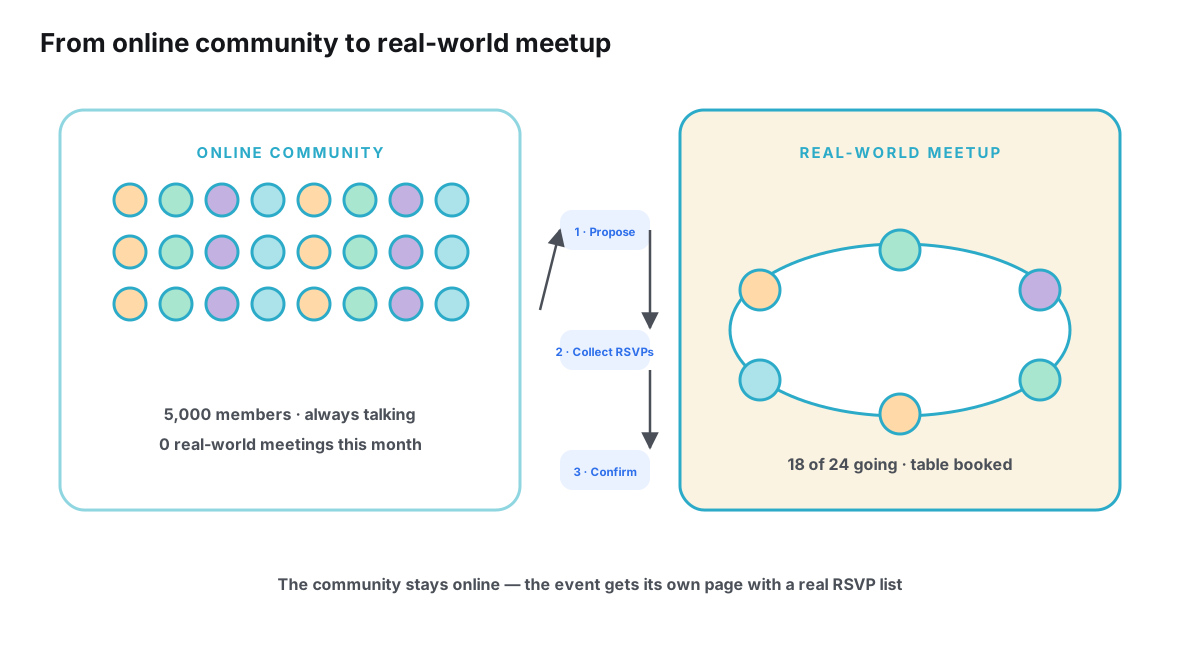
The moment of truth is the one in that picture — when an online community has to become a real-world meetup. Discussion is cheap to correct; a room with the wrong number of people in it is not. The restaurant wants a headcount, the walk needs a meeting point, the workshop needs a final start time. At that boundary, the group’s conversational strengths stop being sufficient, because the questions being asked are no longer “what does everyone think?” but “what is the state, per person, right now?”
Polls and pins: conveniences, not records
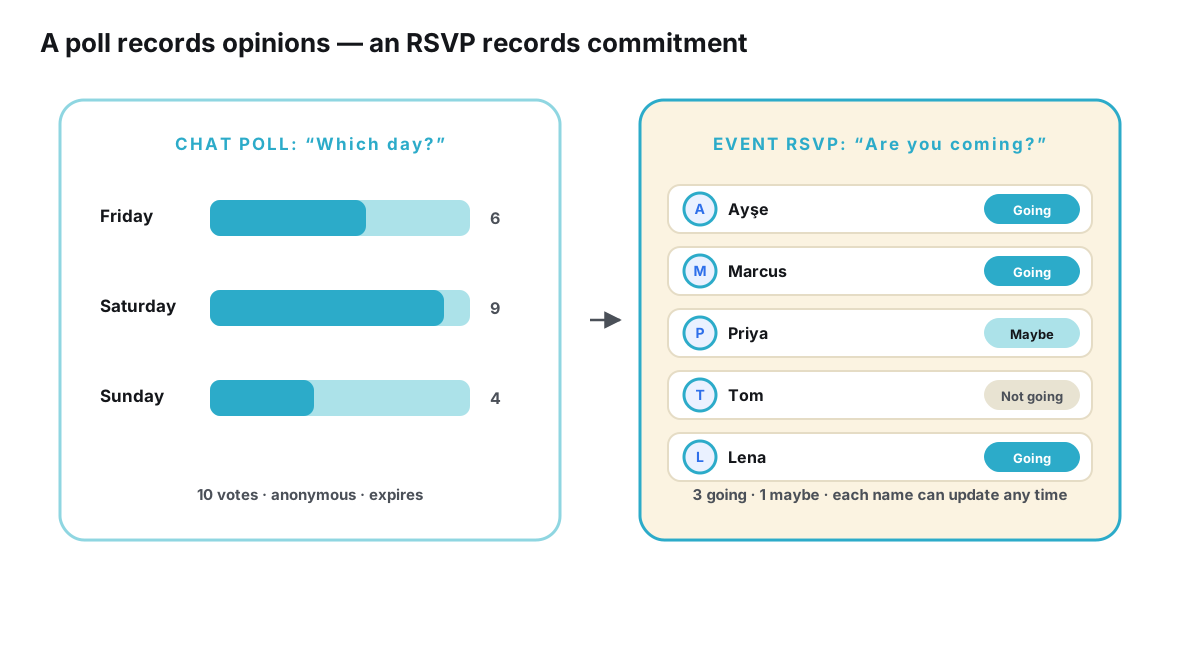
It’s worth pausing on the two features organizers press hardest into service, because both are better than their reputation and worse than the job asked of them. A public poll with visible votes is a fine instrument: it shows the distribution of preference and, with visible votes, who holds each one. But a vote is cast once, at one moment, in response to one phrasing of a question. It doesn’t update when someone’s week collapses on Friday; it doesn’t distinguish “sounds nice” from “I’ll be there”; and if the poll is anonymous, it can’t even support a follow-up question. Polls measure enthusiasm at a point in time. Attendance is a commitment that evolves over time.
Pinned messages have the complementary weakness: they freeze rather than measure. A pin is a snapshot of one message at one moment, and plans are not snapshots — they’re trajectories. The pin-based workflow every experienced Telegram organizer eventually invents is telling: edit or delete the old pin, re-pin the new one, post a message saying the pin changed, then answer the private questions from people who missed all of it. That workflow works, and groups run on it daily. But notice what it is: human labor simulating a database. Every update costs an organizer action, and every reader’s experience depends on the maintainer’s consistency.
| Coordination need | The coping pattern in a Telegram group | What it costs |
|---|---|---|
| A readable current plan | Maintain a pinned “living facts” message by hand | Every change is silent labor; one missed edit poisons trust in the pin |
| A real headcount | Run a poll, then manually chase the maybes and adjust for no-shows | The organizer becomes the attendance system, by memory |
| Changes that reach everyone | Re-pin, repost, and repeat the change in conversation | Repetition noise; people who saw version one and missed version two |
| Late joiners getting current | Answer “scroll up” or privately re-explain the plan | The same onboarding, repeated per person, forever |
| Post-event clarity | Scroll back through the thread to reconstruct what happened | An archaeology exercise exactly when energy is lowest |
Read the middle column charitably and a fair conclusion appears: a Telegram group can be bent into a workable coordination system by a sufficiently disciplined organizer. Read the right column honestly and the second conclusion appears: the discipline is expensive, invisible when it works, and fragile exactly when the event is busiest — which is when plans change most.
Channel or group? The first structural choice
One Telegram-specific decision arrives before any of the above: whether the event’s home should be a group at all. Telegram deliberately separates channels — one-to-many broadcast, where subscribers watch what the organizer posts — from groups, where everyone can talk to everyone. The separation is a genuinely useful design, because it lets announcements and discussion live in containers shaped for each. A weekly social club might run a channel for the schedule and a group for the banter; a one-off dinner rarely needs the channel at all. The trade-offs of each model, and the hybrid patterns communities build from them, are laid out in why Telegram channels and groups are different for event communication — a choice worth making consciously rather than by default.
A cleaner split: conversation in the group, state on a page
The groups that coordinate large events well over long periods tend to converge on the same architecture, whether or not they can articulate it: conversation stays in Telegram, and the event’s state lives somewhere with an address. The chat remains what it is best at — the place where the plan is argued into existence. But every settled fact is written once to a page that anyone can open, and the answer to “what’s the plan?” becomes a link instead of a paragraph.
This split changes the economics of every seam in the earlier table. Updates become edits at one address instead of messages in a stream, so they never need repeating and never go stale. Late joiners onboard themselves in seconds by reading current values rather than reconstructing history. The headcount becomes a live roll-up of per-person statuses — going, maybe, not going — instead of a poll the organizer must mentally adjust. And the organizer stops being the group’s human API, because the record answers the routine questions and the chat handles everything that genuinely needs a human.
Tools like Ontaym exist precisely to be the second half of that split — one link per event holding the final details, RSVP statuses and updates, while Telegram keeps the conversation — but the architecture matters more than any particular product. What matters is that the plan acquires a stable address that shows its current state, because that is the one thing a message stream structurally cannot offer. The broader argument is developed in chat versus structured event information in Telegram group planning, and the underlying reason the split works at all is explained in why an event needs its own digital space.
Scale changes the stakes, not the shape
Everything above is true for a group of twelve and doubly true for a group of twelve hundred. The seams don’t appear at scale; they widen. More members means more messages per hour, which means pins decay faster, changes reach a smaller fraction of readers, and the silent majority — people who never speak but fully intend to come — grows in step with the group. The organizers of big Telegram communities feel this as a rising sense that the group is talking about the event more and coordinating it less. What actually happens at that scale, including the specific behaviors that emerge as membership climbs, is covered in what happens when a Telegram event has hundreds of participants.
For smaller groups, the honest summary is kinder: a dinner among friends with one pinned message and a diligent host coordinates perfectly well in a plain group. The seams described here are not arguments against Telegram groups — they are a map of where the container’s guarantees end. Organizers who know where that line is can stop fighting the stream and start complementing it.
That framing is also fair to the platform. Telegram built a superb conversation venue and then kept adding conveniences — pins, polls, topics, bots — that soften the record-keeping gaps without eliminating them. Judging the venue harshly for not being a database mistakes a design choice for a defect. The practical move is to accept the venue for what it is and to give the plan what the venue doesn’t provide: somewhere to live.
Frequently asked questions
How many people can a Telegram supergroup hold for an event?
Up to 200,000 members, according to Telegram’s FAQ — far more than most messaging apps allow. That ceiling is about reach, though, not coordination: the work of keeping facts current and tracking attendance doesn’t get easier because the room is bigger. If anything, a larger group makes a structured event record more necessary, not less.
Are Telegram polls enough to know who is coming?
They’re a good first signal and a poor final answer. A poll captures a preference at the moment someone voted; it doesn’t update when plans change, distinguish enthusiasm from commitment, or produce a headcount you can give a venue. Public polls with visible votes help because you can follow up with specific people — but following up manually is exactly the labor a real RSVP system is meant to remove.
What’s the most reliable way to keep the final plan visible in a Telegram group?
A pinned message, edited rather than replaced whenever facts change, plus the discipline of posting a one-line notice whenever the pin changes. That combination is the best pure-Telegram answer. Its weakness is that it depends entirely on maintainer consistency, and every reader’s experience silently degrades the first time an edit is forgotten.
Should my event use a Telegram channel instead of a group?
If your event is mostly announcements to a large audience — a schedule, a venue change, a cancellation — a channel keeps that signal from drowning in chatter. If the event needs negotiation, questions and social energy, a group is the right container. Many communities run both and link them. The deciding factor is whether your attendees need to talk to each other or only to hear from you.
Can bots solve event coordination inside a Telegram group?
Bots can automate genuinely useful pieces: scheduled reminders of the plan, RSVP collection into a list, welcome messages for newcomers. What they can’t do is turn the chat itself into the record — a bot’s output is still messages in a stream, competing with everything else for attention. Automation is best aimed at pointing people at a current-state page, not at recreating that page message by message.
Conclusion
Telegram groups earn their place in event coordination honestly: they assemble people with almost no friction, host better discussion tooling than most messengers, and scale to communities other platforms simply cannot hold. For the conversational half of planning — proposing, arguing, persuading, joking a plan into existence — they are excellent, and pretending otherwise would be inaccurate.
The seams appear at the record-keeping half, and they are structural rather than accidental: a stream of messages holds statements, not state. Groups cope through pins, polls, reposts and organizer labor, and the coping works until it quietly doesn’t. The strongest pattern available to a Telegram organizer is therefore not to fight the container but to complete it: keep the group as the conversation, and give each event one addressable page that always shows the current plan, the live headcount and every change. The chat keeps its energy; the event gets its memory. That division of labor, more than any feature list, is what separates groups that merely discuss events from groups that reliably deliver them.
Let the group do the talking — and give the plan itself one address.
Plan it with Ontaym