
Telegram Polls vs Dedicated Event Decisions
A Telegram poll is a fine instrument for one job: collecting what people prefer, at the moment they’re asked. An event decision is a different object entirely — a commitment that binds, persists and updates. Confusing the two is the single most common way an enthusiastic group chat produces an under-booked room.
Quick answer
Telegram polls record opinions: each member votes once, at one moment, and the tally shows where preference stood. Event decisions need commitments: a per-person status that can change, an authoritative final value for time and place, and a headcount someone can act on. A vote is cast in seconds and costs nothing to abandon; a commitment is tracked, updated and expected to survive until the event. Telegram’s polls — which can be anonymous, public with visible votes, or quiz-style, per the platform’s FAQ — are excellent for narrowing options and building consensus. But converting those options into a decided event requires a record with identity, mutability and roll-up: who is coming, who is maybe, and what the final facts are. Use polls to choose; use a decision record to commit.
What a Telegram poll actually is
Mechanically, a Telegram poll is a message with a question and a set of options. Members tap a choice, the running tally updates for everyone, and the poll lives in the chat’s history like any other message. What elevates Telegram’s implementation above the average is the range of trust models it offers, as described in Telegram’s own FAQ: a poll can be anonymous, so votes carry no names and awkward preferences stay private; or public, with visible votes, so the group can see who stands where; or quiz-style, with one option marked correct — a format aimed at testing readers rather than surveying them, and one organizers occasionally press into service as a playful “did everyone read the plan?” check.
This flexibility is genuinely useful, and it belongs to a family of tools event planners have used for a long time. Scheduling polls are old enough to be their own category — Doodle has been running date-and-time polls for groups since well before chat apps had polls at all, as a long-standing dedicated scheduling-poll service. What that lineage shows is that the poll is a mature, respected instrument for one phase of planning: discovering what a group wants, given options.
Notice what even the best poll structurally contains, though: a question, options, and a set of one-time selections. There is no field for “but my Wednesday might collapse,” no way to vote conditionally, no mechanism for the vote to expire into a commitment, and — in the anonymous case — no identity attached to the signal at all. The instrument measures preference. It was never shaped to hold a promise.
What polls do brilliantly while a plan is forming
Before any decision exists, options have to be generated and narrowed, and here the poll is close to ideal. It lowers the cost of participating in a decision to a single tap, which changes who gets heard: the quiet members who would never type out “Saturday works better for me” in a fast-moving thread will click an option without thinking about it. Groups that debate dates in prose hear from the loud; groups that poll hear from nearly everyone. For any organizer who has watched a decision get made by the three people who type fastest, that widening alone justifies the tool.
Polls also make preference visible as a shape rather than a din. In discussion, the strength of feeling is hard to gauge — is Friday genuinely better, or did Friday’s supporters just post first? A tally turns diffuse argument into a legible distribution: a clear winner, a close race, or a fractured field that tells the organizer the options themselves are wrong. That diagnostic function is underrated. A poll that splits evenly is not a failed poll; it is a well-formed finding that the group needs a different question.
And polls create a quiet form of legitimacy. When the group can see the count, the losing side can see that it lost — visibly, numerically, without anyone having to argue the point to exhaustion. Many organizers run a poll precisely to close a debate painlessly, and it works: the vote becomes a small ceremony that converts discussion into a shared conclusion. Public polls with visible votes add accountability, since positions carry names; anonymous ones add honesty, since they catch the preferences people won’t say aloud. Choosing between those modes is itself a small design decision, and Telegram letting organizers choose is a real strength.
Designing the poll you do run
Since the poll is staying — for its phase — it deserves to be run well, and the difference between a good and a bad poll is larger than it looks. A good poll asks one question at a time. The compound poll — “Saturday 7pm at the ramen place or Sunday 6pm at the pizza place?” — quietly bundles date, time and venue into a single choice, and its result answers nothing cleanly: a group that picks option two may be voting against ramen rather than for Sunday. Where the dimensions can be separated, separate them, and let each poll close exactly one question.
A good poll also has exhaustive, non-overlapping options, including the escape hatches: “neither works for me” as an option tells the organizer infinitely more than silence does, because uncast votes are ambiguous while a vote for neither is data. And a good poll has a stated endpoint — “vote by tomorrow evening, majority takes it” — because a poll without a closing rule doesn’t resolve; it lingers, accumulating stray votes for days while the group mentally moves on. The closing rule is what converts the tally into anything usable, and it is the part organizers most often forget to announce. A poll is a small institution; like all institutions, it works when its rules are visible.
The moment a vote stops being a decision
The trouble begins at the boundary where preference has to become plan. A decision, in the sense an event needs, has properties a poll does not: it is binding rather than expressive, it persists rather than snapshotting, and it attaches to a specific person with a specific status. Consider what a restaurant actually requires from a party of fifteen: not fifteen signals of enthusiasm, but a number of firm commitments it can set tables for, with a way to absorb the two people who will inevitably wobble. The poll’s tally of fifteen yeses and the venue’s need for a reliable twelve are different quantities that merely look alike in a chat window.
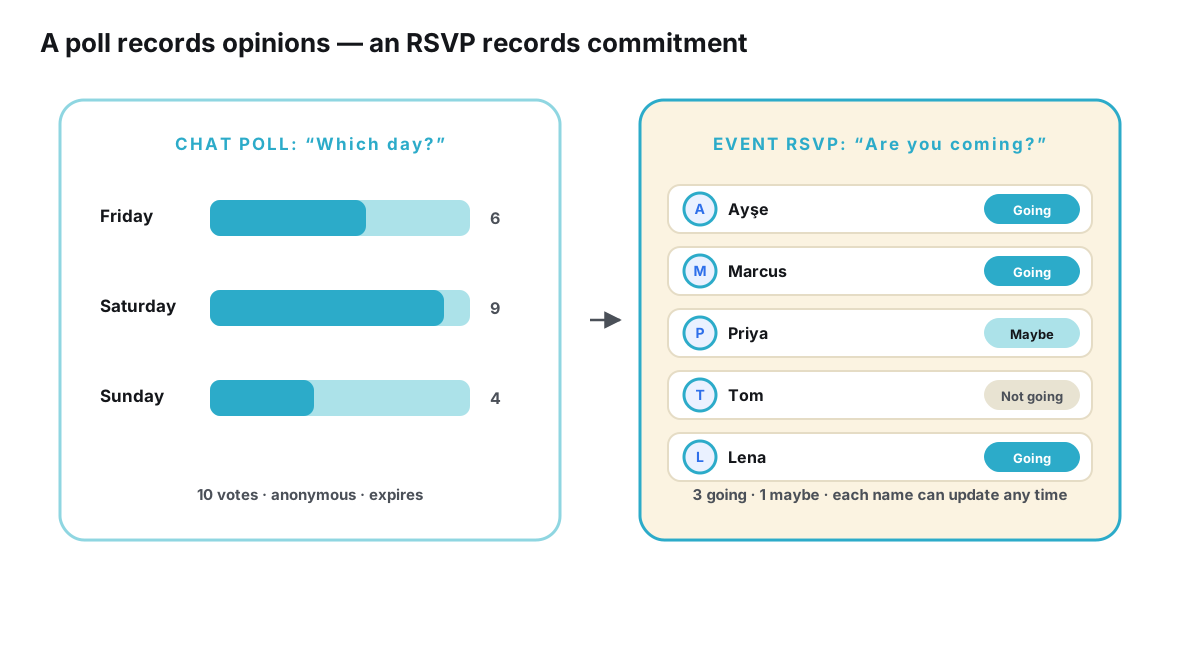
The structural differences are worth naming precisely, because they repeat across every event ever planned in chat. A vote is one-shot: it is cast once and cannot say “changed my mind.” A commitment is a living field: it is expected to move, and its whole value is that the movement is tracked. A vote is anonymous or semi-detached: even public votes don’t obligate the voter to anything beyond the click. A commitment carries identity and consequence: it is attached to a person the organizer can count, contact and re-confirm. And a vote’s meaning decays silently: the poll from Monday says the same thing on Friday even if the world has changed. A decision record that decays silently isn’t a record at all — which is the point at which the poll quietly stops being the event’s instrument.
| Dimension | Telegram poll answer | Dedicated event decision / RSVP |
|---|---|---|
| What it records | A preference, expressed once | A commitment, held until changed |
| Identity | Optional — can be fully anonymous | Essential — every status belongs to a named guest |
| Obligation created | None; a tap costs nothing | Social and practical; the organizer acts on it |
| How it changes | It doesn’t — the vote stands as cast | By design — going becomes maybe becomes not going |
| What it aggregates into | A distribution of opinion | A current headcount, at all times |
| Who can rely on it | The debate, to see which way the wind blows | The venue, the budget, the shopping list |
| After the event | Historical curiosity in the scroll-back | A comparable record: who came, who cancelled, when |
The headcount that keeps moving
The practical gap is easiest to see in a realistic week. Priya books a table for her book club’s anniversary dinner: fourteen people, a restaurant that wants a final number by Thursday. On Monday she runs a public poll — “Who’s in for Saturday?” — and by Monday evening twelve people have voted yes, one no, and three haven’t voted. The poll reads like an answer: twelve.
It isn’t. On Wednesday, Tom’s vote is still yes, but Tom has since learned his in-laws arrive Saturday — the poll doesn’t know, because votes don’t update, and Tom doesn’t think to find the poll and… do what, exactly? There is no mechanism for un-voting. On Thursday, one of the three non-voters tells Priya in a private message that she’s coming with a friend; another non-voter assumed the poll was optional and meant nothing. Meanwhile two of the twelve yeses were cast on enthusiasm Monday night and have since dissolved into busy weeks, without anyone deciding anything — commitment that was never actually asked for has simply evaporated. By Thursday night, Priya’s honest number is nine, plus one probable, minus one maybe. The poll still says twelve. She gives the restaurant ten and hopes.
Nothing in this story involves anyone behaving badly. Every individual acted reasonably: votes were cheap, so people clicked them lightly; plans changed, as plans do; and no instrument existed in which the changes could be recorded. The poll did its job perfectly — it measured Monday’s enthusiasm. The failure was architectural: the group used an opinion instrument as an attendance system, and the two diverged all week without anyone watching.
| When | What the poll shows | What a decision record shows |
|---|---|---|
| Monday, plan announced | Enthusiastic early voting; a promising tally | Invitees hold statuses: mostly undecided, some going |
| Mid-week, lives shift | Identical tally — unchanged by reality | Tom flips going to not going; the headcount moves with him |
| Thursday, venue deadline | A number no one can defend: stale yeses, invisible maybes | A current list: committed, maybe, out — decidable |
| Saturday, day-of | Buried in the thread; newcomers find it or don’t | The live list the organizer works from, updates included |
| Afterwards | A historical artifact of Monday’s mood | What actually happened, useful for planning the next one |
Why voting feels like deciding
If polls and decisions are so different, why do groups so reliably treat the poll as the finish line? Part of the answer is the tally itself. A vote count has the visual grammar of resolution — numbers, a winner, a closed question. Seeing “12 for Saturday” produces the feeling of having decided Saturday, even though nothing binding has occurred anywhere. The interface supplies the sensation of an outcome without the machinery of one.
Part of it is timing. Polls naturally appear early, when the group is excited and engagement is easy, and the click captures peak enthusiasm — Monday night’s yeses, everyone rested and optimistic. Commitment, by contrast, is asked late, when the event is close enough to compete with real life. Groups that poll well and never re-ask have effectively measured the mood at its high point and assumed it would hold.
And part of it is that a poll requires no one to do anything awkward. Re-confirming attendance means chasing people; closing a decision means announcing it and handling objections; collecting a real headcount means maintaining a list. The poll lets the organizer feel the administrative work is finished at the exact moment it has barely started. That comfort is precisely why dedicated decision tooling earns its place: it automates the awkward parts — re-asking, updating, tallying — that social momentum alone never will.
There is also an accountability asymmetry worth noticing. When a decision record exists and someone cancels late, the cancellation is visible against their commitment, and the norm becomes “update your status.” When the only record is a poll, attrition is invisible — the no-shows simply never mention it, and the group’s picture of itself stays flattering. Communities that run on polls systematically overestimate their own reliability, not because anyone lies, but because the medium has no place to record the truth.
Anatomy of a decision, apart from any tool
It helps to spell out what a real event decision consists of, independent of platforms. Stripped to its parts, deciding an event means closing four questions and recording the answers somewhere with an address: which option won, what the final facts are, who is committed to each status, and when the whole thing will be re-confirmed. Every reliable planning system — from a wedding spreadsheet to a dedicated event platform — is a structure for those four answers. The interesting design question is only ever where the structure lives.
In a chat-first workflow, the structure lives in the organizer: the pinned message holds the facts, the poll holds a fossil of preference, and the organizer’s memory holds the actual state of every guest. This works, the way a human can be a database for a small dinner. It fails the way human databases always fail — silently, at capacity, exactly when usage peaks. Structured alternatives move the four answers into fields: the option that won is recorded, the final facts are the page, the statuses are per-person and editable, and re-confirmation is a nudge rather than a nagging match. There is even a formal vocabulary for this pattern in the wider web — the schema.org project, which defines the structured data types search engines understand, includes an RsvpAction type modeling exactly this: a person, a response, and an event, as data rather than prose.
Where polls belong in a healthy planning flow
The corrective is not to abandon polls — they remain the best low-friction instrument chat apps have produced — but to assign them their true phase. A healthy Telegram planning flow separates opinion from commitment and gives each a home:
- Generate options in conversation. Let the group propose dates, venues and formats freely in the chat; this is what chat is for, and the mess is productive mess.
- Narrow with a poll. When the field of options has stabilized, run one public or anonymous poll to find where the group actually leans, and treat a split result as a signal to rethink the options.
- Close the question explicitly. Announce the winner as a decision — not “the poll says Saturday” but “we’re going with Saturday” — and move the final facts somewhere stable.
- Collect commitments separately. Ask for RSVPs against the decided plan, per person, in a form that can update. The poll chose the event; the RSVP list is the event’s census.
- Re-confirm near the date. Run one gentle round of reminders before the final headcount is due, absorbing the silent attrition that every week produces.
Notice that the poll occupies exactly one step. The rest is decision mechanics — closing, recording, committing, confirming — and the smoother those mechanics are, the more the poll’s honest measurement translates into people at a table.
As the guest list grows
Everything in this article intensifies with scale. In a group of eight friends, the organizer’s memory can bridge the gap between a poll and the truth; everyone knows everyone, and a Thursday message saying “so it’s nine of us, yes?” repairs the drift. At eighty, or eight hundred, the drift is no longer repairable by attention: the number of maybes alone exceeds what one person can track, and the poll-to-reality gap becomes structural rather than social. How coordination behaves at that size — including why large Telegram events develop their own distinct attendance dynamics — is covered in what happens when a Telegram event has hundreds of participants.
Scale also changes what the decision record must hold. Small events need a headcount; larger ones need per-person statuses the organizer can segment — firm commitments versus maybes, plus-one counts, dietary notes in aggregate. That is a different data shape than a tally, and it is why organizers running bigger events stop reaching for the poll at all past the option-narrowing stage. The practical craft of keeping all of this coherent inside Telegram’s own tools is its own subject, covered in how to keep event information organized in a Telegram group; the broader contrast between chat and structure is developed in Telegram group planning: chat versus structured event information.
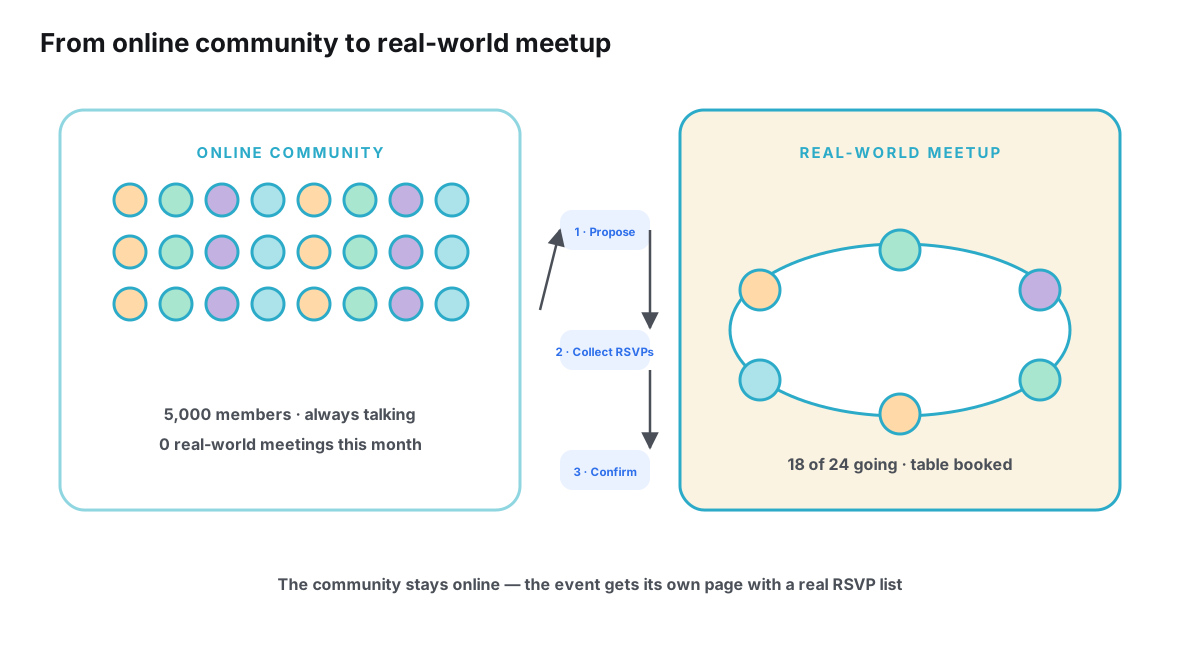
The cleanest resolution is the pattern this blog keeps returning to, because it keeps being true: one source of truth per event. The poll narrows options in the chat; the chosen facts and the RSVP statuses live on a page with an address; the chat links to it forever. Tools like Ontaym implement exactly this split — voting on options for the choosing phase, going/maybe statuses and reminders for the committing phase — and the step-by-step version of assembling such a record is in how to create one source of truth for a group event.
Frequently asked questions
Can a Telegram poll work as an RSVP list?
Only for casual events where a rough signal is enough. A poll captures one tap per person at one moment; it can’t be updated, doesn’t distinguish “definitely” from “sounds fun,” and anonymous polls don’t even tell you who voted. For anything with a headcount that matters — a reservation, a workshop, a trip — a poll is a starting estimate, not an RSVP system.
Should I use an anonymous or a public poll for event planning?
Public, with visible votes, is usually better for planning: it lets you follow up with specific people, and visible names make preferences feel real. Anonymous polls shine when honesty matters more than follow-up — sensitive dates, dietary constraints, potentially awkward choices. If you’ll need to chase anyone based on the result, you need the names.
What about quiz-style polls — do they help event planning?
Not with deciding anything, but they have a charming niche: confirming that people read the plan. A quiz question with one correct answer (“What time do we meet? — 6, 7, 8”) turns the confirmation-of-reading problem into a tiny game. It still doesn’t record commitments — it records who clicked correctly.
How do I handle people who voted yes but have quietly drifted?
Re-confirm, once, near the final headcount deadline — a short message asking everyone to check their status, ideally somewhere that status is a field rather than a vote. In poll-only workflows this is a manual chase; in a structured record it’s a reminder that prompts people to update themselves. Either way, build the drift into your planning: some yeses are weather.
When is a poll actually enough for an event?
When the event is small, informal, tolerant of error, and its headcount doesn’t drive any decision — a picnic where extra people are fine, a pub evening where the venue doesn’t take bookings. The moment a number matters to anyone — a table, a ticket, a car seat — the poll has left its jurisdiction.
Do dedicated scheduling tools like Doodle solve this?
They solve the scheduling slice of it very well — finding a time that works across calendars is exactly what a scheduling poll is built for, and often better than a chat poll. But time is one decision of several: venue, commitments, changes and headcounts still need somewhere to live after the scheduling poll closes. The poll family answers “when can people?”; the event still needs “who’s actually coming?”
Conclusion
Telegram polls are good tools used slightly too long. In the forming phase of a plan they widen participation, make preference legible and settle debates with less friction than argument ever could — and the platform’s anonymous, public and quiz variants are genuinely thoughtful instrumentation for that phase. The failure mode is not the poll; it is stopping there. A tally is a snapshot of enthusiasm, and events are run on commitments that move.
The practical discipline is sequencing: poll to narrow, then decide explicitly, then collect commitments in a form that can update, then re-confirm near the date. Each phase wants a different instrument, and the chat alone can only ever supply the first. Groups that separate choosing from committing — keeping the poll for what it measures and giving the decision a record with identity, final facts and a live headcount — get the best of both: the low-friction inclusiveness of the vote, and the reliability of an actual decision. The poll asks the group what it wants. Something else has to remember what it chose.
Poll for preferences — then let real commitments pick the table size.
Plan it with Ontaym