
Why Telegram Channels and Groups Are Different for Event Communication
Telegram deliberately keeps channels and groups apart: one built for broadcasting to an audience, the other for conversation among equals. Choosing between them — or wiring them together — is the first structural decision an event organizer makes on the platform, and it shapes everything downstream.
Quick answer
A Telegram channel is one-to-many broadcast: the organizer posts, subscribers read, and by design almost nobody can talk back. A Telegram group is many-to-many conversation: everyone can post, question and argue. Events need both functions — announcements that must reach everyone cleanly, and discussion that turns strangers into participants — which is why the choice matters. Use a channel when the event’s audience mainly needs to listen (schedules, changes, cancellations); use a group when the event’s success depends on people talking (planning, questions, social energy); use the linked channel-plus-discussion hybrid for larger communities that need both. Neither container, though, holds the event itself: final facts, RSVPs and per-person state still need a structured record beyond the chat.
Two containers, two theories of communication
Most messaging apps offer one group primitive and let scale problems sort themselves out. Telegram made a different call: it separates channels — one-to-many broadcast — from groups — many-to-many chat — as distinct containers with distinct rules, a split documented plainly in Telegram’s own FAQ and reflected throughout the platform’s documentation for developers. The separation looks like a minor feature difference until you notice that it encodes two incompatible theories of what communication is for.
A channel assumes communication is announcement. There is a source with something to declare, and an audience whose job is to receive it. Every design choice follows: only admins post, the history reads top-down like a noticeboard, there is no meaningful noise because there is no crowd talking, and the subscription relationship is intentionally loose — people follow the way they follow a newspaper, without becoming part of anything.
A group assumes communication is negotiation. Everyone in the room is potentially a speaker, the value comes from exchange, and the history is a flowing conversation rather than a stack of notices. The costs are the mirror image of the channel’s strengths: noise, drift, repetition, and the slow burial of anything important under everything else.
Neither theory is wrong, and neither is better. What’s genuinely useful is that Telegram refuses to blur them — which forces an event organizer to think, before creating anything, about which kind of communication their event actually runs on.
A concrete contrast makes the difference tangible. A photography club announces its monthly walk through a channel: one post with the route, the meeting point and the time, reaching every subscriber identically. A separate group exists for everything else — gear questions, weather complaints, arranging carpools, sharing photos afterwards. Now imagine swapping the containers. The announcement goes into the group, where it is questioned, teased and buried within the hour, and by evening three people are privately asking the organizer what the meeting point was. The chatter moves to the channel, where it cannot happen at all, because the audience has no way to speak. Both failures are the same failure: communication assigned to a container built for the other theory.
How each container behaves across the event’s life
The cleanest way to see the split is to walk a single event through its life stages and watch how each container fares. During formation — gathering the audience — a channel is slow but durable: followers accumulate over time, and the channel’s history tells them what they’re joining. A group forms fast, because invitation is its native act, but what newcomers find is a conversation already in progress rather than a statement of purpose.
During negotiation, the positions invert completely. Dates, venues, formats — these need voices, and the channel has none to offer. The group negotiates natively; that is what it is made of. During the commitment stage, both containers go quiet in the same telling way: the channel can broadcast that registration is open, and the group can talk about who’s coming, but neither converts talk into a count. The event’s real guest list forms in private messages and in the organizer’s notes, invisible to both containers.
On the day, each container earns its keep differently. The channel is a megaphone that cannot be shouted down: schedule changes, room moves, last-minute instructions go out clean. The group is the venue’s corridors — live, chaotic, and indispensable the moment something needs discussing rather than declaring. And after the event, the channel keeps an orderly archive of everything announced, while the group keeps the warm, unsearchable sediment of everything said. An organizer trying to answer “how did the last one go?” gets a press release from one and a party from the other — neither, notably, an attendance sheet.
The moderation reality behind each model
The two containers also carry very different administrative loads, which organizers often underestimate until the audience grows. A channel is nearly self-maintaining: there is nothing to moderate because subscribers cannot post, and the admin’s work is editorial — deciding what to announce and when. A group, by contrast, is a room that requires stewardship. Conversations drift off-topic, questions get asked twice because the first answer scrolled, and as membership grows, the volume of messages grows with it.
Telegram gives group administrators genuine tools for this — member permissions, the option to slow the pace of messages in busy periods, topics that split one large conversation into parallel threads — and large communities rely on them heavily. But it is worth being clear-eyed about what these tools are for: they manage the health of a conversation. None of them makes the conversation an event record, and the labor of moderating a group is paid in addition to, not instead of, the labor of keeping the event’s facts straight. Organizers choosing a group because it feels more alive should budget for the fact that aliveness has a maintenance cost.
What a channel does well for events
The channel’s superpower is signal integrity. When a hundred people need to learn that the venue has changed, an announcement that cannot be answered cannot be derailed, either. The message goes out, it stays where it was posted, it remains findable, and the next announcement sits beneath it in a clean, scrollable list. For the operational moments of an event — schedule releases, room changes, cancellations, day-of instructions — that cleanliness is exactly what you want. Compare the group equivalent: the same announcement posted into an active chat, immediately followed by forty replies, jokes and questions, so that within an hour the facts are genuinely harder to find.
Channels also scale without strain, because audience size doesn’t change the communication cost. Whether fifty people or fifty thousand follow the channel, the organizer writes one post, and no subscriber’s experience degrades because other subscribers exist. For a recurring event series — a weekly run club, a monthly meetup — this means the announcement history doubles as a public archive: a newcomer can scroll the channel and see, in the organizers’ own words, what the series is and how it behaves. That is onboarding by artifact rather than by interrogation, and it is quietly powerful.
There is a subtler benefit worth naming: a channel protects the organizer’s energy. In a group, every message from an organizer invites replies, and every reply implies an obligation. Over months of running a series, that steady drip of micro-obligations is what burns organizers out. A channel draws the boundary early — the audience knows the deal, and the deal is listening.
What a group does well for events
Everything the channel filters out is what the group is for. Planning is rarely announcement; it is negotiation. Which Friday works? Does anyone know the neighborhood? Can someone pick up a guest from the station? These questions have no stage — they need a room. A group creates the room: everyone can ask, answer, hedge, volunteer and joke, and the event acquires social texture before it acquires a date. For events whose real product is community — meetups, clubs, trips — that texture is not a side effect; it is the reason people return.
Groups are also where an event’s questions actually get asked. A channel subscriber who is confused about the meeting point has, by design, no way to say so where others will see it. The same person in a group asks, someone answers, and the answer corrects the confusion for every silent person who had the same question. In that sense the group functions as the event’s error-correction mechanism — messy, but self-healing in a way a broadcast cannot be.
The weaknesses are the familiar ones of any chat: importance decays with position, decisions live inside messages, and attention is consumed by volume rather than directed by need. A group is a superb medium for turning an event into a community and a poor medium for storing what the community decided.
| Event job | Telegram channel (broadcast) | Telegram group (conversation) |
|---|---|---|
| Announcing the schedule or a change | Excellent — clean, orderly, no replies burying it | Works, but the announcement decays under discussion |
| Choosing a date or venue together | Poor — no way for the audience to weigh in | Excellent — that’s what conversation plus polls are for |
| Answering attendee questions | Only via private messages to admins | Naturally — answers correct everyone at once |
| Building social energy before the event | Weak — audiences watch, they don’t mingle | Excellent — the group is the mingling |
| Keeping a findable history of decisions | Good — an ordered noticeboard of declarations | Weak — decisions dissolve into the thread |
| Knowing who intends to come | Weak — subscription is interest, not attendance | Weak — presence in chat is not commitment |
| Day-of live coordination | One-way only; can’t absorb incoming reports | Excellent — fast, everyone’s already there |
Notice the last two rows. The split between broadcast and conversation explains a lot about event communication, but it doesn’t reach the two jobs that ultimately decide whether an event succeeds: knowing who is coming, and holding the event’s current facts. Both containers fall short there, each in its own accent.
The hybrid: channel plus linked discussion group
Telegram’s most interesting answer to the either/or is a third pattern: a channel for announcements connected to a discussion group, so that every channel post automatically gets a thread where subscribers can respond. The design is genuinely thoughtful — announcements stay pristine in the channel while conversation about them lives one tap away, organized by which announcement it concerns rather than interleaved in time.
For event organizers, the hybrid maps naturally onto a real division of labor. The channel carries the record of what has been declared: the schedule, the venue, the rules, the cancellations. The discussion group carries everything human: questions, logistics offers, ride-shares, excitement. Because discussion threads attach to specific announcements, the group suffers less from the classic chat problem of five conversations interleaving — each thread starts from a known anchor.
The cost of the hybrid is architectural overhead. Two containers must be created, linked, administered and explained; the audience must understand which one to join and why; and the organizer now moderates a discussion space that a pure channel would never have created. For a weekly event with a stable community, that overhead amortizes well. For a one-off dinner, it is usually machinery beyond need — a plain group with a disciplined pin does the same job with a fraction of the setup.
Where both stop: neither container is the event
However the containers are arranged, one gap remains, and it is the one that matters most on event day. A channel can broadcast a decision and a group can host the argument that produced it, but neither holds the event as a structured thing — one current time, one current place, and a per-person record of who is coming, who is maybe, and who has bowed out. Subscription to a channel is interest. Presence in a group is participation in conversation. Attendance is a commitment that changes over time, and neither artifact tracks it.
This is the same boundary that makes polls an imperfect attendance instrument. A public poll with visible votes attached to a channel post or group message tells you who leaned which way when the poll was live; it does not update when someone’s calendar collapses, and a thumbs-up is not a promise. The mechanics of that gap — and what a real decision record needs — are the subject of Telegram polls versus dedicated event decisions.
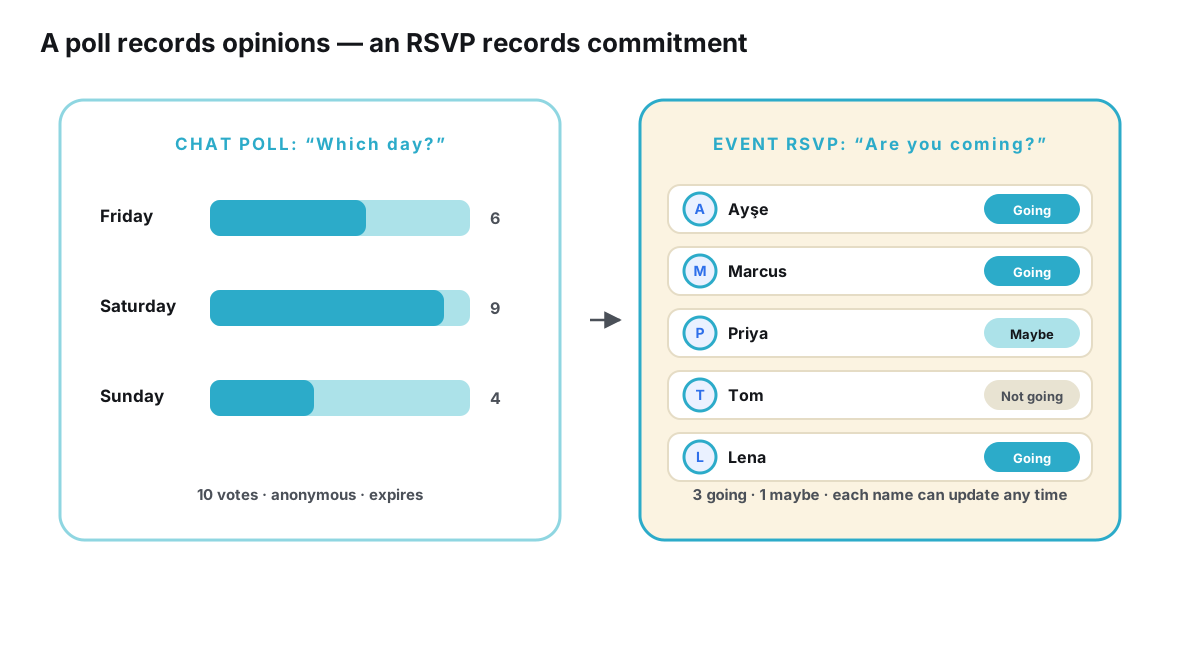
The deeper reason is architectural, and it applies to channels exactly as it applies to groups: both are streams of messages, and an event is a piece of state. This is the argument developed at length in why messaging apps were never designed to be event databases — the container, whatever its posting rules, still stores statements rather than current values. That is why experienced organizers running channel-plus-group hybrids still end up maintaining a facts message by hand, editing pins, and privately tracking the headcount. The hybrid solves communication. It doesn’t solve the record.
What the record needs is an address of its own — one page carrying the final details and the live RSVP list, linked from the channel’s description, pinned in the group, mentioned in every announcement. The channel broadcasts changes to it; the group discusses them; the page simply is the current truth. Tools like Ontaym are built to be that page — one link per event, with RSVP statuses and updates the organizer edits once — but any system giving the event a stable, current-state address completes the architecture.
Choosing the right container for your event
The practical decision is mostly a function of audience relationship and event size. The table below compresses the reasoning.
| Your event situation | Best fit | Why |
|---|---|---|
| Small gathering of friends, one-off | Group | Negotiation and banter are the point; a channel is overhead |
| Recurring series with a stable community | Channel plus linked discussion group | Announcements need a clean archive; regulars want a room |
| Large public event, open invitation | Channel, with discussion optional | Broadcast scales; open discussion at volume becomes moderation work |
| Event run inside an existing community chat | Dedicated group for the event | Keeps the event from colonizing the community’s main thread |
| Workshop or class with logistics questions | Group | Q&A error-correction beats one-way announcements |
| Day-of operations for a big event | Channel for instructions, group for reports | Instructions must stay clean; incoming reports need somewhere to land |
Two refinements are worth the words. First, the choice isn’t permanent: many series start as a group, and the channel appears the day the organizer realizes they are repeating the same announcement to a room that keeps talking over it. Second, the container choice is downstream of a prior question — what does this event need to be true? If the answer includes a reliable headcount or a single findable set of final facts, then no container choice alone gets you there; that requirement points beyond chat entirely, toward structured event information alongside a Telegram group.
From audience to room: the community trajectory
Channels and groups also represent stages in the life of a community rather than just tools. A healthy event series often grows in a direction: broadcast first, conversation second, belonging third. The channel assembles an audience; the discussion group turns part of that audience into a recognizable group of people; and somewhere in that process, members start wanting to meet in person — which is the point where the community’s online shape meets the physical world.
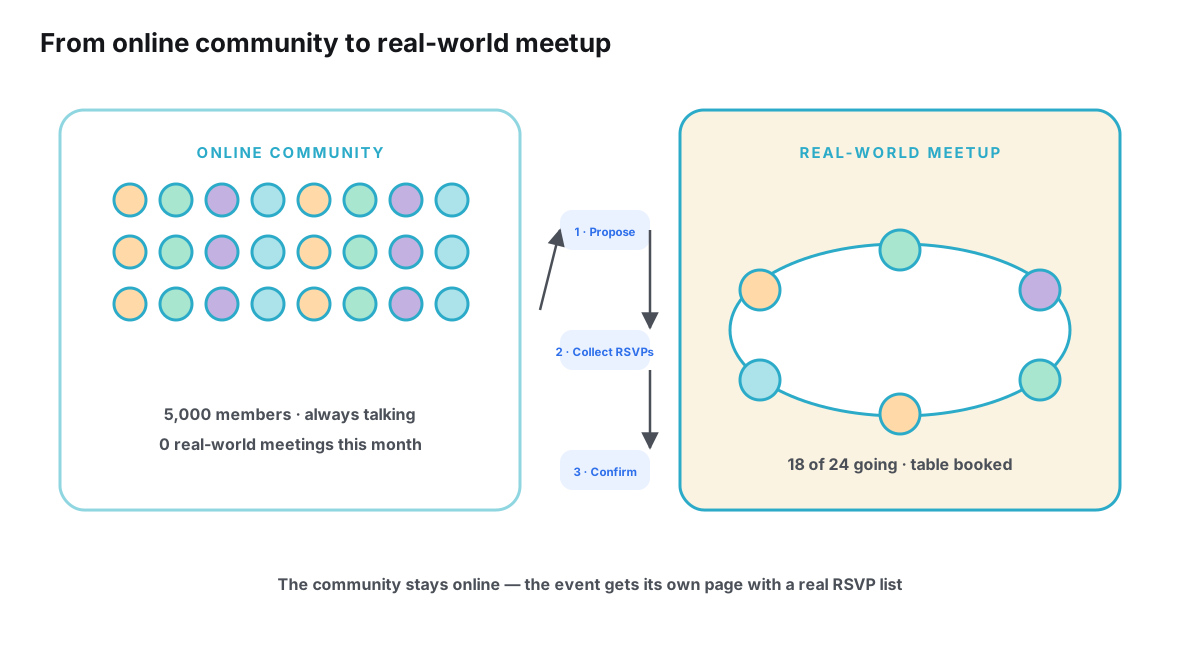
That transition multiplies everything this article has discussed. A meetup drawn from a channel inherits the broadcast relationship — many strangers, one source of truth — so the final facts and the RSVP list matter even more, because nobody else will correct a confused attendee in conversation. A meetup drawn from a group inherits social warmth but maximal information chaos. Either way, the moment an online crowd commits to a physical time and place, the need for a structured record stops being theoretical. The dynamics of that exact jump, including how Telegram communities handle the offline gap, are covered in how Telegram communities can handle real-world meetups.
Frequently asked questions
Can people reply to a Telegram channel?
Not in the channel itself — posting is restricted to admins, which is the point of the format. Reactions and forwards exist, but substantive replies have to happen elsewhere: in private messages to the admins, or in a discussion group linked to the channel, where each broadcast post gets its own comment thread.
Which is better for a big event, a channel or a group?
A channel, usually. Large audiences make one-to-many broadcast dramatically more efficient than many-to-many conversation, and they keep the organizer’s announcements from drowning. What large events still need beyond the channel is a discussion venue for questions and a structured record for RSVPs — the channel is the backbone, not the whole skeleton.
Do subscribers to my channel count as attendees?
No — a subscription signals interest, the way following a schedule signals intent. Some fraction of subscribers will come to any given event, and the fraction varies by event, weather and week. Headcounts come from per-event RSVPs, not from audience size, and conflating the two is a classic over-ordering mistake.
Is the channel-plus-discussion setup worth it for a small group?
Usually not. If your event fits in one conversation and everyone knows each other, a single group with a well-kept pinned message is simpler and does everything the hybrid does. The hybrid earns its keep when announcements and conversation are both substantial — recurring series, larger communities, or events where the schedule is genuinely public information.
If I keep the plan pinned in the group, do I still need anything else?
A disciplined pin is the best answer available inside the chat, and for small stable groups it can be enough. Its limits are structural: it decays when maintenance lapses, it can’t track per-person RSVP changes, and it isn’t visible to people who don’t join the group. The fuller toolkit for pushing organization as far as it goes inside Telegram is covered in how to keep event information organized in a Telegram group.
Four mistakes organizers make with the split
Certain failure patterns recur whenever events are run across channels and groups, and each one is an avoidable mismatch of theory to job.
The first is using the group as an announcement board. The organizer posts the plan into the conversation, then reposts it every few days as it sinks — a human being performing the scroll-resistance a channel would have provided for free. The reposting feels diligent and reads as noise, and each repost fragments the history further: by the third version, which one is current is a question the thread answers ambiguously.
The second is the mirror error: using a channel as if it hosted a community. A subscription list is not a membership, and a channel that never opens a discussion venue will find, when it announces an event, that its audience has no way to self-organize around it — no ride-shares, no questions answered in public, none of the connective tissue that converts interest into attendance.
The third is running both containers without declaring their roles. Members guess where to ask questions, split their attention between two feeds, and cross-post out of uncertainty. The fix is cheap: state the division of labor in both descriptions — announcements here, conversation there — and link each container to the other so the boundary is one tap wide.
The fourth is subtler: treating the choice between containers as the whole organizational decision. Containers solve communication. Facts and headcounts need a record, and no arrangement of streams substitutes for one. The organizers who feel vaguely cheated by the hybrid — everything announced properly, discussion thriving, headcount still a guess — are experiencing exactly this gap.
Conclusion
Telegram’s separation of channels from groups is not a quirk; it is a rare moment of honesty about the fact that announcement and conversation are different jobs, and event communication needs both. Channels give events a clean voice that scales and an archive that reads like a noticeboard. Groups give events negotiation, questions and warmth, and correct confusion in public. The linked hybrid combines them at the cost of a little architecture.
What neither container gives an event is itself. The final time and place, the evolving guest list, the difference between a follower and an attendee — these are pieces of state, and both channels and groups are streams. The organizers who get the most from Telegram are the ones who use each container for its strength and then give the event one address of its own: linked from the channel, pinned in the group, current for everyone. Broadcast the changes, discuss the possibilities, and let a real record carry the facts.
Broadcast in your channel, talk in your group — and give the event one address of its own.
Plan it with Ontaym