
How to Organize Offline Activities From a WeChat Community
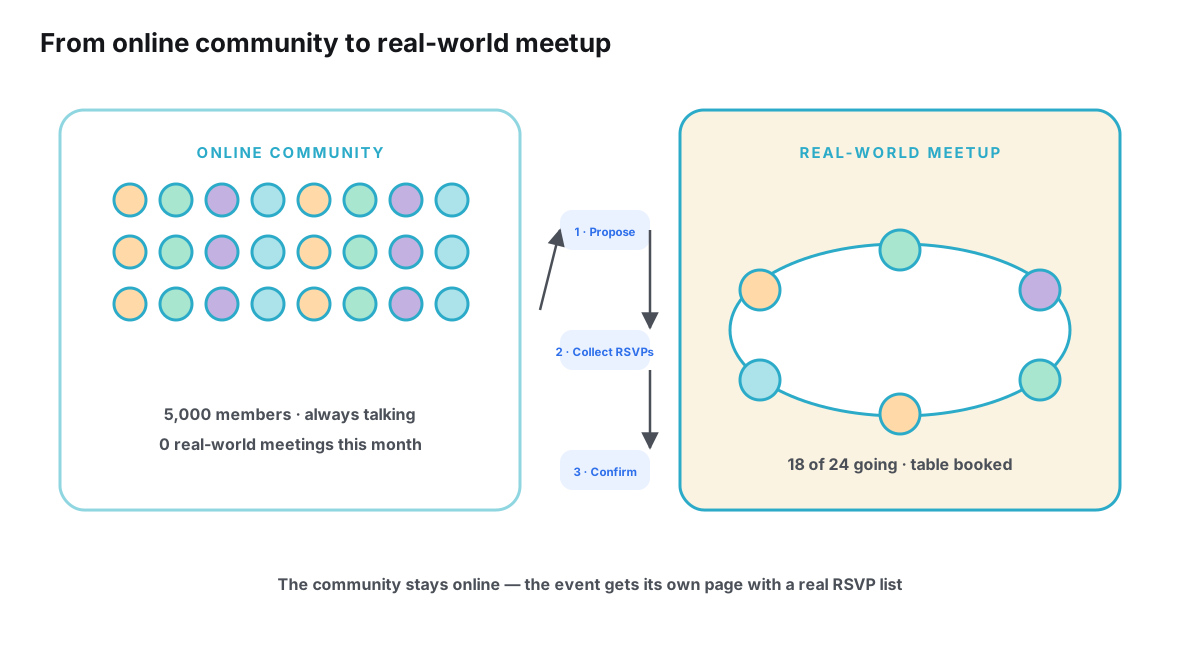
An online community that talks every day and never meets is a hobby; one that meets is a club. This is the operational guide to taking a WeChat group — hobby circle, alumni chapter, neighborhood society — and turning it into people at a table, on a trail, in a room.
Quick answer
Organizing offline activities from a WeChat community works best as a repeatable eight-step loop. Match the activity format to the community’s real size and energy, gauge interest with a lightweight poll rather than the thread’s mood, and lock the essentials — date window, capacity, budget — before announcing anything. Give the activity its own linkable page so the plan has one current version, announce once in the group, and answer every later question with that link. Convert enthusiasm into a firm headcount with named RSVP statuses, run the day itself from the chat’s strengths — location pins and arrival messages — and close the loop afterwards with photos, settled costs and a date for the next one. The failure modes are predictable — poll votes that never become attendees, silent plan forks, organizer burnout — and each has a specific counter in the steps below.
What changes when a community goes offline
A WeChat community is already a super-app achievement: messaging, payments, mini-programs and official accounts under one roof, as described on WeChat’s product site, with group chats holding up to 500 members. What it has, though, is a room full of people talking. What it needs for offline life is a program: formats chosen to fit the crowd, dates that survive contact with everyone’s calendars, venues booked against real numbers, and a day-of operation that gets thirty people to one place at one time.
The transition is worth the effort for reasons beyond any single event. Communities that meet in person keep their members longer, tolerate quieter weeks in the chat, and generate the photos and stories that recruit the next cohort. The organizing itself becomes an asset: run the loop well once, and the second run inherits venues, formats and habits instead of starting from zero. Run it badly once — a miscounted reservation, a hike nobody could find — and the community remembers that too.
It is also worth being honest about what the transition asks of the organizer, because the first offline event is always the hardest one a community will ever run. There is no accumulated trust in the process yet, members have no habit of responding to anything, and the organizer is simultaneously inventing the format and proving that gatherings can work at all. Expect the first run to feel heavier than it looks on paper, and deliberately make it smaller than your ambition — the first event’s job is to succeed visibly, not to impress. Every subsequent run gets cheaper as the habits compound: the venue knows you, the members know the rhythm, and the loop you are about to read starts running half by itself.
Know the community before you commit it
Before any venue is booked, spend a week observing the group honestly. Three properties matter more than membership count. The first is energy distribution: every community has a core that posts daily and a broad periphery that reads occasionally. An offline activity is usually organized by the core and attended by a blend — so the core’s preferences set the tone, but the periphery’s constraints set the ceiling. The second is geography: a group whose members span three cities plans differently from one concentrated in a single district, and pretending otherwise produces events that are theoretically for everyone and practically for nobody. The third is cadence appetite: some communities want a monthly rhythm, others want two big gatherings a year — and over-scheduling a low-cadence crowd burns out the organizers before it activates the members.
Format selection follows from those properties more than from ambition. A quiet book club of forty will produce a lovely twelve-person dinner and a disappointing conference. A raucous hiking group of two hundred will find a waiting list for a trail outing and no interest whatsoever in a seated lecture. The table below matches common community shapes to the formats that reliably work for them.
| Community shape | Formats that work well | Watch out for |
|---|---|---|
| Small interest circle, everyone active | Rotating dinners, home gatherings, weekly games | Overthinking — this shape barely needs process |
| Large group, small active core | Core-organized meetups with open invitations | Assuming silence means disinterest |
| City-local community | Monthly venue events, sports, walks | Venue repetition fatigue |
| Multi-city or diaspora community | Big annual reunions plus city chapter events | Planning everything around one mega-event |
| Hobby or sports club | Skill-level splits, recurring bookings, trips | Beginners drowned by veterans’ pace |
| Alumni or association chapter | Semi-formal dinners with a program | Formality creep that suppresses turnout |
Three communities, three runs of the loop
The playbook below stays the same regardless of scale; what changes is how each step lands. Three brief portraits show the range. A book circle of forty, for instance, where a dozen members carry the conversation: Lin, one of the dozen, runs a simple monthly dinner. She posts two date options as a poll, books a private room once the votes settle, and asks members to mark a status on the event page she created — going, maybe, not going. The chapter’s actual dinner crowd turns out to be fourteen, reliably, which she now books for without a poll. Her whole loop takes an afternoon a month, and the “maybe” list tells her exactly whom to nudge on Thursday.
A hiking community of three hundred runs the loop at a different scale. Tao, who coordinates the weekend program, splits each outing by difficulty — an easy city walk, a moderate hill, a hard route — and gives each its own sign-up, because the hard route has a firm cap set by safety, not comfort. Announcement day is fixed: Monday evening, one post per route, each with its link. The chat stays lively all week with gear talk and route nostalgia, but the plan lives in the three pages, and when a route fills, the page shows the waiting list — visible scarcity that Tao never has to adjudicate by hand. On Sunday morning the group chat does what only a group chat can: a stream of arrival messages and a live location from the trailhead.
A multi-city alumni association runs the loop annually at full ceremony. Priya’s committee keeps one general group as the common room, city chapters with their own local events, and a single annual gala that everyone travels for. The gala gets the full treatment: an interest poll three months out, a venue contract against a firm headcount, a fee collected through the app as statuses firm, and an event page that becomes the one address a member in any city can open. Sub-groups announce it, but they all point at the same link — which is the only reason three cities’ worth of versions never drift apart.
The playbook, step by step
The loop below is written for a mid-size community event — the kind with a venue and a headcount — but it scales down by skipping steps and scales up by delegating them. Run it as written the first time; after that, your community will tell you which steps to keep.
- Match the format to the community. Choose an activity whose natural group size, cost and energy fit what you observed, not what you wish were true. A format that fits survives; a format that strains the community’s real shape collapses by the second edition.
- Gauge interest with a lightweight poll. Put two or three concrete options in front of the group — date windows or activity variants — rather than asking the open-ended “what does everyone want?” Specific options convert lurkers into respondents, and respondents into a planning basis.
- Lock the essentials before announcing. Fix the date window, the venue’s capacity, the per-person budget and the reservation deadline into a short list of facts. Everything announced later refers back to this list, so it deserves more care than any single message about the event.
- Give the activity its own address. Create a page for the event that holds the current facts — time, place, cost, what to bring — and will hold the guest list as it forms. Tools like Ontaym exist for exactly this: one link per event, RSVP statuses, voting on options and updates — and the pattern matters more than the tool.
- Announce once, then answer with the link. Post the announcement to the group with the link, pin it if the platform allows, and resist re-explaining the details in the thread afterwards. Every question gets the link; that habit is what keeps one version of the plan authoritative all the way to the day.
- Convert interest into a firm headcount. Ask members to set their own status on the page — going, maybe, not going — and watch the number against the venue’s capacity as the deadline approaches. Chase only the maybes that matter to the math, not the entire membership.
- Run the day from the chat. On the day, return to the group’s strengths: post the meeting point with a map pin in the morning, let arrival messages flow, and keep the page for the facts rather than the chatter. This is the hour the chat is genuinely the best tool you have.
- Close the loop and seed the next one. After the event, share photos where the community lives, settle any costs through the app’s payments while goodwill is high, thank the venue, and — while the room is warm — float the date for the next edition.
Two habits make the loop durable. First, write down what happened — turnout, costs, what broke — somewhere that survives the chat’s scroll, because the second organizer’s best resource is the first organizer’s notes. Second, delegate one step of the loop to a different person each time; communities where the whole loop lives in one head are one busy season away from having no events at all.
Delegation: shrinking the organizer’s role
The step-by-step loop has a hidden second purpose beyond producing events: it produces divisible work. A monolithic “organizer” role cannot be shared — it lives in one person’s head, their relationships with the venues, their feel for the group’s taste. A loop made of named steps can be split like any other workload: one member owns the poll and the format choice, another knows the venues and makes the bookings, a third is the money handler whose transfers everyone trusts, and a fourth simply agrees to be the visible host on the day — the person at the door whom newcomers ask for.
This division works only because the loop’s artifacts are shared objects. When the plan lives in one person’s head, delegating means briefing; when it lives on a page, delegating means handing over a link. The book circle’s Lin can hand venue duty to a clubmate in a single message; Tao of the hiking community can hand an entire route to a new leader by transferring its sign-up page. The stronger the community’s record-keeping, the cheaper every handover becomes — and cheap handovers are what turn an organizing scene dependent on one hero into a tradition that survives its founder’s busy year.
A practical way to start: at each event’s close, while thanks are flowing, ask one attendee to own one step of the next edition. Most people decline “helping organize” and accept “pick the restaurant this time” — the ask must be shaped like the step. Over a season, the organizer’s residual role shrinks to what they actually enjoy: the format, the dates, the people. That is the version of the role that volunteers keep volunteering for.
Handling the mechanics inside WeChat
The steps above deliberately use each layer of the ecosystem for what it does best. Interest-gathering belongs to polls — whether run through a mini-program card or a scheduling poll service such as Doodle for date-finding — and the trade-offs between polling mechanics are worth understanding before you lean on them; see how WeChat polls work for group decisions. Payments belong to the app’s built-in rails: collect fees as soon as statuses firm up, not on the day, and red packets handle the small change afterwards.
Scale has its own mechanics. A community pushing against the 500-member ceiling — or already split across a general chat and several sub-groups — faces a boundary problem on top of the volume problem: announcements must reach every room, and versions of the plan drift apart quietly. The dynamics and remedies are laid out in what happens when a WeChat group becomes too large; the short version is that structure pays for itself exactly when headcount makes repetition unaffordable.
| Phase | Do | Where |
|---|---|---|
| Two to four weeks out | Observe the group, pick the format, run the interest poll | The group chat and a poll tool |
| Announcement | Lock essentials, create the event page, post and pin the announcement with the link | Chat for the announcement; page for the facts |
| Planning window | Answer questions with the link; track statuses against capacity; collect fees as they firm | The page for status; the app for money |
| Final week | Confirm the venue with the headcount, chase only the decisive maybes, post the final plan once more | Both — page edited, chat reminded |
| The day | Morning re-post of the meeting point and pin, arrival messages, live adjustments | The group chat |
| After | Photos, thanks, settled costs, notes for next time, next date floated | The chat for warmth; your notes for process |
Failure modes and their counters
Community events fail in patterned ways, and the patterns are stable enough to plan against. None of them are character flaws of organizers or members — they are the predictable physics of large chats doing coordination work, analyzed structurally in why WeChat group chats become difficult for event coordination.
The enthusiasm gap. The poll gets sixty votes; twenty people come. Votes are opinions at a moment in time, not commitments that persist and update — expecting them to behave like RSVPs sets both the venue and the organizer up for a bad afternoon. Counter: treat polls strictly as interest-gathering, and require the separate, self-updated status step before anything is booked against a number.
The silent fork. The venue changes on Tuesday; by Saturday, most of the group knows and a loyal minority is en route to the old address, armed with screenshots that were correct when taken. Counter: changes go onto the page as edits, and the chat gets exactly one line pointing at the link — never a restatement of the whole plan, which restarts the fork inside the thread.
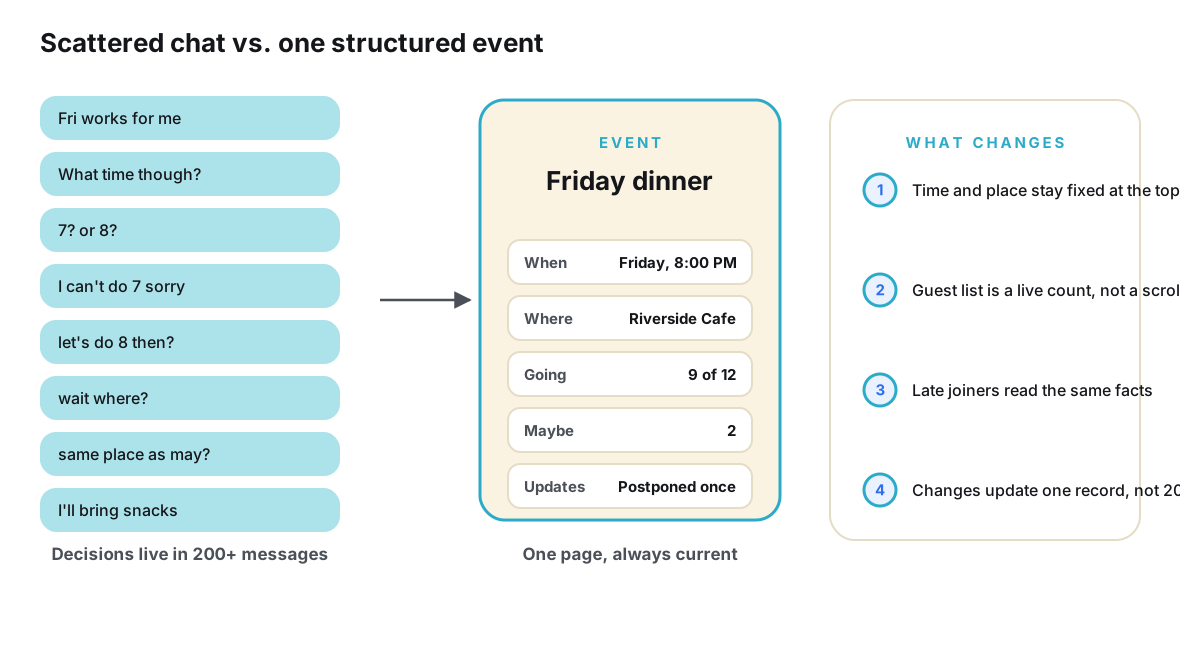
The overcommitted venue. A restaurant for twelve receives twenty-two because the thread’s warmth felt like attendance. Counter: book against the firm headcount plus a small buffer, keep a waiting list once capacity is reached, and let the page show the list — visible scarcity is fairer and more persuasive than private counting.
The burned-out organizer. One person re-answers every question, chases every maybe, repeats every change — and quietly declines to run edition two. Counter: the loop’s structure is the protection. A link that answers questions, statuses that count themselves and a written playbook are precisely the things that make the organizer role small enough to hand to someone else. The deeper reasons chat-first organizing concentrates labor on one person are covered in why messaging apps were never designed to be event databases.
Etiquette that keeps the community willing
Offline programs live or die on goodwill, and goodwill has its own hygiene. A few norms, widely understood, keep a community’s events something members are glad to hear about rather than braced against. Announcement discipline heads the list: big news goes out rarely and completely — one post containing everything a member needs, rather than a drip of fragments that each interrupt the whole room. Quiet hours matter more as a community grows; a reminder about Sunday’s hike is welcome at nine in the morning and hostile at midnight. Consent about membership is basic courtesy: ask before adding someone’s friend to the main group, and let the event page — openable by link — be the way guests participate without being enrolled.
Two more norms protect the organizers specifically. One version of the plan: when details change, the edit goes to the page and the announcement points at it; re-explaining different versions in different corners of a large group is how forks are born and how trust in announcements dies. Public gratitude, private correction: thank the people who booked, collected and cleaned up where everyone can see it, and deliver any criticism of the event privately to whoever ran it — unpaid organizers metabolize public complaints about free labor by simply stopping. Communities that observe these habits keep their volunteers for years; communities that do not cycle through them event by event and wonder why the fifth dinner never gets planned.
Frequently asked questions
How often should a WeChat community meet offline?
There is no universal cadence, but there is a reliable signal: if planning the next event starts feeling like a chore to the organizers rather than a pleasure, the rhythm is too fast. Many communities settle into a monthly meetup with one or two larger gatherings per year — frequent enough to keep momentum, sparse enough that each edition stays special.
Should I create a separate group for each activity?
Usually not. A standing community group plus a per-activity page preserves the community’s continuity while giving each event its own record. Separate per-event groups fragment the membership, lose history between events, and ask people to join yet another chat — a cost that is rarely worth paying outside very large one-off reunions.
How do I get lurkers to show up?
Lower the stakes of saying yes. Open formats with no skill requirement, transparent costs set in advance, a clear meeting point posted with a map pin, and a named person to look for at the venue. Lurkers rarely join because of persuasion; they join when the event looks easy to attend and easy to leave early if it is awkward.
What’s the best way to collect activity fees?
Through the app’s built-in payments, as early as the plan allows. Collecting at the moment someone marks themselves as going converts a soft intention into a real commitment; collecting on the day converts it into a chase. Red packets and transfers both work — the discipline that matters is timing, tied to the RSVP, not the mechanism.
How large should the first offline event be?
Smaller than the group’s apparent enthusiasm suggests. A first event’s job is to succeed visibly — a full table, a smooth day, photos that make the next edition recruit itself. Cap it at a size you could coordinate alone if the internet vanished: for most first-time organizers, that number is far below the poll’s response count.
What if the community spans several cities?
Split the program rather than the community. Keep one shared group as the common room, run city-level events locally with their own pages, and reserve the big everyone-travels reunion for once a year. This preserves a single identity while letting most offline activity happen at a distance people will actually commute.
Conclusion
Taking a WeChat community offline is less a single event than a loop you learn to run: observe the group, poll concrete options, lock the essentials, give the activity an address, announce once, count firmly, run the day from the chat, and close the loop warmly enough that the next one starts itself. Each step exists because a specific, predictable failure lives where the step is skipped — enthusiasm gaps where polls are treated as promises, forks where changes are re-explained instead of edited, burnout where the organizer becomes the medium.
The community you already have is the hard part, and it is done: the people, the warmth, the payment rails, the daily conversation. What the loop adds is program discipline — formats that fit, one authoritative plan per activity, and a role small enough to share. Run it once and the venue remembers you; run it twice and the members start suggesting dates; run it a season and the community stops being a chat that occasionally dreams of meeting, and becomes a club that happens to keep its conversation on WeChat.
Your community is already talking — give its next activity one link.
Plan it with Ontaym