
How to Organize Events Without Giving Strangers Your Contact Information
You can host a great event and still keep your phone number, your profile and your inbox to yourself. The trick is separating what an event needs — a plan people can see and a headcount you can trust — from the contact details most group tools demand on the way in.
Quick answer
To organize events without exposing contact information, replace membership-based access with scoped access. Instead of adding people to a group chat — where joining typically exposes your phone number or account identity to every other member — put the event on its own page behind a single link. Guests open the link, read the plan, and mark themselves as going or maybe. The organizer gets an accurate headcount; guests keep their numbers, profiles and messaging accounts private; and when the event ends, nothing connects anyone to anyone. The pattern works for mixed social circles, friends-of-friends, and organizers — teachers, coaches, sellers, hosts — whose audiences include people they barely know.
The moment the number leaves your control
It usually happens quickly. You join a hiking group chat for a single Saturday trail. Or you sign your child up for a football session and are added to a parents’ group. Or you attend one meetup and agree to “stay in the loop.” A moment later you are a member of a room containing two dozen people you have never met, and the room knows exactly who you are — because on the most popular messaging platforms, membership is identity.
The WhatsApp Help Center is matter-of-fact about this: groups are built on phone numbers, up to 1,024 participants per group. Translated into practice, joining a WhatsApp group for a one-off event places a durable personal identifier in front of every stranger in that group — people who can save it, share it, and reach you on it indefinitely. Most of them never will. But you have no way of knowing which of them might, and no way to un-share what has already been seen.
This is the asymmetry that makes contact sharing feel so sticky. Sharing a number takes one tap. Un-sharing it takes nothing less than changing the number itself. Between those two poles there is only hope — hope that the roster stays civil, that nobody screenshots the member list, that the group is dissolved rather than abandoned to whoever remains. A reasonable person might want something better than hope when the occasion is a single board-game evening.
What a phone number actually unlocks
It helps to be precise about why a number is different from, say, a first name on an RSVP list. A phone number is not a label; it is a key. It unlocks direct messages, calls, and — critically — it resolves to your account on any contact-based messaging platform. Anyone holding your number can check whether you use certain apps, see the profile you have attached to it, and initiate contact without your consent. On platforms like WhatsApp and Signal, your number is precisely how membership and reachability are expressed; Signal, whose entire reputation is built on privacy, still organizes its groups of up to 1,000 members around phone numbers — private messaging and private membership are different things.
The number also travels well, which is the problem. Unlike a username scoped to one platform, a phone number works everywhere — every app, every carrier, every contact list it is saved into. It correlates: cross-reference two member lists and you can identify who belongs to both. It persists: you will likely still have this number in five years, while the hiking group is long forgotten.
| Information | What it unlocks for a stranger | Who sees it in a typical event group chat |
|---|---|---|
| Phone number | Direct calls and messages; your account on contact-based apps; a durable identifier that outlives the event | Every member, immediately and permanently |
| Profile photo and name | Visual identification that can follow you across platforms and into real life | Every member, on joining |
| About text and online indicators | Presence signals and self-description you may have tuned for friends, not strangers | Every member, depending on privacy settings |
| Membership itself | Proof you were at, or were invited to, a specific gathering — social metadata you never chose to publish | Every member, and anyone a member shows the roster to |
| A first name next to an RSVP | Almost nothing: the minimal fact that someone of that name plans to attend | Only what the organizer chooses to display |
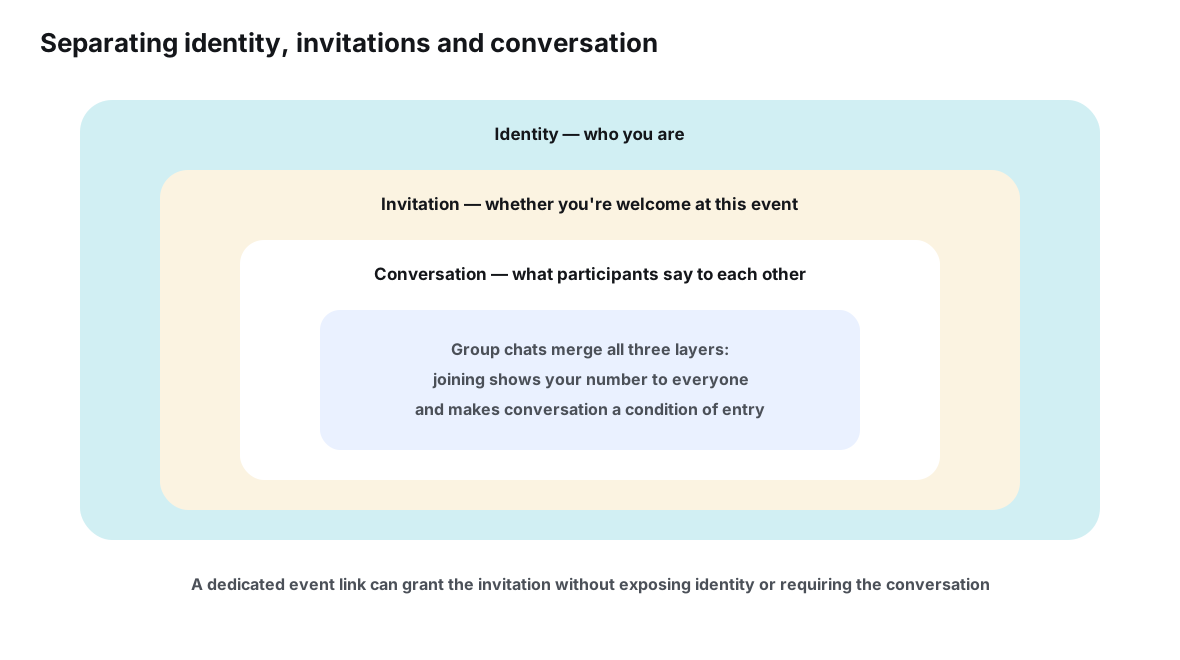
The last row is the quiet revelation. Everything an event genuinely needs from a guest — a name to count, a status to plan around — can live at the bottom of that exposure ladder. Everything above it is incidental: collected not because the event requires it, but because the access model of group chats demands identity as the price of entry.
Match the access level to the relationship
Nobody shares the same things with everyone, and nobody should have to. A useful way to think about event access is in circles. Your inner circle — family, close friends — can reach you anywhere, and a shared chat with them costs nothing because the trust is already underwritten by the relationship. The middle circle — colleagues, teammates, regulars from a club — deserve coordination without necessarily deserving your number. The outer circle — friends-of-friends, parents you met once, people who replied to a public post — deserve the event and nothing more.
Group chats flatten these circles. Everyone from the innermost to the outermost enters the same room, sees the same roster, and receives the same access to your identity. The flattening is invisible when it happens, which is why it so rarely gets consented to explicitly — it is simply the shape of the tool. Scoped access restores the gradient: you choose, per event and per audience, how much of yourself the invitation requires. A dinner with old friends can stay in the family chat. A trail run open to friends-of-friends can run on a link that asks nothing but a first name.
The arithmetic of exposure
It is worth pausing on how contact exposure compounds, because the compounding is invisible at the moment of sharing. When you hand your number to a room of thirty people, the risk is not that any specific person misuses it — almost none will. The risk is structural. Thirty people now hold a permanent, working identifier for you, some of them will sync it into their contacts, a few of those contacts get backed up and shared through the various conveniences of modern phones, and the number surfaces in contexts you never chose: a group someone else creates later, a forwards chain, a “quick question” from a stranger who was in that room once and still has you saved.
Each individual event feels harmless, and each individual one mostly is. The trouble is that the exposures add while the control does not. A season of casual membership — the hike, the quiz night, the class, the parents’ group, the neighborhood cleanup — leaves your number scattered across a half-dozen rosters of varying trustworthiness, none of which you can recall. There is no un-share. The only lever you control is the point of entry, which is why the access model at the door matters more than anyone’s behavior inside the room.
This is also why “I have nothing to hide” answers the wrong question. The discomfort of contact exposure is not about secrets; it is about reversibility. A fact you share freely and can never take back is different from a fact you share freely and can. Choosing scoped access is not secrecy — it is keeping your future options intact, the same instinct as not giving every shop your home address just because you bought something once.
Scoped access: the principle of least exposure
The design principle underlying all of this is simple enough to state in one sentence: an invitation should require exactly as much identity as the event needs, and not one field more.
What does an event need? Time, place, cost, what to bring — these belong to the event, not to the guests. A headcount — this requires each guest to leave one mark: a name and a going/maybe status. Optional communication — a way for a guest to ask the organizer a question. None of these require a member roster visible to strangers, a phone number, or a persistent account inside a specific messaging app.
An event page behind a single link delivers precisely this minimum. The link is the invitation; the page is the event; the RSVP is a first name and a status. The guest’s identity beyond that stays where it belongs — with the guest. And because access is scoped to the event rather than granted to a group, it expires naturally: when Saturday ends, there is no room to leave, no roster to be removed from, and no lingering connection between the strangers who attended.
How link-based participation works in practice
Running an event this way is not a philosophy; it is a short workflow. Here it is end to end.
- Put the event on its own page. Create the event with its known facts — date, start time, meeting point, cost, what to bring — and leave undecided fields visibly undecided. The page becomes the single place where the plan is true.
- Share the link through channels you already trust. Send it from your own messaging account to the specific people you are inviting. The link rides on top of relationships that already exist; it creates no new ones.
- Let guests respond on the page. Going and maybe statuses collect into a live headcount without a roll-call message. Guests answer privately, at their own pace, without an audience of strangers watching them decide.
- Route questions to a channel you control. The page can carry your preferred way to ask a question — a direct message to you, for instance — so strangers reach the organizer, not each other.
- Update the page, not the people. When details change, edit the page. Everyone who holds the link sees the current state next time they look; tools built around event pages can also push updates or reminders to people who opted in.
- Let it end. After the event, the link simply stops being relevant. Guests who became friends can exchange numbers the old-fashioned way — deliberately, bilaterally, with actual consent.
Notice what never happens in this workflow: no guest is ever added to anything, no roster is ever formed, and no contact details are collected as a side effect. The event gets its headcount; the guests keep their privacy; the organizer is spared moderating a room of strangers. This is the same division of labor described in how to create one source of truth for a group event, applied to privacy rather than logistics — one address holding the current plan, with conversation flowing wherever people already talk.
| The event needs… | It does not need… |
|---|---|
| A visible, current plan: time, place, cost, what to bring | A chronological conversation every guest must read to reconstruct the plan |
| A per-person status — going, maybe, not going | A visible roster of every guest’s identity |
| A live headcount the organizer can trust | Emoji reactions that might mean anything by event day |
| A way for guests to ask the organizer one question | A room where every guest can message every other guest forever |
| Updates that reach people who opted in | Another permanent group in everyone’s chat list |
| Access that ends when the event ends | Membership that persists until someone remembers to dissolve it |
One plan, many apps, zero membership
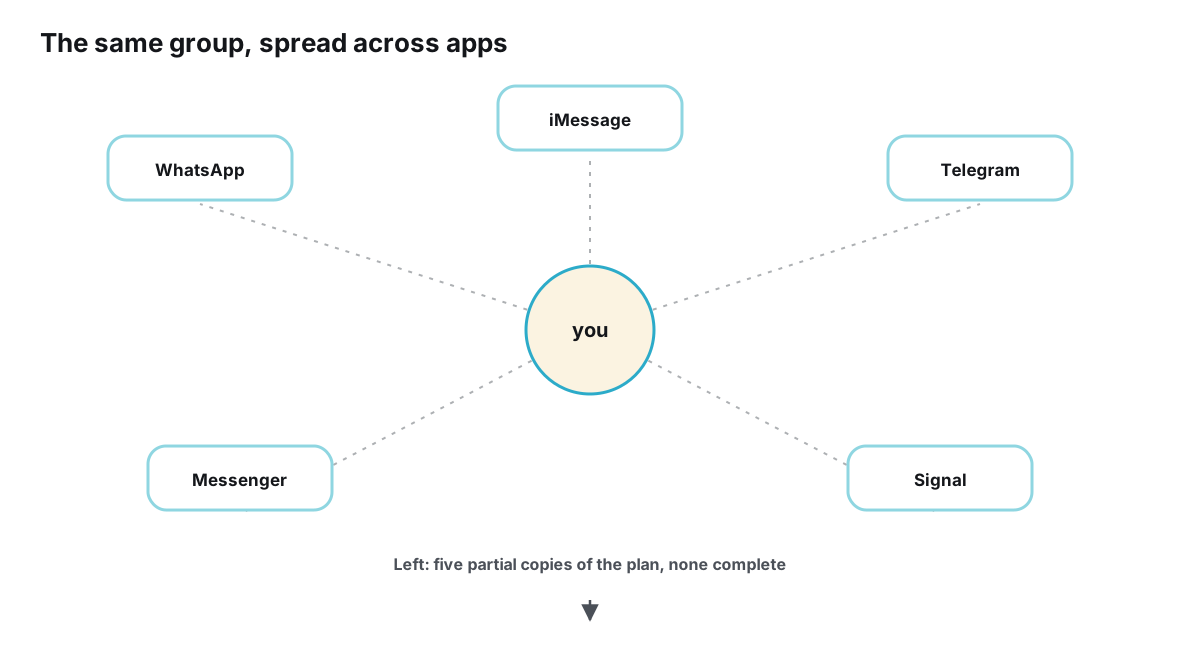
There is a second, less obvious benefit to link-based participation: it dissolves the platform problem. Any group chat excludes the people who do not use its app. The workaround — parallel groups on WhatsApp, Telegram, WeChat or iMessage, one per audience — multiplies both the organizer’s workload and the number of rosters holding copies of everyone’s identity. A plan maintained that way also drifts, because each copy of the details evolves separately.
A link, by contrast, is indifferent to where it lands. The same address pasted into any messenger, email, or a printed flyer leads to the identical page and rolls into the identical headcount. Conversation about the event stays distributed across the apps people already prefer — which is fine, because the plan no longer lives in the conversation. The people you coordinate are the same; the number of places holding their contact details drops to zero.
When you are the public-facing organizer
The stakes rise sharply when the audience includes genuine strangers — and many people organize for strangers without thinking of themselves as organizers at all. The teacher running a weekend language exchange. The coach managing three junior teams and their parents. The artist hosting an open studio. The person selling second-hand gear who agrees to a pickup. The volunteer coordinating a neighborhood cleanup. In each case, the “group” is not a friend circle with soft edges; it is an audience, and audiences contain people the organizer cannot vouch for.
For these organizers, contact exposure is not a theoretical concern. A WhatsApp group of parents, for example, shares every family’s number with every other family by default — a trade most parents never consciously accepted. A seller’s group chat hands buyers a persistent channel to the seller’s personal phone long after the transaction. The privacy-preserving pattern is the same at any scale: one event, one link, responses collected on the page, and direct contact reserved for the specific people the organizer chooses — bilaterally, when there is a reason.
Tools designed for exactly this shape exist — Ontaym, for instance, builds each event as a page with one link, RSVP statuses and updates attached, no group roster required — but the principle is tool-agnostic. Anything that lets people see a plan and leave a mark, without enrolling, gives you scoped access.
The legal backdrop, in one careful paragraph
There is a formal version of this argument, and it is worth knowing exists. Phone numbers are personal data under the EU’s General Data Protection Regulation (Regulation (EU) 2016/679), whose official text is published by the EU, and contact information is covered similarly by California’s CCPA under the California Attorney General’s guidance; the UK’s Information Commissioner’s Office publishes practical guidance on data protection as well. Those regimes principally bind organizations processing personal data, and this article is not legal advice — a private hiking group is not a company. But the core idea the law encodes, minimizing the personal data collected to what the purpose actually requires, is the same idea this article recommends for purely social reasons. Legal obligation aside, least-exposure is simply better invitation design.
Handling the honest objections
Some concerns come up reliably, and they deserve straight answers rather than dismissal.
“What if someone needs to reach me directly?” Sometimes one does — a guest running late, a parent with an allergy question. The answer is that direct contact should be granted, not surrendered. Put your preferred contact method on the page; give your number to the co-organizer; share it case by case. The difference between that and a roster is the difference between lending a book and giving away your library.
“Isn’t withholding your number standoffish?” Among close friends, possibly — and for close friends you do not need this pattern at all. Among strangers it reads the opposite way: as professionalism, or simply as everyone’s quiet preference finally made explicit. Most people, asked whether they would like their number broadcast to a room of people they have never met, do not say yes. They just are never asked.
“How do I keep the wrong people out?” The same way private events always have: by controlling distribution of the invitation. A link known only to invited people admits only invited people. State the forwarding policy on the page, and treat the link the way you would treat the address of your home — shareable by you, and by guests you trust. For a fuller treatment of that surface and its trade-offs, see private event links vs public group chats.
On the day, nothing else changes
A quiet worry sometimes keeps organizers on the group-chat path: that everything else — the logistics, the last-minute hiccups, the atmosphere — depends on the room. It doesn’t. Walk through the day of a typical event under scoped access and compare it with the chat-based version. Guests wake up to whatever reminder the event page sends, open the one link they were given, and see the current plan: the time, the meeting point, what to bring. Nobody scrolls. Nobody asks “wait, which car park?” — or rather, they ask it once, in whatever thread they share with the organizer, and the answer is always the same link.
When something shifts at the last minute — rain moves the picnic, the restaurant changes the table — the organizer edits the page, and the link every guest holds now shows the new state. Compare that with the chat-based scramble: re-announcing the change into a busy thread, hoping the people who read the old plan see the new message, then answering the inevitable questions from those who didn’t. The scoped version is calmer for the organizer precisely because there is only one copy of the truth to fix.
The atmosphere, meanwhile, takes care of itself. People who want to arrange a shared ride do it in their own threads. The friend who always arrives early texts the organizer directly — through the contact channel you chose to provide. Strangers who hit it off on the trail exchange numbers on the trail, with actual consent, face to face. What the scoped model removes is not the sociability; it is the assumption that sociability requires permanent, mutual, roster-wide access to everyone’s identity.
Frequently asked questions
Do guests need to install anything or create an account?
A properly scoped event needs only a browser: guests open the link, read the plan, and leave their response. That is the point of scoped access — the event meets people where they are instead of requiring them to enroll somewhere first. Whatever apps guests use for their own conversations is entirely their business.
How do I collect RSVPs without seeing everyone’s details?
You do not need details; you need a headcount. A page that collects a first name and a going/maybe status per guest gives you everything planning requires — how many seats, how much food, whether the event is viable. Precision of headcount and richness of personal data are unrelated; the second is not required to achieve the first.
What if someone forwards the link to people I don’t know?
Then the event has the same property as any word-of-mouth invitation: its boundary is social, enforced by your stated policy rather than by identity checks. Put the rule on the page — plus-ones welcome, or invite-only — and most recipients respect it. The exposure ceiling stays low regardless: an uninvited visitor sees the plan, not a roster of guests’ contact details.
Doesn’t this make events feel cold or transactional?
The warmth of an event comes from the people and the occasion, not from mutual access to each other’s phone numbers. Guests still chat in whatever channels they share; they still meet on the day. What changes is that connection after the event becomes a choice both people make, rather than a default the tool imposed — and chosen connections tend to be the warmer ones.
What about recurring events, where people really do need to reach each other?
Recurring groups with stable membership are the legitimate home of the group chat — trust accumulates, and membership means something. Even there, a per-event link helps newcomers join one session before committing. And if the recurring group does form, membership can be offered deliberately rather than extracted, which is the difference discussed in why event participation shouldn’t require joining a community.
Is it safe to put event details on a page anyone with the link can see?
Put on the page only what invited guests need to know, and treat the link as the boundary. That is the same reasoning you already apply to a printed invitation or a venue address sent by text. If certain details are sensitive — a home address for a surprise party, say — keep them off the general page and share them narrowly with confirmed guests.
Conclusion
Most contact exposure in event planning is not chosen; it is defaulted. The tool demands identity at the door, everyone pays, and the receipt is a room of strangers holding a key to your phone. The alternative is not secrecy or suspicion — it is scoping. Let the event have what it needs: a visible plan, a headcount, a way to ask the organizer a question. Let guests keep what is theirs: numbers, profiles, and the decision of whom to admit into their digital life.
Three practices carry most of the weight. First, default to a link: one address per event, responses on the page, membership nowhere. Second, grant direct contact deliberately — case by case, person to person — instead of broadcasting it to a roster. Third, reserve the group chat for groups that actually persist, where membership is a genuine bond rather than a side effect of attending.
The result is events that are no harder to organize and noticeably easier to attend. Strangers become people you hiked with once, not people who can reach you forever. And when a real connection forms, the exchange of numbers becomes what it always should have been: a small, mutual, meaningful gift rather than the entry fee.
Coordinate the event without collecting anyone’s private details.
Try Ontaym for your next event